by Carl Islam, LLM (Exon)(International Business Legal Studies), Diploma in Art Law (Institute of Art & Law) (London), Barrister & CMC Registered Mediator – Contentious Probate & Cultural Heritage Disputes – 1 EC Barristers, Temple, London.
Cognitive bottlenecks heavily influence how Participants (‘P’s’) process information during Mediation.
Mediators and disputants operate under strict psychological limitations, which can be strategically managed or accidentally exploited.
(i) Inattentional Blindness in Mediation
Inattentional blindness occurs when an individual fails to perceive an unexpected stimulus that is in plain sight because their attention is entirely focused on another task.
The Mechanism: The human brain has finite attentional resources. When a disputant is deeply absorbed in calculating financial damages or rehearsing their legal arguments, their brain actively filters out ‘irrelevant’ peripheral data.
The Mediation Impact: A P may completely miss a major concession, a non-verbal peace offering, or a creative settlement option proposed by the other side. They are physically hearing or seeing the data, but their brain fails to register its significance.
Mediator Strategy: Use explicit call-outs to disrupt intense focus. Say, ‘I want to pause and make sure we all note the specific offer just made regarding the timeline.’
High-Contrast Narrative Framing
High-contrast narrative framing is a tactic that overloads selective attention by presenting information in stark, emotionally charged, ‘black-and-white’ terms (e.g., Victim v. Perpetrator, Total Victory v. Ruin).
The Mechanism: Selective attention acts as a bottleneck, prioritizing high-salience, threatening, or highly emotional information. High-contrast framing artificially inflates the salience of specific narrative elements.
The Mediation Impact: By flooding a P’s cognitive bandwidth with intense narrative contrast, their selective attention becomes entirely consumed. They lose the ability to process nuanced facts, middle-ground options, or shared interests. The brain treats the high-contrast frame as a survival issue, blocking out peripheral compromise.
Mediator Strategy: De-escalate the contrast through neutral reframing. Disassemble the binary narrative by introducing multi-variable options and factual, low-emotion language to free up cognitive capacity.
Change Blindness and Gestalt Pattern Completion
Change blindness is the inability to detect noticeable alterations in a environment or narrative when the change occurs during a brief disruption. Gestalt pattern completion is the brain’s tendency to automatically fill in missing information to create a continuous, predictable whole.
The Mechanism: Because the brain cannot track every detail over time, it relies on a mental model of the situation. If a minor detail changes while the person is distracted, the brain uses Gestalt principles to ‘fill in the blanks,’ assuming the situation remained consistent with the past model.
The Mediation Impact:
During long, exhausting sessions, a party’s core position or underlying interests may subtly shift (e.g., moving from wanting an apology to simply wanting a quick exit).
The opposing party, blinded by their initial mental model of a “stubborn opponent,’ will completely fail to notice this shift. Their brain ‘completes the pattern” by projecting the opponent’s past aggressive behavior onto their current actions.
Mediator Strategy: Explicitly map out progress visually on a whiteboard. Highlighting incremental changes prevents the brain from reverting to outdated mental models and forces both parties to recognize the evolving reality of the negotiation.
‘How in antiquity was the psychology of change blindness used to hide an encoded esoteric message in ancient art and architecture in plain sight?’
AI – ‘In antiquity, master builders and
artists hid esoteric messages in plain sight by exploiting the human brain’s
natural cognitive bottlenecks—specifically inattentional blindness and slow
change blindness. While ancient creators did not use modern psychological
terminology, they possessed a sophisticated, empirical understanding of visual
perception. They knew that the human brain does not construct a detailed
internal model of an entire scene. Instead, it only encodes what is directly
relevant to a concentrated task. [1, 2, 3, 4, 5]
By intentionally manipulating
environmental transients, composition, and human movement, ancient architects
hid coded symbols right before the eyes of the uninitiated. [1]
1. Saccadic Suppression via
Architectural Thresholds
Change blindness naturally occurs
when a visual transition is obscured by a brief disruption, such as a saccade
(the rapid movement of the eyes between fixation points). Ancient
architects leveraged this by designing physical thresholds that forced sudden
shifts in a viewer’s gaze and posture. [1, 2]
The
Mechanism:
When passing through massive temple gates (such as Egyptian pylons or
Roman triumphal arches), a person must tilt their head up and rapidly
adjust their focus from the dark exterior to the brightly illuminated
interior.
The
Esoteric Hide:
During these brief moments of saccadic suppression and sensory adjustment,
the brain fails to register fine background details. Highly specific
geometric glyphs, astronomical alignments, or heretical text variations
were carved into the friezes directly above the threshold—hiding them from
casual visitors while remaining visible to initiates who knew exactly
where to look. [1]
2. Overloading the Attentional
Bottleneck
The human visual system suffers from
a tight attentional bottleneck; if attention is consumed by a dominant task,
even massive visual anomalies go unnoticed. [1, 2]
The
Mechanism:
Ancient rituals and artistic compositions deliberately engineered task-driven
focus.
The
Esoteric Hide:
In grand bas-reliefs or mystery school frescoes, artists utilized
dramatic, emotionally gripping narratives (e.g., a pharaoh striking down
enemies or a god performing a miracle) to anchor the viewer’s focal
attention. While the uninitiated viewer’s eye tracking was entirely
consumed by the central figure, esoteric geometric shapes, ratios (like
the golden ratio), or forbidden alchemical symbols were woven into the
repetitive, decorative border patterns. The brain dismissed these borders
as background “noise,” failing to encode their hidden meaning. [1, 2, 3,
4, 6]
3. Exploiting Slow Change Blindness
with Lighting
When a visual change happens
exceedingly slowly, the brain’s visual transients are not triggered, meaning
the change is completely missed unless a direct, conscious comparison is made.
[1, 2]
The
Mechanism:
Ancient monuments were dynamic structures completely dependent on the
movement of the sun and moon.
The
Esoteric Hide:
In structures like the Karnak Temple Complex or European megalithic
mounds, shadows cast by columns would slowly alter the appearance of wall
relief carvings over several hours. A carving that appeared to represent a
standard mythological tale at noon would, through the slow movement of
shadows, highlight completely different glyphs by sunset to reveal an
entirely separate, esoteric message. Because the transition happened
without a sudden visual flash, it bypassed the brain’s motion detection,
rendering the message invisible to anyone who did not stand watch with
specific chronological intent. [1]
Concealing radical formulas or
heretical texts in overhead architecture.
Narrative Misdirection
Inattentional Blindness
High-drama central imagery that
completely monopolises focus.
Encoding mathematical ratios or
sacred geometry into background borders.
Chronological Shadowing
Slow Change Blindness
Utilizing the slow, natural
progression of sunlight and shadow.
Altering the readable meaning of a relief carving only at a precise hour.
Renaissance builders and masters hid esoteric messages in plain sight by mastering the mechanics of human attention centuries before modern cognitive science formalised them. [1, 2]
By structuring their environments and artworks around the brain’s natural capacity limitations, they effectively weaponised inattentional blindness (failing to see an unexpected object because attention is engaged elsewhere) and change blindness (failing to notice visual alterations over time or space). [1, 2, 3]Here is how these precise cognitive bottlenecks were exploited to conceal mathematical, theological, and scientific heresies.
1. Exploiting Inattentional Blindness via “Task-Driven” FocusInattentional blindness dictates that when the human brain is assigned a high-priority visual task, it systematically filters out highly obvious secondary stimuli. Renaissance masters exploited this by creating overt, compelling narrative “anchors” to occupy the viewer’s conscious mind. [1, 2, 3]
The Narrative Diversion: Masters used dramatic biblical or political narratives as psychological blinds. While a viewer’s attention was completely consumed by analyzing the overt story (e.g., Christ’s crucifixion or a saint’s expression), their cognitive bandwidth was maxed out. [1, 2]
The Anatomical Subversion: In Michelangelo’s The Creation of Adam on the ceiling of the Sistine Chapel, the focal point is the highly charged, dramatic near-touch of God’s and Adam’s fingers. Because the viewer’s top-down attention is anchored entirely on this narrative climax, the brain completely ignores the background. This allowed Michelangelo to paint God enveloped in a perfectly accurate cross-section of the human brain (anatomical heresy), hidden in plain sight via the drapery and figures. [1, 2, 3, 4, 5]
[Dramatic Narrative Anchor] ===> Absorbs Conscious Attention
                                          || (Cognitive Bottleneck)
[Esoteric Geometry/Anatomy] ===> Screened Out as "Noise" (Inattentional Blindness)
2. Exploiting Change Blindness via “Saccadic and Spatial Interruption”Change blindness occurs when the brain fails to notice a massive visual change because a temporary interruption disrupts the local “flicker” or motion signal that normally alerts our eyes. Renaissance architects and fresco painters could not use digital screens to create temporal flickers, so they exploited spatial, architectural, and movement-based interruptions. [1, 2, 3, 4]
Saccadic Suppression and Movement: When walking through vast Renaissance cathedrals or viewing massive frescos, a viewer’s eyes must constantly shift. During these rapid eye movements (saccades), the brain temporarily goes blind to visual updates. Architects like Filippo Brunelleschi engineered spaces where columns, arches, and shifting perspectives acted as physical “mudsplashes” or obstructions. [1, 2, 3]
The Slow-Flicker of Moving Perspective: In paintings like Hans Holbein’s The Ambassadors, an esoteric message (a massive human skull) is warped across the bottom of the canvas using anamorphic perspective. Viewed from the front, the brain perceives it merely as an abstract, unimportant smudge. The “interruption” is the viewer’s physical movement across the room. Only when the viewer changes their angle by 90 degrees does the image instantly snap into a skull. The dramatic spatial transition acts exactly like a modern change-blindness flicker experiment, hiding the memento mori until a specific physical key is turned. [1, 3, 4]
3. Value Camouflage and Gestalt Grouping RulesRenaissance artists deeply understood how the brain groups visual elements into unified scenes, a concept later known as Gestalt psychology. [1]
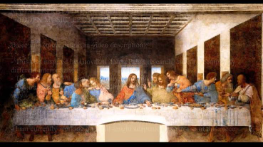
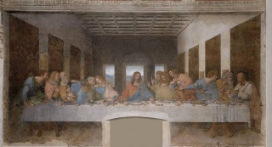
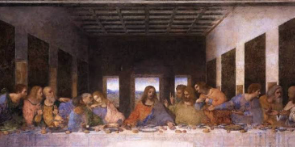
Luminance and Contrast Balancing: The brain is hardwired to track areas of extreme contrast first. Masters utilized value camouflage—deliberately tinting esoteric symbols to perfectly match the local background luminance. In The Last Supper, Leonardo da Vinci structured the lines of perspective, windows, and hand placements to keep the eyes cycling through a specific geometric loop centered on Christ. The secret geometric matrices, musical codes hidden in the bread rolls, and underlying pentagrams were drawn using the exact same contrast levels as the background texturing. [1, 2, 3, 4, 5]
Prototypical Schema Ingestion: The brain saves energy by relying on an internal “rulebook” or schema of how objects should look. If an artist paints a crowd, the brain quickly scans the faces, registers them as “a crowd,” and stops processing deeper details. Artists hid forbidden self-portraits, esoteric astrological alignments, or political counter-messaging directly inside these dense clusters. The brain categorized the group at a macro level, leaving the micro details unparsed by the viewer’s conscious mind. [1, 2, 3, 4, 5]
Core Mechanics Matrix
Cognitive Bottleneck
Renaissance Technique
Real-World Application Example
Inattentional Blindness
High-contrast narrative framing to overload selective attention.
Michelangelo’s Sistine Chapel (Brain/Anatomy hidden behind the divine narrative focus).
Holbein’s The Ambassadors (The skull remains a smudge until perspective shifts).
Gestalt Pattern Completion
Value camouflage and luminance matching to hide geometry.
Da Vinci’s architectural layouts and hidden geometric matrices.
Renaissance masters systematically encoded occult text and musical notation into visual art by translating sonic frequencies and forbidden scripts into structural, spatial, and geometric elements.Rather than hiding letters or notes literally on the canvas, they treated the canvas as a mathematical and symbolic grid. They exploited the brain’s tendency to group disparate objects into patterns, layering hidden data directly beneath orthodox religious narratives.Here is how musical scores and esoteric scripts were seamlessly woven into visual masterpieces.
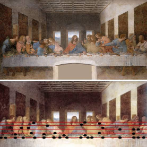
1. Encoding Musical Notation via “Spatial Harmonics”In the Renaissance, music, mathematics, and cosmology were fundamentally linked through the concept of Musica Universalis (the Music of the Spheres). Artists did not simply paint musical notes; they used physical objects and architectural dimensions to represent pitches and intervals. [1]The Horizontal Staff Overlay: Leonardo da Vinci’s The Last SupperModern reconstructions have revealed that Leonardo da Vinci—who was himself a brilliant court musician—structured his legendary fresco The Last Supper as a giant, playable musical score. [1]
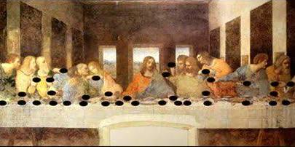
The Grid: When a standard five-line musical staff is superimposed horizontally across the table, the loaves of bread and the hands of the Apostles align precisely with specific musical notes.
The Cipher Key: To unearth the melody, the notes must be read right-to-left, mimicking Leonardo’s signature mirror-writing.
The Result: When played on a pipe organ (the premier polyphonic instrument of the 15th century), this hidden layout yields a haunting, 40-second requiem that structurally accentuates the tension of Christ’s looming betrayal. [1, 2]
Structural Isochronism: Architectural Lutes and ChordsIn complex altarpieces, artists frequently used the rhythmic spacing of columns, window panes, or the strings of painted musical instruments to indicate musical chords. If the distance between three columns adhered to a 4:5:6 ratio, an educated viewer would instantly recognize the geometric signature of a major musical triad.
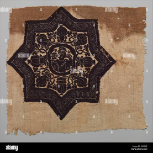
2. Encoding Occult Text via “Pseudo-Script” and Kabbalistic GematriaWhen Renaissance humanists sought to integrate forbidden Hermetic, Arabic, or Kabbalistic occult texts into their art, they had to bypass strict Church censorship. They relied on visual camouflage that mimicked decorative patterns or holy vestments.Pseudo-Kufic and Pseudo-Hebrew BordersArt historians identify cryptic, unintelligible lettering on the hems of garments in Renaissance paintings as pseudo-script. [1]
The Concealment: Artists like Fra Angelico and Gentile da Fabriano decorated the halos and robe borders of biblical figures with elegant, twisting scripts that closely resembled Arabic (Kufic) or Hebrew lettering.
The Double-Meaning: To the standard Church inquisitor, these were merely decorative, exotic flourishes meant to evoke the authentic Holy Land. However, to underground esoteric circles, specific configurations of these strokes encoded hidden Hermetic maxims or divine names drawn directly from texts like the Picatrix or Hebrew mysticism. [1, 2]
Kabbalistic Gematria and Finger SpellingChristian Kabbalah flourished during the Renaissance, popularized by figures like Pico della Mirandola. This school of thought heavily utilized gematria—a system where letters correspond directly to numerical values.
Geometric Ingestion: Instead of painting letters, artists calculated the exact surface area, perimeter, or angle of geometric shapes within the painting to total a specific holy number.
Chironomia (Hand Gestures): The bizarre, rigid hand gestures displayed by figures in Renaissance art were rarely accidental. The positioning of fingers (crossed, extended, or bent) was frequently mapped to the Hebrew alphabet. By reading the hands of figures from one side of a canvas to the other, initiate viewers could spell out specific esoteric concepts, planetary names, or alchemical formulas. [1, 2]
3. Astral Magic and Color-Frequency CorrelationUnder the influence of Marsilio Ficino’s De vita libri tres, Renaissance artists began using occult color correlations to compress text-based magical spells into purely visual fields. [1]
The Cosmic Frequency: Ficino argued that specific planets emitted distinct metaphysical virtues, which corresponded directly to specific earthly colors, metals, and musical pitches.
Spells in Paint: If an artist wished to invoke the protection of Jupiter or the intellect of Mercury without writing out a forbidden pagan incantation, they would blend pigments (such as lapis lazuli for divinity or mumia for vitality) in strict accordance with astral magic charts. The resulting painting functioned as a visual talisman—a literal, condensed occult text projecting its intended frequency straight into the viewer’s subconscious mind. [1, 2, 3]
The hidden hymn in Leonardo’s The Last Supper is a slow, 40-second pipe organ composition that represents a mournful, solemn requiem, discovered by reading the musical notes mapped from the loaves of bread and hands,. It functions as a somber soundtrack for the scene, with the notes, chords, and pacing, which moves from right to left, revealing a 3/4 or 4/4 time signature that builds in intensity around the central figure of Christ. [1, 2, 3, 4, 5]
When Italian musician Giovanni Maria Pala mapped out The Last Supper in 2007, he unlocked a hidden musical composition that was structurally engineered into the painting’s architecture. [1]Here is the exact structural, harmonic, and mathematical breakdown of how Leonardo encoded this music.
1. The Visual Staff and Note PlacementTo see the score, you must imagine a standard five-line musical staff laid horizontally across the painting. The table itself serves as the foundational line.
The Clef / Reading Direction: Leonardo wrote in mirror script (right-to-left). Therefore, the music must be read from right to left, tracking across the table.
The “Notes”: The loaves of bread on the table and the hands of the Apostles serve as the individual notes.
The Value of Elements: A hand represents one type of note value (e.g., a sustained note), while a piece of bread represents another (e.g., a shorter beat), depending on its vertical position relative to the hidden staff lines.
2. Musical Structure and Audio CharacteristicsWhen the right-to-left sequence of bread and hands is translated into pitch, it reveals a deliberate polyphonic piece.
The Instrument: The piece does not sound like a cheerful Renaissance dance. It is written as a solemn requiem (a funeral dirge) intended to be played on a pipe organ or a viola organista (an experimental instrument Leonardo himself designed). [1, 2]
The Rhythm: The piece follows a slow, somber 3/4 or 4/4 meter. The rhythm is dictated by the physical grouping of the Apostles. The gaps between the four distinct groups of three Apostles act as musical rests or phrasing pauses.
The Melody: The melody climbs in pitch as you move right-to-left, creating an ascending, melancholic arc that peaks near the centre of the table (around Christ) before resolving.
3. The Mathematical and Acoustic BreakdownLeonardo did not just hide a random tune; he aligned the composition with the acoustic math of the Renaissance.
[Right Side of Painting] ------------------------> [Left Side of Painting]
  Apostle Hands / Bread      ======> Clef Key ======> Ascending Melodic Arc
  (Acts as Musical Notes)    (Read Right-to-Left)     (Resolves at the End)
Consonant Intervals: The vertical distances between the hands of the Apostles correspond to the mathematical ratios of perfect consonances (\(2:3\) for a perfect fifth, \(3:4\) for a perfect fourth).
Harmonic Anchor: Christ sits exactly at the geometric and acoustic centre. The spatial symmetry around Him creates a harmonic anchor point, meaning the most mathematically pure chord occurs right at the focal point of the narrative.
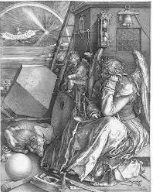
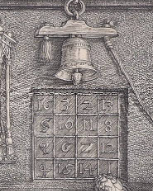
Albrecht Dürer encoded alchemical texts into his engravings by replacing literal words with precise geometric allegories, physical tools of transmutation, and mathematical matrices. [1]In his foundational masterwork Melencolia I (1514), Dürer created the ultimate alchemical puzzle. Instead of drawing banned sigils, he exploited the cognitive bottleneck of schema ingestion. He disguised a step-by-step allegorical guide to the Magnum Opus (the Great Work of alchemical transmutation) as a collection of random laboratory debris. [1, 2, 3]The specific alchemical steps and texts are physically mapped within the engraving’s composition.
The 4×4 Magic Square1. The Crucible and the First Stage: Nigredo (Blackness)The engraving opens with the depiction of a dejected, winged figure representing Melancholy. In Renaissance alchemy, melancholy was not just a mood; it was directly paired with the element of Earth and the initial, painful stage of transmutation known as Nigredo (blackening or calcination). [1, 2, 3]
The Raw Material: The scattered, discarded tools on the ground—the hammer, pincers, saw, and nails—represent the heavy, untamed base metals (associated with Saturn).
The Furnace: Right behind the central figure sits a roaring, hidden alchemical crucible heater. The surrounding instruments symbolize the physical, chaotic labor required to break down base matter before spiritual purification can begin. [1]
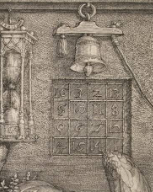
2. The Transmutation Matrix: The Jupiter Magic SquareDirectly mounted onto the stone wall is a famous 4×4 mathematical magic square. To a casual viewer, it appears to be a mere mathematical curiosity. To an initiate reading Renaissance alchemical theory, it is a defensive talisman. [1]
The Formula: Every horizontal row, vertical column, and diagonal line adds up to the number 34. The bottom row even displays the exact year of the engraving’s creation: 1514. [1, 2, 3, 4]
The Counter-Spell: Alchemy taught that melancholy was governed by the dark, heavy planet Saturn. According to occult philosophy popularized by Cornelius Agrippa, this specific 4×4 numerical grid represents the intelligence of Jupiter. By placing the magic square directly over the winged figure, Dürer encoded a literal remedy: using Jupiter’s bright, expansive geometry to conquer the heavy, dark stasis of Saturnian Nigredo. [1]
3. The Philosopher’s Stone: The Truncated PolyhedronDominating the left side of the engraving is a massive, strangely shaped stone block known to mathematicians as Dürer’s Polyhedron.
The Rough Ashlar: In alchemical texts, the journey begins with the materia prima (raw material), often illustrated as a rough, unshaped stone block. [1]
The Refined Geometry: This giant, mathematically perfect solid has been deliberately carved and shaped. It represents the Lapis Philosophorum—the Philosopher’s Stone—midway through its refinement. Dürer is showing the literal text of transmutation: taking rough, chaotic matter from the earth and using geometry to refine it into a perfect, transcendent shape. [1]
4. The Distillation Process: The Hourglass and ScalesSuspended directly above the winged figure are a balanced scale and an hourglass.
The Element of Time: The hourglass symbolizes the exact timing required for alchemical distillation. If a substance is heated for even a moment too long, the work is ruined.
The Element of Measure: The scales represent the cosmic balance (pondera) of elements. Alchemical manuscripts frequently warned that the four classical elements (Earth, Air, Fire, and Water) must be weighed with absolute geometric precision to achieve the final stage of illumination.
Albrecht Dürer’s masterpiece Knight, Death, and the Devil (1513) is a masterclass in psychological warfare and esoteric symbolism, encoding an underground handbook on moral fortitude and Christian stoicism. [1, 2]To a casual viewer, the engraving portrays a terrifying medieval nightmare. However, Dürer used schema ingestion to hide an empowering, anti-fear blueprint. By mapping out specific visual markers, Dürer transformed a scene of impending doom into a roadmap of absolute spiritual invulnerability.Here is the exact map of the hidden symbols layered across the composition.1. The Knight: The Invulnerable “Miles Christianus”The central figure is an armored knight riding steadfastly through a dark, treacherous valley. He ignores the terrifying apparitions beside him. [1, 2]
The Armor of God: The knight’s armor represents the literal manifestation of Erasmus of Rotterdam’s 1501 treatise, Enchiridion militis Christiani (Handbook of a Christian Soldier). Dürer was a close follower of Erasmus. The armor is not just physical protection; it represents absolute faith, moral steel, and intellectual clarity that renders the wearer completely immune to spiritual terrors. [1, 2, 3]
The Forward Gaze: The knight’s gaze is locked entirely on his forward destination. By keeping his eyes fixed straight ahead, Dürer visually demonstrates the conquest of inattentional blindness turned into a virtue. The knight deliberately starves the terrifying monsters of his cognitive attention, rendering them powerless. [1]
2. Death: The Decay of TimeRiding a pale, decrepit horse directly beside the knight is the grotesque figure of Death. He attempts to halt the knight’s progress. [1, 2]
The Hourglass: Death holds up an hourglass, pointing to the trickling sand. This is a direct psychological attack, a visual text warning the knight that his time on earth is short and his death is imminent. [1, 2, 3]
The Crown of Snakes: Death wears a crown intertwined with living vipers rather than a royal diadem. This encodes the biblical reference to the fall of man and the decay of earthly flesh, symbolizing that mortal power is temporary and corrupt.
3. The Devil: The Multi-Beast of ChaosSkulking behind the knight’s horse is a bizarre, misshapen Devil. Dürer deliberately chose not to draw a standard biblical Satan.
The Amalgam Creature: The Devil is a chaotic patchwork of various animals—he possesses a ram’s horn, a wolf’s snout, a pig’s ears, and a single horn like a mythical beast. This represents the alchemical and theological concept of prime chaos. He embodies the base, animalistic passions (greed, lust, anger) trying to pull the rational human back into the mud. [1]
The Hooked Pike: The Devil carries a sharp pike with a hook on the end, positioned just behind the knight’s back. This represents the subtle temptation to look back in fear. The moment the knight turns around to address the threat, he loses his focus and succumbs to chaos. [1]
4. The Micro-Symbols: The Fox, Dog, and LizardDürer scattered tiny, easily missed allegories across the foreground and background to lock in the engraving’s esoteric text.
[Top Left: The High Citadel] ===> The Ultimate Spiritual Destination
       ^
       | (The Perilous Path)
[The Knight & Dog] ===> Truth & Loyalty marching forward
       ^
[The Foreground Lizard] ===> Warning sign of immediate danger/decay
The Foxtail on the Lance: Tied to the tip of the knight’s towering lance is a long foxtail. In Renaissance folklore, the fox was the ultimate symbol of cunning, deceit, and falsehood. By pinning the foxtail to his weapon, the knight demonstrates that he has conquered lies and carries truth as a trophy into battle. [1]
The Faithful Retriever: Running directly beneath the horses is a loyal dog. While the horses look skittish, the dog matches the knight’s forward march perfectly. The dog encodes the virtues of absolute loyalty, truth, and vigilance, acting as a psychological anchor that keeps the horse moving straight. [1]
The Scurrying Lizard: At the very bottom right, a lizard scrambles in the opposite direction of the horse’s hooves. In alchemical text, the lizard/salamander was highly sensitive to spiritual shifts. Here, its flight serves as a visual warning of a highly toxic, spiritually dangerous environment.
The Citadel on the Hill: Far in the background, shining at the very top of the mountain path, sits a fortified castle. This is the “New Jerusalem” or the fortress of the rational mind. It symbolizes the final destination of the Magnum Opus—the place of absolute peace achieved only by walking through the valley of shadows without flinching.
The comet and rainbow in the background of Melencolia I encode a precise system of Renaissance cosmological magic derived from the Hermetic and Neoplatonic texts of Marsilio Ficino and Cornelius Agrippa.Rather than portraying a literal weather event, Albrecht Dürer engineered these celestial phenomena to represent a cosmic clash of planetary frequencies, offering an astronomical “cure” for the psychological devastation of melancholy.Here is the exact breakdown of how these background elements encode cosmological magic.1. The Comet: The Threat of Saturnian RuinBlazing across the sky inside the arc of the rainbow is a bright, weeping comet (often linked to the historical comet of 1514). In Renaissance astrology, comets were terrifying omens of destruction, plague, and the death of kings.
The Signature of Saturn: Dürer deliberately places the comet within a dark, brooding sky. In cosmological magic, comets were classified as highly concentrated bursts of Saturnian energy—cold, dry, destructive, and deeply associated with madness or spiritual stagnation.
The Melancholic Trap: The comet represents the macrocosmic version of the winged figure’s internal state. It symbolizes a mind being utterly consumed by its own burning intellect, trapped in the lowest, darkest phase of alchemical transformation (Nigredo).
[Microcosm: The Winged Figure] <===(Resonates With)===> [Macrocosm: The Cold Saturnian Comet]
                                           ||
                        [The Alchemical/Magical Counter-Force]
                                           ||
                                [The Lunar/Solary Rainbow]
2. The Rainbow: The Lunar and Solar Counter-ForceEnclosing the comet is a perfectly geometric rainbow. However, this is no ordinary rainbow; its placement in a dark, starry night sky indicates it is a lunar rainbow (moonbow) or a highly stylized solar reflection.
The Alchemical Bridge: In the cosmological text De Occulta Philosophia (circulating in manuscript form during Dürer’s time), the rainbow is the ultimate symbol of the horizon—the literal bridge between the volatile earthly realm and the immutable celestial spheres.
The Multi-Layered Cure: In astral magic, a rainbow contains all visible frequencies of light. By arching over the dark comet, the rainbow acts as a protective shield. It introduces the vital, life-giving frequencies of the Sun (gold/light) and the Moon (silver/silver-white) to dilute and neutralise the toxic, monochromatic blackness of Saturn’s comet.
3. The Magical Geometry of the SkyThe interaction between the comet, the rainbow, and the background landscape creates a hidden geometric glyph.
The Light Array: The comet does not just burn; it emits blinding, geometric rays of light that fill the entire background quadrant. These rays strike the water below, which reflects the light back upward.
The Talismanic Horizon: In Neoplatonic magic, water acts as a massive elemental mirror that catches and anchors celestial rays. By drawing the rays striking the sea directly beneath the rainbow, Dürer transformed the background of the engraving into a giant visual talisman.
The Micro-Macro Link: The cosmic light from the sky perfectly matches the mathematical angles of the Jupiter Magic Square mounted on the wall below it. Dürer is showing that the same geometric laws that govern the alignment of the stars (macrocosm) can be captured by human mathematics and art (microcosm) to heal the human soul.
Albrecht Dürer calculated and visualized the end of the world in his 1498 woodcut masterpiece The Apocalypse (Apocalipsis cum figuris) by structurally engineering biblical numerology, geometrical alignments, and millennial anxieties directly into the printing blocks. [1, 2]During the late 1490s, Europe was gripped by an intense mass hysteria that the world would end exactly in the year 1500. This widespread panic relied heavily on a mathematical phrase found in the Book of Revelation: “a time, and times, and half a time” (interpreted by eschatological scholars to calculate 1,500 years from the birth of Christ). [, 2]Dürer capitalized on this exact psychological bottleneck, designing a visual narrative that transformed complex theological mathematics into a terrifyingly scannable reality. [1]1. The Geometry of the Inevitable: Overlapping DiagonalsIn his most famous woodcut, The Four Horsemen of the Apocalypse (1498), Dürer mathematically structured the composition using strict diagonal spatial splitting to dictate the absolute pacing of time on Judgment Day. [1, 2, 3]
The Velocity Vector: Rather than arranging the horsemen staticly side-by-side as in traditional medieval bibles, Dürer used a calculated geometric grid to align the horses on a severe, parallel diagonal slope. They move ruthlessly from the top right down to the bottom left. [, 2]
The Time Compression Matrix: The layout divides the visual frame into precise geometric regions. The upper-right quadrant represents the divine order breaking through, the central matrix holds the crushing weight of the accelerating riders, and the lower-left represents the physical destruction of humanity. This diagonal trajectory creates a mathematical illusion of unyielding forward momentum, tricking the human brain into feeling that the end of days is actively and rapidly closing in. [, 2]
[Top Right: Cosmic Command]  =======> Accelerating Diagonal Grid
                                           \\
                                            \\ (Unstoppable Velocity Vector)
                                             v
[Bottom Left: Human Defeat] <====== [Crushed under Hooves of the Four Riders]
2. Incorporating Sacrificial Proportions: Doubling the CubeBeyond literal translation, Dürer infused his woodblocks with classical geometric equations that humanists linked to cosmic architecture.
The Greek Problem Ingestion: In certain panels of The Apocalypse, Dürer subtly arranged the overlapping background architecture and figures to trace out the lines of the Delian Problem (the classical geometric task of doubling a cube using only a straightedge and compass). [1]
The Esoteric Alignment: To Renaissance humanists, doubling the cube was a mathematical riddle tied intimately to the harmony of the temple altar and spiritual purification. By superimposing St. John’s visions onto a rigorous grid reflecting classical mathematical solutions, Dürer attempted a literal reconciliation between pagan geometry and Christian prophecy. He constructed doomsday not as an engine of random chaos, but as an mathematically perfect act of cosmic rebalancing. [1, 2]
3. Scriptural Multiplication and Numerical StackingDürer precisely mapped the structural pacing of his entire 15-woodcut series to mimic the accelerating, compounding mathematics of biblical prophecy. [1]
The 7-7-7 Equation: The Book of Revelation relies on sequential judgments: 7 Seals, 7 Trumpets, and 7 Vials. Dürer exploited the brain’s pattern-recognition system by structurally stacking these numbers within the woodcut frames. [1, 2, 3, 4]
Visual Fractioning: In panels like St. John Devouring the Book or The Seven Trumpet Angels, the sky is neatly subdivided into exact fractional portions. Dürer mapped out a precise third of the sun being blotted out, a third of the moon turning to blood, and a third of the earth burning. By enforcing literal mathematical boundaries on his artistic framing, he forced the viewer’s brain to visually execute the apocalyptic fractions described in the text, maximizing the immediate cognitive impact of the prophecy. [1]’
Cultural Heritage Disputes involving state actors are by their nature international. However, since the restitution of artefacts removed during times of Colonial occupation is outside the scope of the UNESCO Convention, the question of ‘international accountability’ does not arise in such disputes. So, axiomatically – by accepting Mediation a state actor does not thereby acknowledge that the dispute is a legitimate matter of international concern. Consequently a ‘no compromise’ situation does not arise. In other words, there is no bar to Mediation.
Mediation in any dispute involving state actors is likely to be particularly relevant when it has compelled them to revaluate their policies. e.g. where the dispute is in a state of limbo i.e. stalemate.
Because Mediation is a voluntary i.e. consensual process, the willingness by the Participants (‘P’s’) to participate indicates a willingness to engage with each other’s perspectives in exploring potential resolutions, thereby validating each other’s interests in the Artefact. So, Mediation implies ‘Recognition.’
However, in a claim for the restitution of artefacts removed during times of Colonial occupation, this does not amount to an acknowledgement that the dispute is a legitimate matter of international concern, i.e. because under International Law the issue is not capable of arising.
So, if the legal advisors to a state which has received the request/claim advise their political masters that their state cannot engage in Mediation because of the risk of potential ‘international accountability’, that advice is legally wrong.
AI – ‘Prisca Theologia and Perennialism are closely related religious and philosophical concepts asserting that all the world’s major spiritual traditions share a single, divine origin.
The “Myth of the Primordial Core” is the modern academic and critical term used to describe and dismantle this belief, arguing that it oversimplifies and misrepresents the deep, irreconcilable differences between individual religions. [1, 2]
Prisca Theologia v. Perennialism
While both frameworks assume a
single “true religion” underlies human history, they differ
significantly on how that truth travels through time. [1]
Concept
Historical
Origin
Core
Belief
Timeline
& Trajectory
Key
Figures
Prisca Theologia(Ancient Theology)
15th-century Renaissance
A pure, singular divine revelation
was given to ancient sages.
Linear Decline. Truth was perfect in antiquity
but became corrupted and fragmented over time.
Marsilio Ficino, Giovanni Pico
della Mirandola
Perennialism(Perennial Philosophy)
16th-century, popularized in
20th-century
All world religions share a
universal, timeless metaphysical reality.
Cyclical Manifestation. The ultimate truth is eternal and
continually sprouts fresh, valid forms across cultures.
René Guénon, Aldous Huxley,
Frithjof Schuon
Prisca Theologia
Coined by Renaissance humanist
Marsilio Ficino, this doctrine states that God delivered a primordial secret
doctrine to ancient non-Christian masters—such as Hermes Trismegistus,
Zoroaster, Pythagoras, and Plato. Ficino used this framework to translate
pagan classical texts while maintaining his Catholic faith, claiming that Greek
philosophy simply preserved fragments of the original divine truth that
prepared the world for Christianity. [1, 2,
3]
Perennialism
Perennialism expands this idea
globally. It argues that if you strip away the historical context, localized
rituals, and dogmas of religions (their exoteric layer), you will find
the exact same core mystical experience and metaphysical truth (their esoteric
layer). Whether a mystic is Sufi, Buddhist, Christian, or Hindu, perennialists
claim they are scaling different sides of the exact same mountain. [1, 2, 3, 4,
5]
The Myth of the Primordial Core
The “Myth of the Primordial
Core” is a critical counter-argument raised by modern comparative
religion scholars, historians, and anthropologists. It argues that the idea of
a universal spiritual “core” is an intellectual illusion. Critics
claim this “core” is a myth for several major reasons: [1, 2]
Flattening
Crucial Differences:
To make all religions fit into a single “perennial” box, one
must ignore their fundamental, structural disagreements. For example,
Christianity asserts a distinct, personal Creator God; Islam emphasizes
absolute divine unity; Hinduism often points to an all-encompassing
monistic reality (Brahman); and Buddhism rejects the concept of a
permanent soul or creator deity entirely. Pretending these are “the
same” erases their unique theological identities. [1, 2, 3]
Western
and Christian Bias:
Historically, Western thinkers have designed the “primordial
core” to mirror their own values. Renaissance thinkers used Prisca
Theologia to show that all ancient wisdom naturally culminated in
Christianity. Modern perennialists often build their “universal
core” around Western concepts of individualism and mystical
consciousness, ignoring religions that prioritize community, law, or
ritual over private ecstasy. [1, 3]
Imperialism
and Intellectual Appropriation: Academic critics note that perennialism can act as a
form of cultural imperialism. By claiming that an indigenous or Eastern
tradition is actually just saying the same thing as a Western
mystical philosophy, perennialists strip those cultures of their autonomy
and distinctiveness, absorbing them into a single, Western-managed
worldview. [1, 2]
In short, while Prisca Theologia
and Perennialism look back through human history to find a comforting,
unified spiritual anchor, critics label this search the Myth of the
Primordial Core—an attempt to force vastly different human traditions into
a single, artificial mold. [1]
Prisca Theologia and Perennialism are closely
related religious and philosophical concepts asserting that all the world’s
major spiritual traditions share a single, divine origin. The “Myth of
the Primordial Core” is the modern academic and critical term used to
describe and dismantle this belief, arguing that it oversimplifies and
misrepresents the deep, irreconcilable differences between individual
religions. [1, 2]
Prisca Theologia vs. Perennialism
While both frameworks assume a
single “true religion” underlies human history, they differ
significantly on how that truth travels through time. [1]
Concept
Historical
Origin
Core
Belief
Timeline
& Trajectory
Key
Figures
Prisca Theologia(Ancient Theology)
15th-century Renaissance
A pure, singular divine revelation
was given to ancient sages.
Linear Decline. Truth was perfect in antiquity
but became corrupted and fragmented over time.
Marsilio Ficino, Giovanni Pico
della Mirandola
Perennialism(Perennial Philosophy)
16th-century, popularized in
20th-century
All world religions share a
universal, timeless metaphysical reality.
Cyclical Manifestation. The ultimate truth is eternal and
continually sprouts fresh, valid forms across cultures.
René Guénon, Aldous Huxley,
Frithjof Schuon
Prisca Theologia
Coined by Renaissance humanist
Marsilio Ficino, this doctrine states that God delivered a primordial secret
doctrine to ancient non-Christian masters—such as Hermes Trismegistus,
Zoroaster, Pythagoras, and Plato. Ficino used this framework to translate
pagan classical texts while maintaining his Catholic faith, claiming that Greek
philosophy simply preserved fragments of the original divine truth that
prepared the world for Christianity. [1, 2,
3]
Perennialism
Perennialism expands this idea
globally. It argues that if you strip away the historical context, localized
rituals, and dogmas of religions (their exoteric layer), you will find
the exact same core mystical experience and metaphysical truth (their esoteric
layer). Whether a mystic is Sufi, Buddhist, Christian, or Hindu, perennialists
claim they are scaling different sides of the exact same mountain. [1, 2, 3, 4,
5]
The Myth of the Primordial Core
The “Myth of the Primordial
Core” is a critical counter-argument raised by modern comparative
religion scholars, historians, and anthropologists. It argues that the idea of
a universal spiritual “core” is an intellectual illusion. Critics
claim this “core” is a myth for several major reasons: [1, 2]
Flattening
Crucial Differences:
To make all religions fit into a single “perennial” box, one
must ignore their fundamental, structural disagreements. For example,
Christianity asserts a distinct, personal Creator God; Islam emphasizes
absolute divine unity; Hinduism often points to an all-encompassing
monistic reality (Brahman); and Buddhism rejects the concept of a
permanent soul or creator deity entirely. Pretending these are “the
same” erases their unique theological identities. [1, 2, 3]
Western
and Christian Bias:
Historically, Western thinkers have designed the “primordial
core” to mirror their own values. Renaissance thinkers used Prisca
Theologia to show that all ancient wisdom naturally culminated in
Christianity. Modern perennialists often build their “universal
core” around Western concepts of individualism and mystical
consciousness, ignoring religions that prioritize community, law, or
ritual over private ecstasy. [1, 3]
Imperialism
and Intellectual Appropriation: Academic critics note that perennialism can act as a
form of cultural imperialism. By claiming that an indigenous or Eastern
tradition is actually just saying the same thing as a Western
mystical philosophy, perennialists strip those cultures of their autonomy
and distinctiveness, absorbing them into a single, Western-managed
worldview. [1, 2]
In short, while Prisca Theologia and Perennialism look back through human history to find a comforting, unified spiritual anchor, critics label this search the Myth of the Primordial Core—an attempt to force vastly different human traditions into a single, artificial mold. [1]
Prisca
theologia is related to concept of perennial philosophy, but an essential
difference is that prisca theologia is understood…
Prisca Theologia vs. Perennialism in
ancient art?
Because “ancient art”
refers to the era before these explicit concepts were named, we do not
see ancient Roman, Greek, or Egyptian artists consciously painting “Prisca
Theologia” or “Perennialism”. Instead, we see these two concepts
look back at, interpret, and visually remix ancient art in vastly different
ways.
Prisca Theologia manifests visually by inserting
ancient, non-Christian figures directly into Christian sacred spaces to show a
linear inheritance of truth. Perennialism manifests visually through
cross-cultural hybrid art, showing how completely different civilisations
naturally created identical geometric symbols and archetypes due to a shared
mystical blueprint.
1. Prisca Theologia in Art: Ancient
Sages in Christian Spaces
In art, Prisca Theologia
functions like a historical family tree. Renaissance artists, commissioned by
thinkers like Marsilio Ficino, depicted ancient pagan
philosophers as holy prophets who laid the groundwork for Christ. The visual
goal was to prove that ancient art and classical pagan wisdom were naturally
absorbed and perfected by Christianity. [1]
Hermes Trismegistus on Christian
Floors
The most literal artistic
manifestation of Prisca Theologia is the famous 1488 floor mosaic inside
the Siena Cathedral. The
artist, Giovanni di Stefano, depicts the ancient Egyptian sage Hermes
Trismegistus handing an open book of wisdom to two men representing the
East and the West. Right on the floor of a Catholic cathedral, Hermes is
labeled as a “contemporary of Moses”, visually canonising a pagan
figure as a direct ancestor of Christian theology. [1, 2]
In Raphael’s legendary fresco, The School of Athens
(1509–1511), located inside the Apostolic Palace in the Vatican, we see an
artistic manifestation of Prisca Theologia. On the far right side of the
painting, Raphael groups the ancient Persian prophet Zoroaster (holding
a celestial sphere) next to Ptolemy. By placing Persian, Greek, and Egyptian
sages under the magnificent Roman arches of a papal library, Raphael visually
asserts that all ancient knowledge flows harmoniously toward Catholic truth. [1]
2. Perennialism in Art: Syncretism
and the Universal Blueprint
Perennial art does not care about
historical lineages or pointing toward Christianity. Instead, it looks at
ancient art through the lens of syncretism—the merging of different
cultures—to prove that the exact same spiritual core emerges spontaneously
across the globe. Perennialists use ancient artifacts to point out
cross-cultural structural identicals.
The Sun God Syncretism
In late antiquity, the Roman Empire
experienced an artistic explosion of Perennial-style syncretism. As people
traveled across the empire, artists began fusing deities. For instance, Roman
reliefs of Sol Invictus
(the Unconquered Sun) and the Persian-influenced mystery god Mithras were often
visually conflated. To a Perennialist, an ancient Roman relief showing Mithras
banqueting with Sol is proof that ancient people intuitively understood that
Apollo, Helios, Mithras, and Christ were all just different cultural masks for
the exact same “Universal Sun” archetype. [1]
Perennialism heavily relies on
ancient sacred geometry. Perennialist scholars like Frithjof Schuon point to
the fact that ancient cultures with zero historical contact—such as the
builders of Buddhist Stupas in India, Native American medicine wheels, and the
creators of Gothic rose windows in Europe—all independently used the Mandala
structure (a circle divided into quadrants mirroring a central point). To a
Perennialist, this cross-cultural artistic phenomenon is visual evidence of a
single, primordial blueprint hardwired into the human soul.
Direct Artistic Comparison
Feature
Art
of Prisca Theologia
Art
of Perennialism
Visual Structure
Linear Hierarchy. Ancient pagans are depicted
physically passing scrolls, books, or torches forward to Christian heirs.
Cyclical/Parallel Symmetry. Radically different cultural
symbols are placed side-by-side to show they share the same geometric
architecture.
Key Imagery
Portraits of specific historical
sages (Plato, Hermes, Zoroaster) behaving like Old Testament prophets.
Abstract archetypes, solar
symbols, cosmic trees, and matching geometric shapes across disconnected
civilizations.
Ultimate Goal
To justify the use of ancient
pagan philosophy inside a dominant, single tradition (like Renaissance
Catholicism).
To strip away individual religious
identities and show that all historical art points to an formless, universal
mysticism.
Would you like to examine more examples of sacred geometry across ancient civilisations, or look into how the “Myth of the Primordial Core” critics deconstruct these artistic parallels?’
In the context of perennialism, the reliance on sacred geometry (such as the mandala) does not “prove” scientific or objective facts in the traditional sense. Instead, perennialists argue it proves the transcendent unity of religions and the existence of a universal human psychology. [1, 2, 3, 4, 5]The use of these universal shapes demonstrates several core tenets of the philosophy:
Universal Metaphysics: Perennialism posits that all major spiritual traditions share a single, metaphysical origin. The recurrence of the mandala—found in Hindu and Buddhist traditions, Christian Gothic rose windows, and Mesoamerican cosmograms—proves to perennialists that different cultures independently tapped into the exact same “Universal Truth”. [1, 2, 3, 4, 5]
The Macro/Micro Mirror: Sacred geometry maps the cosmos (the macrocosm) onto the human mind (the microcosm). It demonstrates the perennialist belief that the human soul and the universe are structured by the same fundamental laws. [1, 2]
A Universal Language of Consciousness: The reliance on such geometric aids illustrates that mysticism transcends cultural language barriers. Symbols like the circle (representing eternity/divinity) and the square (representing the terrestrial world) serve as a cross-cultural visual language meant to elevate human consciousness. [1]
Psychological Unity: On a psychological level (popularized by thinkers like Carl Jung), the prevalence of the mandala suggests that human beings share a collective unconscious. It proves that the human mind naturally relies on symmetrical, bounded centers to organize the self and find inner harmony. [1, 2, 3, 4]
For perennialists, this convergence indicates that geometry and cosmic order are not merely man-made inventions, but reflections of an underlying, divine intelligence. [1]
Perennialists (proponents of the perennial philosophy or traditionalist schools) believed that the universal sun symbol across ancient American civilizations reflects an innate, transcultural human awareness of a singular Divine Source. Rather than viewing isolated cultural developments, they interpreted these symbols as evidence of a universal, primordial wisdom.
Wikipedia +4Key Beliefs of Perennialists
The Sun as the Supreme Creator: Perennialists viewed the sun not merely as a physical star, but as the most potent visible manifestation of the formless, supreme Deity or “Almighty”. They saw it as the ultimate source of all light, life, and consciousness. High Altitude Observatory +3
Universal Transcendent Wisdom: The striking similarities between solar motifs in North America (like the Sun Cross or the Zia sun symbol) and the highly structured solar theologies of Mesoamerica (Aztec and Maya) and South America (Inca) were, to perennialists, proof of a shared spiritual lineage. They believed these cultures tapped into the same metaphysical truths as ancient Eastern and Egyptian traditions. Aeon +3
Cycles of Time and Renewal: Because the sun dies every night and is reborn every morning, perennialists believed the universal solar motif symbolized the deeper cosmic truths of cyclical creation, destruction, and spiritual rebirth. This perfectly mirrored Mesoamerican concepts like the cyclical Fifth Sun. Wikipedia +4
Axis of Divine Kingship: Across both North and South American civilizations, perennialists noted that the sun was tied to ultimate authority. They interpreted the Mesoamerican priest-kings and the Inca Inti (the sun incarnate) as representatives of spiritual illumination ruling over temporal society, mirroring the cosmic order. Encyclopedia Britannica +2
Light over Darkness: They interpreted indigenous solar myths and architecture (such as the solar alignments of temples) as allegories for the soul’s journey. The sun’s light represented spiritual awakening, while the sun’s journey through the underworld symbolized the overcoming of the material ego. Brewminate +3
Would you like to explore how perennialists compare ancient American solar mythology with the solar symbolism found in ancient Egypt or Hinduism?’
AI – ‘In art theory, visuality
refers to how we are socially and culturally trained to see, whereas virtuality
refers to the creation of spaces, dimensions, or experiences that exist
perceptually but lack physical substance. While “vision” is the
biological act of looking, visuality introduces the politics, history, and
ideology behind the gaze. Conversely, virtuality shifts art from a static
object to an interactive, immersive environment. [1,
2,
3, 4, 5]
Visuality is the understanding that
vision is never completely objective. It is shaped by the context of the person
looking at the artwork. [1]
Cultural
Conditioning:
The distinction within the visual between the biological mechanics of
sight and historical techniques. [1]
Power
Dynamics:
Media theorists like Guy Debord point out that contemporary visuality is
saturated by “the spectacle”—an accumulation of images that
control, instruct, and shape social relationships. [1]
Mutable
Standpoints:
An artist intends for a picture to be seen from a specific physical and
historical standpoint. However, viewers from different eras bring their
own cultural framework, creating what Davis calls “bivisibility”—the
fact that pictures can always be seen in ways other than originally
intended. [1, 2]
🌐 Virtuality: Space Beyond the
Physical
Virtuality in art is the
psychological and physical experience of an environment or object that does not
exist in tangible reality. [1, 2]
The
Illusion of Space:
Historically, virtuality began long before computers. It includes ancient
Roman frescoes or Renaissance linear perspective, which trick the human
brain into seeing three-dimensional depth on a flat canvas. [1,
2, 3,
4, 5]
Technological
Immersion:
Art historian Oliver Grau outlines how modern Virtual Art uses human-machine
interfaces—such as VR headsets, stereoscopic screens, and data gloves—to
collapse the distance between the viewer and the art piece. [1, 2,
3]
Active
Interactivity:
Unlike a traditional painting, technological virtuality allows users to
enter, rearrange, and physically interact with the artwork via movement,
speech, or gestures, making the viewer an active part of the system. [1, 2]
Where They Intersect
The intersection of these two
concepts creates what Lev Manovich calls “augmented space”.
When artists overlay physical spaces with digital, virtual data, they create a
new model of visuality. The viewer’s body and cultural background (visuality)
must constantly negotiate and process the changing digital stimuli
(virtuality). This completely changes our spatial experience, blurring the
boundaries between what is real, what is seen, and what is simulated. [1, 2, 3, 4]
Historical art movements used
virtuality by transforming flat, physical surfaces into psychological windows
that simulated depth, space, and presence. Long before digital screens, artists engineered
“virtual spaces” using mathematical systems, architectural tricks,
and optical illusions to manipulate the viewer’s perception. [1, 2]
Here is how key historical art
movements weaponised virtuality.
🏛️ The Renaissance: Linear Perspective
& The Window Grid
Renaissance artists treated the
canvas not as a flat surface, but as a transparent pane of glass looking into
an extension of the real world. [1, 2]
Mathematical
Space: Filippo
Brunelleschi and Leon Battista Alberti formalised linear perspective,
using a single vanishing point to mathematically map out a
three-dimensional virtual room. [1, 2, 3, 4, 5]
The
“Window” Concept: Artworks like Masaccio’s Holy Trinity
created the illusion of an actual architectural chapel receding into the
stone wall of the church. [1]
Spatial
Continuation:
The virtual space was designed to perfectly match the physical viewpoint
of the spectator standing in the real room.
🎭 The Baroque: Trompe l’Œil &
Dissolving Architecture
Baroque art pushed virtuality
further by erasing the boundaries between the physical building and the painted
image, aiming for total psychological immersion.
Trompe
l’Œil: Meaning
“trick the eye,” this technique used hyper-realistic perspective
to make painted figures appear as though they were physically stepping out
of the frame. [1]
Quadratura: Artists like Andrea Pozzo
painted massive, faux-architectural ceilings, such as the Allegory of the Jesuits’ Missionary Work,
which made flat roofs look like they opened directly up into a swirling,
infinite virtual heaven. [1]
Theatrical
Scale: The
virtual space did not just sit quietly on a wall; it actively overwhelmed
the viewer’s biological sight to induce religious awe.
🌲 The 19th Century: Panoramic
Landscapes
Before modern virtual reality
headsets, 19th-century panoramic painters built physical rooms dedicated
entirely to 360-degree virtual simulations. [1]
Total
Enclosure:
Artists like Robert Barker created massive, circular paintings displayed
in custom-built rotundas. [1, 2, 3]
Erasing
the Frame:
Viewers stood on a central platform in the dark, unable to see the edges
of the canvas, which completely detached them from the outside city.
Immersive
Transportation:
These paintings simulated highly accurate battles, foreign landscapes, or
cityscapes, tricking the viewer’s sensory system into feeling physically
present in another time or place. [1]
🧩 Cubism & Futurism:
Multi-Dimensional Virtuality
In the early 20th century,
avant-garde movements rejected Renaissance perspective to invent a conceptual,
non-Euclidean virtuality.
Simultaneous
Viewpoints:
Cubists like Pablo Picasso shattered objects into multiple angles at once,
constructing a virtual space based on time and memory rather than a single
frozen glance.
Spatiotemporal
Dynanism:
Futurists mapped the virtual trajectory of speed and motion across a
canvas, attempting to visualize the invisible forces of the modern
industrial world. [1]
📊 Quick Comparison of Historical
Virtuality
Movement
Core
Technique
Primary
Illusion
Viewer
Experience
Renaissance
Linear Perspective
A controlled, logical window into
depth
Analytical spectator standing
outside looking in
Baroque
Quadratura / Trompe l’Œil
Dissolving physical boundaries
into heaven
Overwhelmed participant pulled
into the drama
19th Century
360-Degree Panorama
Complete geographic transportation
Isolated traveler enclosed by an
artificial world
Cubism
Fragmented Planes
Multi-dimensional, non-linear
space
Conceptual thinker reconstructing a shifting reality.
Visuality and virtuality can serve as highly effective tools in the mediation of visual art disputes. They help translate complex, subjective, or technical arguments into concrete, shared references. Mediators use these tools to facilitate agreement and resolve conflicts over copyright, authenticity, and spatial installation. [1, 2, 3, 4, 5, 6, 7]How Visuality and Virtuality Function in Dispute Resolution
Comparative Analysis: By using high-resolution overlays and 3D modeling, parties can conduct side-by-side visual comparisons of disputed artworks. This clarifies arguments over alleged copyright infringement, alteration, or forgery. [1, 2, 3, 4]
Space and Installation Reconstruction: For disputes involving site-specific installations, digital mapping and Virtual Reality (VR) allow mediators to virtually recreate the contested gallery space. This helps disputing parties understand exactly how an artwork was intended to be displayed without the cost of physical site visits. [1, 2, 3, 4]
Perspectival Shifts: Immersive environments and Augmented Reality (AR) can help both creators and beholders view the artwork from alternative angles. This can foster empathy, helping opposing sides visualize the intent of the artist or the perception of the viewer. [1, 2, 3, 4, 5]
Visualizing Abstract Concepts: Complex legal or copyright arguments can be mapped visually through timelines, causal maps, or 3D animations, making it easier for all stakeholders to understand the dynamics at play. [1, 2]’
AI – ‘The works of Renaissance masters like Leonardo da Vinci, Michelangelo, and Sandro Botticelli are heavily infused with astrological, astronomical, and Neoplatonic codes. During the Renaissance, astrology was not considered a superstition but a serious science closely tied to medicine, philosophy, and theology. Driven by the Medici family’s revival of ancient texts, these artists embedded celestial maps and zodiac systems into their masterpieces. [1, 2, 3, 4, 5]
🎨 Leonardo da Vinci: The Zodiac and the Solar CultLeonardo da Vinci frequently blended cosmic geometry with traditional Christian narratives, leveraging his belief that the universe was bound by mathematical harmony. [1, 2]
The Last Supper as a Zodiac Chart: A prominent art history theory suggests that the Twelve Apostles represent the Twelve Signs of the Zodiac, with Jesus Christ positioned in the center as the Sun. Starting from the far left, the order aligns with the astrological wheel beginning with Aries (Bartholomew, who rules the head) and moves sequentially across the table. [1, 2, 3, 4]
The Solstice Windows: The three large windows framing Christ in The Last Supper are designed to mimic ancient solar cult temples. They correspond directly to the Spring Equinox, Summer Solstice, and Winter Solstice, anchoring the biblical scene to the movements of the cosmos. [1, 2]
The “Exile-Domicile” Axis: Scholars analyzing early works like the Annunciation have uncovered an encoded system mapping out celestial planetary rulers according to their traditional domiciles (astrological homes) and signs of exile, aligning the divine figures with specific celestial coordinates. [1, 2, 3]
🏛️ Michelangelo: Astrological Anatomy and Divine TimingWhile Michelangelo is famous for hiding anatomical structures in his art, his work in the Sistine Chapel also acts as a monument to planetary hours and astrological alignments. [1, 2]
Calculated Horoscopic Timing: Under the orchestration of the papacy and his Florentine patrons, the construction and painting schedules for key chapels—including the Sistine Chapel ceiling—were synchronized with specific planetary hours and stellar configurations to ensure the architecture mirrored the power of the constellations. [1, 2]
Macrocosm vs. Microcosm: In The Creation of Adam, Michelangelo famously painted God within the silhouette of a human brain. Astrologically, this represented the core Renaissance belief that the human mind (the microcosm) is a perfect, direct reflection of the cosmic divine mind (the macrocosm). [1, 2, 3]
🌸 Sandro Botticelli: Planetary Conjunctions and Neoplatonic TalismansBotticelli was deeply integrated into the Neoplatonic Academy of Marsilio Ficino, a philosopher who famously used astrological talismans and planetary therapy. Botticelli’s masterpieces effectively function as giant, visual astrological talismans. [1, 2]
The Birth of Venus (The Alchemical Venus): In The Birth of Venus, the goddess represents the actual planet Venus. Botticelli intentionally gave her striking copper-red hair because copper is the literal alchemical and astrological element ruled by Venus. Her posture and the blowing West Wind symbolize the divine geometry of desire and cosmic harmony. [1, 2]
Primavera (The Triumph of Mercury and Venus): Primavera maps out a highly specific astrological transition. On the right, Zephyrus and Flora represent the earthy fertility of Taurus (ruled by Venus). On the far left, Mercury raises his staff to dispel the clouds, representing Gemini (ruled by Mercury) ushering in the early summer cosmos. [1, 2, 3, 4]
The Madonna del Magnificat as a Cosmic Map: In The Astronomical Meaning of Botticelli’s Paintings, researchers note that the figures surrounding the Madonna mirror the Martianus Capella astronomical system. The surrounding figures represent Mercury, Mars, Jupiter, and Saturn, while the Madonna represents the Sun, and the Christ child represents the Moon, forming a precise planetary map in the guise of religious devotion. …
The Martianus Capella astronomical
system is a geo-heliocentric model of the universe created in the 5th
century. In this system, the Earth is stationary at the center. The Moon, Sun,
Mars, Jupiter, and Saturn orbit the Earth, but Mercury and Venus orbit the
Sun as it moves. [1, 2, 3, 4, 5]
This model correctly explained why
Mercury and Venus always appear close to the Sun from Earth. It became a highly
influential astronomical theory during the Middle Ages and helped inspire
Nicolaus Copernicus’s later heliocentric system.
In late antiquity, the Martianus Capella astronomical system introduced a significant geo-heliocentric model where Mercury and Venus orbit the Sun, while the Sun and other planets orbit a stationary Earth. It mathematically resolved why the inner planets never stray far from the Sun. Embedded within his widely preserved encyclopedia De nuptiis Philologiae et Mercurii, this framework served as a vital bridge for classical cosmic knowledge into the medieval liberal arts curriculum. Centuries later, Nicolaus Copernicus credited Capella’s model as a key historical precedent that directly inspired his own groundbreaking heliocentric theory. [1, 2, 3, 4]’
AI – ‘In Art and Architecture modernity has trained eyes to prioritize surface-level style due to the rise of Enlightenment rationalism and scientific materialism, which separated objective reality from subjective experience. Consequently, humanity has largely lost the ability to decode the ancient visual archive, primarily because we no longer read art using a symbolic or metaphysical literacy.
In the ancient and pre-modern world,
the purpose of art and architecture was not to mimic the physical world
(mimesis) or merely please the eye. Instead, it acted as a conduit to the
divine, where the physical form was entirely subordinate to metaphysical
reality. [1,
2, 3]
Transcendence
over Observation:
Ancient architecture—such as the pyramids of Giza or the great temples of
Mesopotamia and Mesoamerica—was designed using sacred geometry,
astronomical alignments, and mathematical ratios meant to mirror the order
of the cosmos. [1]
The
Transmutation of Matter: To the ancients, stone was not merely a physical
building block. It was animated by cosmic forces, meaning its aesthetic
beauty was a direct reflection of spiritual truth rather than a stylistic
choice. [1,
2,
3, 4,
5]
Why Modern Eyes See Only
“Style”
The shift from metaphysical reality
to surface-level aesthetics occurred gradually over the last several centuries,
driven by specific cultural and philosophical milestones: [1]
Descartes
and the Separation of Mind/Body: René Descartes and subsequent Enlightenment thinkers
reduced the understanding of beauty to a subjective experience of the
observer, stripping art of its inherent, objective, or God-given meaning.
[1]
Materialism: The modern scientific method
rejects the notion that the universe is alive with inherent meaning or
spiritual forces. As a result, we view ancient artifacts through a modern,
materialist lens, reducing religious or cosmological symbols to mere
primitive myths. [1, 2,
3,
4]
Commodification
and the Art Market:
Modern capitalism has transformed art and architecture into commodities.
We judge buildings by their economic utility or superficial facades, and
art by its market value or visual novelty, rather than its capacity to
elevate human consciousness. [1, 2,
3,
4,
5]
The Loss of Symbolic Literacy
Deciphering the visual archive of
ancient consciousness requires symbolic literacy—the foundational
knowledge of how humanity mapped its inner psychological and spiritual
landscapes onto the physical world. [1]
The
Decline of Shared Mythologies: Before modern secularization, cultures shared
collective religious and philosophical myths. The symbols embedded in
art—such as the mandala, the lotus, the cross, or specific ziggurat
forms—were universally understood within the culture’s tradition. [1,
2,
3]
Loss
of the Esoteric Meaning: When a viewer today looks at an ancient icon or a
gothic cathedral, they see the “style” (Gothic architecture,
Baroque drama, or Egyptian stylization) but miss the esoteric intent. For
instance, the All-Seeing Eye or depictions of sacrifice were never
intended to be taken literally; they were symbolic representations of the
ego dissolving to allow higher consciousness to emerge. [1,
2]
Understanding this requires stepping outside of the modern, materialist framework and approaching ancient creations as living archives that were designed to alter the observer’s state of mind. [1, 2, 3] …
The separation of aesthetics and metaphysics shifted art from a conduit for universal, transcendent truths into an autonomous, self-referential practice. This rupture redefined visual culture by enabling radical formal experimentation, the rise of conceptual and abstract art, and the commodification of the image. [1, 2, 3, 4]Consequences of this separation include:
Autonomy and “Art for Art’s Sake”: Freed from the necessity of representing religious, moral, or metaphysical ideals, art became an isolated discipline judged solely by its formal, perceptual, or sensory qualities. [1, 2, 3, 4]
Conceptualism and Dematerialization: When beauty and visual representation were no longer tied to ontological truths, the “idea” or process became the artwork. This led to movements where the physical object was de-emphasized or entirely replaced by text, performance, or everyday objects (e.g., Readymades). [1, 2, 3, 4, 5]
The Loss of Shared Meaning: Metaphysical art relied on a shared system of cultural or spiritual beliefs. Once removed, visual culture fragmented into highly subjective, individualistic interpretations, requiring institutional frameworks (galleries, manifestos, and criticism) to designate what is considered art. [1, 2, 3, 4, 5]
Commodification of the Image: Without a metaphysical or sacred dimension, art became increasingly susceptible to market forces and the culture industry, prioritizing spectacle, shock, or decorative value for the viewer. [1, 2]
Politicization of the Aesthetic: As traditional metaphysics faded, visual culture frequently pivoted toward ethics and politics. Art transformed into a tool for social critique or ideological intervention, deliberately engaging with the material world rather than attempting to transcend it. [1, 2, 3, 4, 5]
The separation of aesthetics from metaphysics was formalized through a series of key philosophical texts written between the 18th and 20th centuries. These works progressively stripped art of its role as a portal to transcendent reality, transforming it into an autonomous realm of human experience. [1]1. Immanuel Kant – Critique of Judgment (1790)Kant is the foundational figure who severed aesthetics from both objective knowledge (metaphysics) and moral utility. [1]
Disinterested Pleasure: Kant argued that the beautiful pleases without provoking desire or serving an external purpose.
Purposiveness Without Purpose: He claimed art possesses internal harmony but serves no external metaphysical function.
Subjective Universality: Aesthetic judgment rests on human cognitive faculties, not on the ultimate nature of reality.
2. G.W.F. Hegel – Lectures on Aesthetics (1835)Hegel historically tracked the “death of art” as a primary vehicle for metaphysical truth.
The “Pastness” of Art: He argued that art was once the highest way humanity expressed the divine, but thought had outgrown it.
Subservience to Philosophy: Philosophy and conceptual thought replaced art as the ultimate mediums for grasping absolute truth.
Historical Shift: Visual culture was recontextualised as a historical artifact rather than an ongoing channel to the infinite.
3. Friedrich Nietzsche – The Birth of Tragedy (1872)Nietzsche rejected traditional transcendent metaphysics but repositioned aesthetics as a psychological and existential shield against nihilism. [1]
Life as Aesthetic Phenomenon: He famously wrote that existence is justified only as an aesthetic phenomenon.
Apperance over Truth: He replaced metaphysical “Truth” with the power of illusion, myth, and artistic drive.
Apollonian vs. Dionysian: Visual art was reframed as a product of competing psychological impulses rather than divine revelation. [1, 2, 3, 4]
4. Walter Benjamin – The Work of Art in the Age of Mechanical Reproduction (1935)Benjamin diagnosed how technological shifts finalized the divorce between visual culture and the sacred.
Decay of the Aura: Mass reproduction destroyed the “aura” of art, which was originally rooted in ritual and magical practice.
Political Function: Once freed from its ritual (metaphysical) basis, art’s foundation shifted entirely to the realm of politics.
The Exhibition Value: Visual culture moved from hidden, cultic reverence to mass exhibition and public consumption. [1, 2, 3]
5. Clement Greenberg – Towards a Newer Laocoon (1940) / Modernist Painting (1960)Greenberg translated these philosophical concepts into the definitive framework for 20th-century art criticism.
Radical Autonomy: He argued that each art medium must purge itself of anything borrowed from other mediums or external realities.
Focus on Medium: For painting, this meant abandoning three-dimensional illusion (the depiction of the physical or metaphysical world) and embracing absolute flatness.
Pure Formalism: Visual culture was reduced strictly to its material components—line, colour, and shape. [1]
Artistic movements did not just accept the split between aesthetics and metaphysics; they actively weaponised, mourned, or re-engineered it. [1]Here is how key art movements responded to this philosophical shift:1. Abstract Expressionism: Mysticism Without ReligionAbstract Expressionism (the New York School) operated in the immediate shadow of Nietzsche and early Modernism. They reacted to the loss of traditional religious metaphysics by trying to build a secular, psychological mysticism through pure form. [1, 2, 3]
The Canvas as an Event: Harold Rosenberg famously redefined the canvas not as a space to paint a picture, but as an arena in which to act. [1, 2]
The “Tragic and Timeless”: Artists like Mark Rothko and Barnett Newman rejected decorative formalism. They used massive scales and deep color fields to provoke a sense of the sublime, replacing institutional religion with an individual existential encounter. [1, 2, 3, 4, 5]
Psychological Metaphysics: Instead of looking upward to the heavens (traditional metaphysics), they looked inward to the unconscious mind, heavily influenced by Carl Jung’s archetypes.
2. Conceptual Art: The Complete Shift to PhilosophyConceptual art in the 1960s took Hegel’s prediction—that art would eventually be superseded by philosophy—and made it literal. They completely divorced aesthetics (visual pleasure) from the artwork. [1, 2, 3, 4]
Dematerialisation: Artists like Joseph Kosuth argued that traditional art (painting and sculpture) was dead because it was tied to the physical and visual senses. [1, 2, 3]
Art as Idea: In works like One and Three Chairs, Kosuth presented a physical chair, a photograph of that chair, and a dictionary definition of the word “chair.” The art was the linguistic concept, not the visual object. [1, 2, 3, 4, 5]
The Death of Skill: Visual aesthetics were rejected as mere decoration or market commodity. The artist’s role shifted from a skilled maker of objects to a thinker of thoughts. [1, 2]
3. Pop Art: Embracing the Death of the AuraPop Art was the direct visual realization of Walter Benjamin’s theories. Rather than mourning the loss of the sacred or metaphysical, Pop Art celebrated the surface level of the material world. [1]
The Sacred Consumer: Andy Warhol famously turned the grocery store into the new church. His Campbell’s Soup Cans and celebrity silkscreens treated mass-produced consumer goods with the same visual repetition once reserved for religious icons. [1, 2]
The Artist as Machine: Warhol named his studio “The Factory,” explicitly rejecting the Romantic, metaphysical idea of the artist as a divinely inspired genius. [1, 2]
Radical Surface: Pop Art insisted that there was nothing “behind” the image. Meaning was entirely flat, commercial, and immediate. [1, 2]
4. Minimalist Art: Literalism and Literal SpaceMinimalism rejected both the psychological drama of Abstract Expressionism and the transcendent illusions of traditional art. They embraced a radical version of Clement Greenberg’s formalism. [1, 2]
“What You See is What You See”: Frank Stella’s famous quote summarized the movement. A painting was just paint on canvas; a sculpture was just a steel box.
The Rejection of Metaphor: Artists like Donald Judd and Robert Morris used industrial materials (plywood, aluminum, fluorescent lights) to strip the artwork of any hidden meaning, spiritual depth, or emotional expression.
Phenomenological Space: Instead of pointing to another world, Minimalist objects forced the viewer to become intensely aware of their own physical body in the actual, real-world gallery space. [1, 2, 3, 4, 5].’
AI – ‘The eight-pointed star (octagram) is a deeply significant and historically shared motif across all three of these cultures, reflecting its ancient roots in celestial observation and sacred geometry. [1, 2]
Here is how the motif appears in
each tradition:
Afghan
Weavings:
In Afghan and broader Central Asian tribal weaving, the eight-pointed star
is a foundational geometric medallion. Called Khatim or Khatim
Sulayman (Seal of Solomon) and Yıldız (star) in various
regional traditions, it is frequently woven into the central fields and
borders of traditional Kazak and nomadic rugs. [1, 2, 3]
Palestinian
Weavings:
The star is a prominent, ancient motif in Tatreez (traditional
Palestinian cross-stitch embroidery). Known locally by names such as the
“Star of Bethlehem” or the “Moon of Bethlehem” (Qamar
Beit Lahem), it has decorated Palestinian garments, woodwork, and
textiles for centuries, symbolizing hope and cultural identity. [1, 2, 3, 4, 5]
Native
American Weavings:
The eight-pointed star (often called the “Morning Star” or
“Sioux Star”) is a sacred and central design in Indigenous
American textile traditions. It is notably featured in historic Navajo
weavings (such as the Chinle or Storm patterns) and is an iconic symbol of
the four cardinal directions and the stages of life. [1, 2, 4]
Would you like to explore how to:
Interpret
the symbolic meanings behind the star in any of these specific
cultures?
Distinguish
the geometric weaving techniques used to create these stars?’
The presence of the eight-pointed
star across deeply separated cultures is one of the most fascinating phenomena
in textile history. It is explained by three main concepts: human biology, the
shared sky, and ancient trade.
Here is how this shared imagery
developed:
1. The Geometry of the Loom
(Technological Determinism)
When you weave on a traditional
loom, you work with vertical threads (warp) and horizontal threads (weft).
Grid
Constraint:
Creating curves on a loom is incredibly difficult.
Inevitable
Shape:
If you start from a central point and expand symmetrically using 45-degree
angles, you mathematically arrive at an eight-pointed star. The tool
itself forces the design.
2. The Universal Sky (Archetypal
Symbols)
Ancient humans, regardless of
location, looked at the exact same night sky.
The
Morning Star:
Venus is the brightest object in the night sky and visually appears to
radiate sharp points.
The
Cardinal Directions:
The star naturally maps out the four cardinal directions (North, South,
East, West) combined with the four ordinal directions (Northeast,
Northwest, Southeast, Southwest). It served as a universal compass for
nomadic peoples in the Americas, Central Asia, and the Levant.
3. Deep Historical Trade Networks
(The Silk Road)
While Native Americans developed the
symbol independently, Afghan and Palestinian cultures actually share direct
historical links.’
The
Silk Road:
For thousands of years, the Silk Road connected the Middle East and
Central Asia.
Islamic
Geometry:
The eight-pointed star (known as the Rub el Hizb) became a
foundational mathematical blueprint across the Islamic world, spreading
rapidly through traded textiles, tilework, and manuscripts between the
Levant and Afghanistan.
4. Shared Human Psychology (Carl
Jung’s Archetypes)
Psychologist Carl Jung argued that
certain geometric shapes are hardwired into the human “collective
unconscious.” Symmetrical, centralized shapes like the eight-pointed star
(a mandala) naturally represent balance, wholeness, and the cosmos to the human
brain, prompting unconnected cultures to invent them spontaneously.
What aspect of this connection would
you like to explore next?
See how the Navajo Morning Star
differs from the Palestinian Star of BethlehemLearn about the dyes
and materials used by these different cultures.
Discover other shared textile motifs like the Tree of Life. …
The eight-pointed star is found in ancient textiles and archaeological artifacts from the ancient Near East, though it was not an exclusively Jewish religious symbol. In antiquity, geometric and cosmological motifs like the eight-pointed star (octagram) were shared across many cultures in the region. [1, 2, 3, 4, 5]The octagram’s historical presence in the region’s material culture includes: [1]
Mesopotamian and Canaanite Roots: The eight-pointed star was an ancient symbol for the goddess Ishtar (and earlier, Inanna), signifying divinity and the planet Venus. Ancient texts from the Israel Museum note that gold eight-pointed star ornaments were applied to divine garments. [1, 2]
Canaanite & Levantine Motifs: This star shape has deep roots in the Levant. It is frequently found as an indigenous motif engraved in caves in the Jericho area and is a staple in traditional Palestinian tatreez (embroidery). [1]
Greco-Roman and Byzantine Textiles: Geometric interlace patterns, including eight-pointed stars formed by superimposed squares, were highly popular in late antique and Byzantine-era Egypt (4th century CE) and have been well-documented in collections like the Egypt Centre at Swansea University. [1, 2]
While these historical textiles and artifacts contain the eight-pointed star, it is distinct from the hexagram (six-pointed star or Star of David), which later evolved as a symbol of Jewish identity in the Middle Ages. [1, 2, 3, 4].
Geometric interlace patterns and eight-pointed stars formed by superimposed squares appear across all four of these textile traditions, though their prevalence, meaning, and historical eras vary significantly. [1, 2]While the “overlapping square” octagram is most famously associated with Islamic art (where it is known as the Khatam), its geometric roots predate Islam. It migrated across global trade networks like the Silk Road, appearing independently or via cultural exchange on garments, rugs, and burial cloths. [1, 2, 3, 4]Below is a breakdown of how this specific motif appears in the textile histories of Egypt, Persia, India, and China.
The Era: Late Roman, Byzantine, and Coptic periods (4th to 7th centuries CE). [1, 2]
The Textiles: The eight-pointed star formed by two overlapping squares is a highly popular motif on woven wool and linen Coptic textiles. It appears as decorative medallions (clavi or orbiculi) on tunics and burial shrouds. [1]
Design Style: The Egyptians directly combined the star with heavy interlace or guilloche ornament. The lines of the superimposed squares were woven to visually loop “under and over” each other, framing central figures like warriors, saints, or animals. While Pharaonic Egypt preferred five-pointed stars, the geometric eight-pointed variant flourished under late-antique and Christian influences. [1, 2]
Persia (Iran)
The Era: Pre-Islamic Sasanian Empire (3rd–7th century CE) through the Islamic Golden Age (Samanid, Seljuk, and Ilkhanid periods). [1, 2]
The Textiles: Persia is the epicenter of geometric interlace development. The eight-pointed star appears extensively on luxury silk compound twills (samit), silk tapestries, and early knotted carpets. [1, 2, 3]
Design Style: Known locally in its fully realized structural form as girih (knotting), Persian designers used the motif as a fundamental grid system. Lines cross seamlessly at exact 45-degree angles to generate endless interlocking arrays. It transitioned from early astral symbols on pre-Islamic heraldic silks into a cornerstone of sophisticated mathematical tessellations on medieval Persian garments and rugs. [1, 2, 3, 4, 5, 6]
India
The Era: Ancient Indus Valley to the Medieval and Mughal eras.
The Textiles: The motif is prominent in traditional Indian embroidery, resist-dyed textiles, and block prints, notably in Phulkari embroidery from Punjab and geometric Ajrakh printing from Sindh and Gujarat.
Design Style: In Hindu iconography, this exact geometry—two congruent squares rotated at 45 degrees—is the Star of Lakshmi, representing the eight forms of wealth. When woven or embroidered into textiles, it is frequently used as a central repeating field motif or inside borders. The geometric interlace was further stylized during the Mughal period, blending rigid mathematical lines with traditional Indian floral stems running through the centers of the stars. [1, 2, 3]
China
The Era: Neolithic dawn through the Tang, Song, and Yuan Dynasties (via Silk Road exchange).
The Textiles: The eight-pointed star (Ba Jiao Xing) appears painted on ancient Dawenkou pottery and is later woven into complex silk damasks, brocades, and tapestries (kesi).
Design Style: In early Chinese tradition, the star represented the eight divisions of heaven and the entirety of the universe ruled by the Sky Emperor. Later, as trade with Persia flourished during the Tang and Yuan dynasties, Chinese weavers adopted western Asian interlace styles. They integrated the sharp, square-derived star into continuous geometric backgrounds, often filling the spaces with local motifs like lotus flowers, clouds, or hunting scenes. [1, 2]. …
In ancient Islamic art and textiles, the Khatam motif—most commonly recognized as an eight-pointed star (often formed by two overlapping squares)—symbolized divine order, the harmony of the cosmos, and the ultimate perfection of the Divine. [1, 2, 3, 4]Derived from sacred geometry, it served as a spiritual and philosophical bridge across various art forms, from textiles to architecture. [1, 2]1. The Bridge Between Heaven and EarthIn Islamic cosmology, geometric shapes carry distinct spiritual meanings. The square represents the earthly, physical realm, while the circle represents the infinite heavenly realm. Because the Khatam is formed by rotating and intersecting squares, it creates an eight-pointed star that acts as a transitional shape, symbolizing the harmony between the material world and the spiritual universe. [1, 2, 3, 4, 5]2. Divine Unity and CreationThe complex, interwoven lines of the Khatam motif are a visual representation of Tawhid, the fundamental Islamic concept of the indivisible oneness of God. The infinitely repeating lines and geometric symmetry symbolize how the diverse, multitudinous aspects of creation are all interconnected and unified by a single divine source. [1, 2, 3, 4]3. A “Seal” of Perfection and CompletionThe root of the word Khatam relates to a “seal,” a “signet ring,” or the act of finalizing and authenticating something. In this context, the Khatam motif represents the pinnacle of perfection, completion, and the ultimate truth of the Divine. (For example, this concept is famously used in the phrase Khatam an-Nabiyyin or “Seal of the Prophets”). [1, 2, 3]4. Symbolism in TextilesWhen woven into carpets, garments (such as the tiraz textiles), or tapestries, the Khatam motif functioned as more than mere decoration. It was often imbued with protective, blessing-granting significance. The repetition of the eight-pointed star served as a reminder of divine presence, acting almost as a spiritual seal on the fabric that brought the wearer closer to cosmic harmony. [1, 2, 3, 4, 5].’
Commercial Mediation Levers balance financial value, risk mitigation, and reputational assets to resolve Visual Art Disputes without costly litigation.
When Mediating a dispute involving a Gallery, Artist, Collector, or Insurer, the ‘Strategic Commercial Levers’ to explore include:
(i) Financial and Valuation Adjustments.
(a) ‘Consignment Restructuring’ – Revise commission splits or extend exhibition durations to recoup lost marketing investments.
(b) ‘Price Retro-adjustments’ – Lower the purchase price retroactively if authenticity, condition, or provenance flaws are discovered.
(c) ‘Structured Settlements’ – Deploy staggered payment schedules or use escrow accounts linked to verification milestones.
(d) ‘Credit Notes’ – Issue gallery or auction house credits for future acquisitions instead of cash refunds.
(ii) Title, Ownership, and Control.
(a) ‘Fractional Ownership’ – Divide ownership percentages between competing claimants to share future appreciation value.
(b) ‘Buyout Options’ – Create structured buyback clauses allowing one party to purchase the other’s share at a fixed formula.
(c) ‘Resale Rights (ARR)’ – Negotiate the waiver or restructuring of Artist’s Resale Rights on future secondary market transactions.
(d) ‘Title Transfer Deferral’ – Keep the legal title with the seller while granting the buyer immediate physical possession during payment terms.
(iii) Intellectual Property and Reputational Assets.
(a) ‘Copyright Licensing’ – Grant exclusive digital, merchandise, or exhibition reproduction rights to settle financial shortfalls.
(b) ‘Anonymised Transactions’ – Use strict non-disclosure agreements (NDAs) to protect the market value of the artwork and the artist’s brand.
(c) ‘Provenance Credits’ – Agree on how a disputed party will be listed in future museum labels or catalogues raisonnés.
(d) ‘Exhibition Guarantees’ – Promise the artist a future solo show or museum placement to offset current commercial losses.
(iv) Risk and Asset Swaps.
(a) ‘Collateral Substitution’ – Exchange the disputed artwork for another piece of verified equal value from a gallery’s inventory.
(b) ‘Joint Venture Sales’ – Consign the disputed piece to a neutral third-party auction house and split the net proceeds.
(c) ‘Insurance Subrogation Agreements’ – Coordinate with underwriters to settle claims via partial damage depreciation payouts.
(d) ‘Tax-efficient structuring’ – Facilitate the donation of the artwork to a public institution to yield charitable tax deductions. See Chapter 8 of my book the 2nd Edition of the Contentious Probate Handbook (2025) published by the Law Society, which discusses in detail – ‘Tax-efficient settlement of estate disputes where an estate includes qualifying heritage assets.’
These Mediator Tools will all be discussed in my forthcoming book – ‘Mediation of Visual Art & Cultural Heritage Disputes.’ See the page of the same name at www.carlislam.co.uk
This morning I coined a new concept for my forthcoming book the ‘Mediation of Visual Art & Cultural Heritage Disputes.’ See the page of the same name at www.carlislam.co.uk.
The concept is of ‘patterns’ in the Mediation of a particular commercial disputes.
I call this the ‘Deal-Making Matrix’ or ‘DMM’ for short.
Think of it as the Mediation equivalent of what judges do in court when evaluating the ‘factual matrix’ of a case in order to arrive at a judicial determination.
In Commercial Mediation the DMM is a strategic Mediator [‘M’] tool i.e. framework, used to map out all the possible elements of the dispute in order to find overlapping areas where a mutually beneficial agreement can be reached.
It shifts the focus from simply dividing a fixed pie (a zero-sum game) to expanding it through creative problem-solving.
My concept functions through three core elements:
(i) ‘The Two Axes of the Matrix’ – A standard deal-making matrix evaluates the dispute on two primary dimensions to determine the best path to settlement:
(a) ‘The “As-Is” Value (Legal/Financial Risk)’ = The objective, calculable value of the claim. This represents the financial standing if a judge or arbitrator were to rule strictly on the merits of the case.
(b) ‘The “Future” Value (Business/Commercial Interests)’ = The underlying, often subjective needs of the participants [‘P’s’] e.g. preserving brand reputation, or ensuring future revenue streams.
(ii) ‘Identifying Bargaining Zones (ZOPA)’ – By plotting each P’s priorities on this matrix, M uncovers the Zone of Possible Agreement (ZOPA). P’s often have vastly different valuations of the same issue. The DMM helps identify these ‘asymmetric values’ (e.g., one P cares deeply about cash flow, while the other prioritizes a long-term service contract), allowing M to faciliate a ‘trade’ between items of unequal value to reach a deal.
(iii) ‘Creating Value Through Trade-Offs’ – A well-constructed DMM utilizes several negotiation techniques to resolve stalemates:
(a) ‘Concession Swapping’ – Trading a financial concession (e.g., waiving a late fee) for a favorable business term (e.g., an extended multi-year contract).
(b) ‘Multiple Equivalent Simultaneous Offers (MESOs)’ – Presenting several packaged offers at once. Each package is weighted differently on the matrix, allowing M to gauge what each P truly values without signaling a preference.
(c) ‘Contingent Agreements’ – Structuring parts of the deal based on future events (e.g. lower immediate payouts combined with future royalty payments or performance bonuses) to bridge the gap between differing financial expectations.
Ultimately, the DMM transforms Mediation from an adversarial debate over who is ‘right’ into a ‘transactional deal-making process’ where both sides walk away with their primary commercial interests satisfied.
In a Visual Art dispute, the DMM specifically
helps P’s map intangible intellectual property values v. tangible business
interests, such as financial damages and brand reputation. Evaluating IP
boundaries within this matrix requires strategies that balance strict legal
rights with commercial flexibility.