
‘How in antiquity was the psychology of change blindness used to hide an encoded esoteric message in ancient art and architecture in plain sight?’
AI – ‘In antiquity, master builders and artists hid esoteric messages in plain sight by exploiting the human brain’s natural cognitive bottlenecks—specifically inattentional blindness and slow change blindness. While ancient creators did not use modern psychological terminology, they possessed a sophisticated, empirical understanding of visual perception. They knew that the human brain does not construct a detailed internal model of an entire scene. Instead, it only encodes what is directly relevant to a concentrated task. [1, 2, 3, 4, 5]
By intentionally manipulating environmental transients, composition, and human movement, ancient architects hid coded symbols right before the eyes of the uninitiated. [1]
1. Saccadic Suppression via Architectural Thresholds
Change blindness naturally occurs when a visual transition is obscured by a brief disruption, such as a saccade (the rapid movement of the eyes between fixation points). Ancient architects leveraged this by designing physical thresholds that forced sudden shifts in a viewer’s gaze and posture. [1, 2]
- The Mechanism: When passing through massive temple gates (such as Egyptian pylons or Roman triumphal arches), a person must tilt their head up and rapidly adjust their focus from the dark exterior to the brightly illuminated interior.
- The Esoteric Hide: During these brief moments of saccadic suppression and sensory adjustment, the brain fails to register fine background details. Highly specific geometric glyphs, astronomical alignments, or heretical text variations were carved into the friezes directly above the threshold—hiding them from casual visitors while remaining visible to initiates who knew exactly where to look. [1]
2. Overloading the Attentional Bottleneck
The human visual system suffers from a tight attentional bottleneck; if attention is consumed by a dominant task, even massive visual anomalies go unnoticed. [1, 2]
- The Mechanism: Ancient rituals and artistic compositions deliberately engineered task-driven focus.
- The Esoteric Hide: In grand bas-reliefs or mystery school frescoes, artists utilized dramatic, emotionally gripping narratives (e.g., a pharaoh striking down enemies or a god performing a miracle) to anchor the viewer’s focal attention. While the uninitiated viewer’s eye tracking was entirely consumed by the central figure, esoteric geometric shapes, ratios (like the golden ratio), or forbidden alchemical symbols were woven into the repetitive, decorative border patterns. The brain dismissed these borders as background “noise,” failing to encode their hidden meaning. [1, 2, 3, 4, 6]
3. Exploiting Slow Change Blindness with Lighting
When a visual change happens exceedingly slowly, the brain’s visual transients are not triggered, meaning the change is completely missed unless a direct, conscious comparison is made. [1, 2]
- The Mechanism: Ancient monuments were dynamic structures completely dependent on the movement of the sun and moon.
- The Esoteric Hide: In structures like the Karnak Temple Complex or European megalithic mounds, shadows cast by columns would slowly alter the appearance of wall relief carvings over several hours. A carving that appeared to represent a standard mythological tale at noon would, through the slow movement of shadows, highlight completely different glyphs by sunset to reveal an entirely separate, esoteric message. Because the transition happened without a sudden visual flash, it bypassed the brain’s motion detection, rendering the message invisible to anyone who did not stand watch with specific chronological intent. [1]
Summary of Ancient Visual Hiding Techniques
| Technique | Cognitive Principle | How It Was Executed | Esoteric Purpose |
| Physical Thresholds | Saccadic Suppression | Sudden elevation changes, dramatic indoor/outdoor lighting shifts. | Concealing radical formulas or heretical texts in overhead architecture. |
| Narrative Misdirection | Inattentional Blindness | High-drama central imagery that completely monopolises focus. | Encoding mathematical ratios or sacred geometry into background borders. |
| Chronological Shadowing | Slow Change Blindness | Utilizing the slow, natural progression of sunlight and shadow. | Altering the readable meaning of a relief carving only at a precise hour. |
Renaissance builders and masters hid esoteric messages in plain sight by mastering the mechanics of human attention centuries before modern cognitive science formalised them. [1, 2]
By structuring their environments and artworks around the brain’s natural capacity limitations, they effectively weaponised inattentional blindness (failing to see an unexpected object because attention is engaged elsewhere) and change blindness (failing to notice visual alterations over time or space). [1, 2, 3]Here is how these precise cognitive bottlenecks were exploited to conceal mathematical, theological, and scientific heresies.
1. Exploiting Inattentional Blindness via “Task-Driven” FocusInattentional blindness dictates that when the human brain is assigned a high-priority visual task, it systematically filters out highly obvious secondary stimuli. Renaissance masters exploited this by creating overt, compelling narrative “anchors” to occupy the viewer’s conscious mind. [1, 2, 3]
- The Narrative Diversion: Masters used dramatic biblical or political narratives as psychological blinds. While a viewer’s attention was completely consumed by analyzing the overt story (e.g., Christ’s crucifixion or a saint’s expression), their cognitive bandwidth was maxed out. [1, 2]
- The Anatomical Subversion: In Michelangelo’s The Creation of Adam on the ceiling of the Sistine Chapel, the focal point is the highly charged, dramatic near-touch of God’s and Adam’s fingers. Because the viewer’s top-down attention is anchored entirely on this narrative climax, the brain completely ignores the background. This allowed Michelangelo to paint God enveloped in a perfectly accurate cross-section of the human brain (anatomical heresy), hidden in plain sight via the drapery and figures. [1, 2, 3, 4, 5]
[Dramatic Narrative Anchor] ===> Absorbs Conscious Attention
                                          || (Cognitive Bottleneck)
[Esoteric Geometry/Anatomy] ===> Screened Out as "Noise" (Inattentional Blindness)
2. Exploiting Change Blindness via “Saccadic and Spatial Interruption”Change blindness occurs when the brain fails to notice a massive visual change because a temporary interruption disrupts the local “flicker” or motion signal that normally alerts our eyes. Renaissance architects and fresco painters could not use digital screens to create temporal flickers, so they exploited spatial, architectural, and movement-based interruptions. [1, 2, 3, 4]
- Saccadic Suppression and Movement: When walking through vast Renaissance cathedrals or viewing massive frescos, a viewer’s eyes must constantly shift. During these rapid eye movements (saccades), the brain temporarily goes blind to visual updates. Architects like Filippo Brunelleschi engineered spaces where columns, arches, and shifting perspectives acted as physical “mudsplashes” or obstructions. [1, 2, 3]
- The Slow-Flicker of Moving Perspective: In paintings like Hans Holbein’s The Ambassadors, an esoteric message (a massive human skull) is warped across the bottom of the canvas using anamorphic perspective. Viewed from the front, the brain perceives it merely as an abstract, unimportant smudge. The “interruption” is the viewer’s physical movement across the room. Only when the viewer changes their angle by 90 degrees does the image instantly snap into a skull. The dramatic spatial transition acts exactly like a modern change-blindness flicker experiment, hiding the memento mori until a specific physical key is turned. [1, 3, 4]
3. Value Camouflage and Gestalt Grouping RulesRenaissance artists deeply understood how the brain groups visual elements into unified scenes, a concept later known as Gestalt psychology. [1]
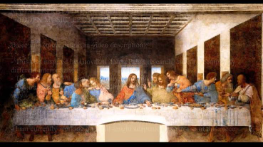
- Luminance and Contrast Balancing: The brain is hardwired to track areas of extreme contrast first. Masters utilized value camouflage—deliberately tinting esoteric symbols to perfectly match the local background luminance. In The Last Supper, Leonardo da Vinci structured the lines of perspective, windows, and hand placements to keep the eyes cycling through a specific geometric loop centered on Christ. The secret geometric matrices, musical codes hidden in the bread rolls, and underlying pentagrams were drawn using the exact same contrast levels as the background texturing. [1, 2, 3, 4, 5]
- Prototypical Schema Ingestion: The brain saves energy by relying on an internal “rulebook” or schema of how objects should look. If an artist paints a crowd, the brain quickly scans the faces, registers them as “a crowd,” and stops processing deeper details. Artists hid forbidden self-portraits, esoteric astrological alignments, or political counter-messaging directly inside these dense clusters. The brain categorized the group at a macro level, leaving the micro details unparsed by the viewer’s conscious mind. [1, 2, 3, 4, 5]
Core Mechanics Matrix
| Cognitive Bottleneck | Renaissance Technique | Real-World Application Example |
|---|---|---|
| Inattentional Blindness | High-contrast narrative framing to overload selective attention. | Michelangelo’s Sistine Chapel (Brain/Anatomy hidden behind the divine narrative focus). |
| Change Blindness | Anamorphic projection requiring physical movement/angle changes. | Holbein’s The Ambassadors (The skull remains a smudge until perspective shifts). |
| Gestalt Pattern Completion | Value camouflage and luminance matching to hide geometry. | Da Vinci’s architectural layouts and hidden geometric matrices. |
Renaissance masters systematically encoded occult text and musical notation into visual art by translating sonic frequencies and forbidden scripts into structural, spatial, and geometric elements.Rather than hiding letters or notes literally on the canvas, they treated the canvas as a mathematical and symbolic grid. They exploited the brain’s tendency to group disparate objects into patterns, layering hidden data directly beneath orthodox religious narratives.Here is how musical scores and esoteric scripts were seamlessly woven into visual masterpieces.
1. Encoding Musical Notation via “Spatial Harmonics”In the Renaissance, music, mathematics, and cosmology were fundamentally linked through the concept of Musica Universalis (the Music of the Spheres). Artists did not simply paint musical notes; they used physical objects and architectural dimensions to represent pitches and intervals. [1]The Horizontal Staff Overlay: Leonardo da Vinci’s The Last SupperModern reconstructions have revealed that Leonardo da Vinci—who was himself a brilliant court musician—structured his legendary fresco The Last Supper as a giant, playable musical score. [1]
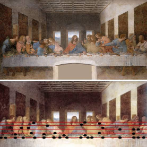
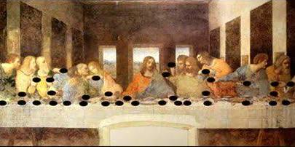
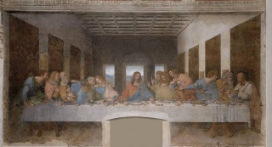
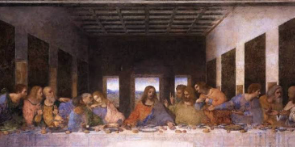
- The Grid: When a standard five-line musical staff is superimposed horizontally across the table, the loaves of bread and the hands of the Apostles align precisely with specific musical notes.
- The Cipher Key: To unearth the melody, the notes must be read right-to-left, mimicking Leonardo’s signature mirror-writing.
- The Result: When played on a pipe organ (the premier polyphonic instrument of the 15th century), this hidden layout yields a haunting, 40-second requiem that structurally accentuates the tension of Christ’s looming betrayal. [1, 2]
Structural Isochronism: Architectural Lutes and ChordsIn complex altarpieces, artists frequently used the rhythmic spacing of columns, window panes, or the strings of painted musical instruments to indicate musical chords. If the distance between three columns adhered to a 4:5:6 ratio, an educated viewer would instantly recognize the geometric signature of a major musical triad.
2. Encoding Occult Text via “Pseudo-Script” and Kabbalistic GematriaWhen Renaissance humanists sought to integrate forbidden Hermetic, Arabic, or Kabbalistic occult texts into their art, they had to bypass strict Church censorship. They relied on visual camouflage that mimicked decorative patterns or holy vestments.Pseudo-Kufic and Pseudo-Hebrew BordersArt historians identify cryptic, unintelligible lettering on the hems of garments in Renaissance paintings as pseudo-script. [1]
- The Concealment: Artists like Fra Angelico and Gentile da Fabriano decorated the halos and robe borders of biblical figures with elegant, twisting scripts that closely resembled Arabic (Kufic) or Hebrew lettering.
- The Double-Meaning: To the standard Church inquisitor, these were merely decorative, exotic flourishes meant to evoke the authentic Holy Land. However, to underground esoteric circles, specific configurations of these strokes encoded hidden Hermetic maxims or divine names drawn directly from texts like the Picatrix or Hebrew mysticism. [1, 2]
[Standard Eye] =======> Exquisite Fabric Border =======> Orthodox Ornamentation
[Esoteric Eye] ======> Decodes Stroke Formations ======> Kabbalistic/Hermetic Formula
Kabbalistic Gematria and Finger SpellingChristian Kabbalah flourished during the Renaissance, popularized by figures like Pico della Mirandola. This school of thought heavily utilized gematria—a system where letters correspond directly to numerical values.
- Geometric Ingestion: Instead of painting letters, artists calculated the exact surface area, perimeter, or angle of geometric shapes within the painting to total a specific holy number.
- Chironomia (Hand Gestures): The bizarre, rigid hand gestures displayed by figures in Renaissance art were rarely accidental. The positioning of fingers (crossed, extended, or bent) was frequently mapped to the Hebrew alphabet. By reading the hands of figures from one side of a canvas to the other, initiate viewers could spell out specific esoteric concepts, planetary names, or alchemical formulas. [1, 2]
3. Astral Magic and Color-Frequency CorrelationUnder the influence of Marsilio Ficino’s De vita libri tres, Renaissance artists began using occult color correlations to compress text-based magical spells into purely visual fields. [1]
- The Cosmic Frequency: Ficino argued that specific planets emitted distinct metaphysical virtues, which corresponded directly to specific earthly colors, metals, and musical pitches.
- Spells in Paint: If an artist wished to invoke the protection of Jupiter or the intellect of Mercury without writing out a forbidden pagan incantation, they would blend pigments (such as lapis lazuli for divinity or mumia for vitality) in strict accordance with astral magic charts. The resulting painting functioned as a visual talisman—a literal, condensed occult text projecting its intended frequency straight into the viewer’s subconscious mind. [1, 2, 3]
The hidden hymn in Leonardo’s The Last Supper is a slow, 40-second pipe organ composition that represents a mournful, solemn requiem, discovered by reading the musical notes mapped from the loaves of bread and hands,. It functions as a somber soundtrack for the scene, with the notes, chords, and pacing, which moves from right to left, revealing a 3/4 or 4/4 time signature that builds in intensity around the central figure of Christ. [1, 2, 3, 4, 5]
When Italian musician Giovanni Maria Pala mapped out The Last Supper in 2007, he unlocked a hidden musical composition that was structurally engineered into the painting’s architecture. [1]Here is the exact structural, harmonic, and mathematical breakdown of how Leonardo encoded this music.
1. The Visual Staff and Note PlacementTo see the score, you must imagine a standard five-line musical staff laid horizontally across the painting. The table itself serves as the foundational line.
- The Clef / Reading Direction: Leonardo wrote in mirror script (right-to-left). Therefore, the music must be read from right to left, tracking across the table.
- The “Notes”: The loaves of bread on the table and the hands of the Apostles serve as the individual notes.
- The Value of Elements: A hand represents one type of note value (e.g., a sustained note), while a piece of bread represents another (e.g., a shorter beat), depending on its vertical position relative to the hidden staff lines.
2. Musical Structure and Audio CharacteristicsWhen the right-to-left sequence of bread and hands is translated into pitch, it reveals a deliberate polyphonic piece.
- The Instrument: The piece does not sound like a cheerful Renaissance dance. It is written as a solemn requiem (a funeral dirge) intended to be played on a pipe organ or a viola organista (an experimental instrument Leonardo himself designed). [1, 2]
- The Rhythm: The piece follows a slow, somber 3/4 or 4/4 meter. The rhythm is dictated by the physical grouping of the Apostles. The gaps between the four distinct groups of three Apostles act as musical rests or phrasing pauses.
- The Melody: The melody climbs in pitch as you move right-to-left, creating an ascending, melancholic arc that peaks near the centre of the table (around Christ) before resolving.
3. The Mathematical and Acoustic BreakdownLeonardo did not just hide a random tune; he aligned the composition with the acoustic math of the Renaissance.
[Right Side of Painting] ------------------------> [Left Side of Painting]
  Apostle Hands / Bread      ======> Clef Key ======> Ascending Melodic Arc
  (Acts as Musical Notes)    (Read Right-to-Left)     (Resolves at the End)
- Consonant Intervals: The vertical distances between the hands of the Apostles correspond to the mathematical ratios of perfect consonances (\(2:3\) for a perfect fifth, \(3:4\) for a perfect fourth).
- Harmonic Anchor: Christ sits exactly at the geometric and acoustic centre. The spatial symmetry around Him creates a harmonic anchor point, meaning the most mathematically pure chord occurs right at the focal point of the narrative.
Albrecht Dürer encoded alchemical texts into his engravings by replacing literal words with precise geometric allegories, physical tools of transmutation, and mathematical matrices. [1]In his foundational masterwork Melencolia I (1514), Dürer created the ultimate alchemical puzzle. Instead of drawing banned sigils, he exploited the cognitive bottleneck of schema ingestion. He disguised a step-by-step allegorical guide to the Magnum Opus (the Great Work of alchemical transmutation) as a collection of random laboratory debris. [1, 2, 3]The specific alchemical steps and texts are physically mapped within the engraving’s composition.
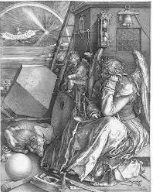
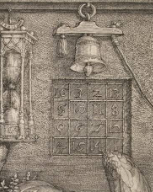
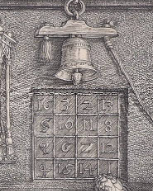
The 4×4 Magic Square1. The Crucible and the First Stage: Nigredo (Blackness)The engraving opens with the depiction of a dejected, winged figure representing Melancholy. In Renaissance alchemy, melancholy was not just a mood; it was directly paired with the element of Earth and the initial, painful stage of transmutation known as Nigredo (blackening or calcination). [1, 2, 3]
- The Raw Material: The scattered, discarded tools on the ground—the hammer, pincers, saw, and nails—represent the heavy, untamed base metals (associated with Saturn).
- The Furnace: Right behind the central figure sits a roaring, hidden alchemical crucible heater. The surrounding instruments symbolize the physical, chaotic labor required to break down base matter before spiritual purification can begin. [1]
2. The Transmutation Matrix: The Jupiter Magic SquareDirectly mounted onto the stone wall is a famous 4×4 mathematical magic square. To a casual viewer, it appears to be a mere mathematical curiosity. To an initiate reading Renaissance alchemical theory, it is a defensive talisman. [1]
- The Formula: Every horizontal row, vertical column, and diagonal line adds up to the number 34. The bottom row even displays the exact year of the engraving’s creation: 1514. [1, 2, 3, 4]
- The Counter-Spell: Alchemy taught that melancholy was governed by the dark, heavy planet Saturn. According to occult philosophy popularized by Cornelius Agrippa, this specific 4×4 numerical grid represents the intelligence of Jupiter. By placing the magic square directly over the winged figure, Dürer encoded a literal remedy: using Jupiter’s bright, expansive geometry to conquer the heavy, dark stasis of Saturnian Nigredo. [1]
3. The Philosopher’s Stone: The Truncated PolyhedronDominating the left side of the engraving is a massive, strangely shaped stone block known to mathematicians as Dürer’s Polyhedron.
- The Rough Ashlar: In alchemical texts, the journey begins with the materia prima (raw material), often illustrated as a rough, unshaped stone block. [1]
- The Refined Geometry: This giant, mathematically perfect solid has been deliberately carved and shaped. It represents the Lapis Philosophorum—the Philosopher’s Stone—midway through its refinement. Dürer is showing the literal text of transmutation: taking rough, chaotic matter from the earth and using geometry to refine it into a perfect, transcendent shape. [1]
4. The Distillation Process: The Hourglass and ScalesSuspended directly above the winged figure are a balanced scale and an hourglass.
- The Element of Time: The hourglass symbolizes the exact timing required for alchemical distillation. If a substance is heated for even a moment too long, the work is ruined.
- The Element of Measure: The scales represent the cosmic balance (pondera) of elements. Alchemical manuscripts frequently warned that the four classical elements (Earth, Air, Fire, and Water) must be weighed with absolute geometric precision to achieve the final stage of illumination.
Albrecht Dürer’s masterpiece Knight, Death, and the Devil (1513) is a masterclass in psychological warfare and esoteric symbolism, encoding an underground handbook on moral fortitude and Christian stoicism. [1, 2]To a casual viewer, the engraving portrays a terrifying medieval nightmare. However, Dürer used schema ingestion to hide an empowering, anti-fear blueprint. By mapping out specific visual markers, Dürer transformed a scene of impending doom into a roadmap of absolute spiritual invulnerability.Here is the exact map of the hidden symbols layered across the composition.1. The Knight: The Invulnerable “Miles Christianus”The central figure is an armored knight riding steadfastly through a dark, treacherous valley. He ignores the terrifying apparitions beside him. [1, 2]
- The Armor of God: The knight’s armor represents the literal manifestation of Erasmus of Rotterdam’s 1501 treatise, Enchiridion militis Christiani (Handbook of a Christian Soldier). Dürer was a close follower of Erasmus. The armor is not just physical protection; it represents absolute faith, moral steel, and intellectual clarity that renders the wearer completely immune to spiritual terrors. [1, 2, 3]
- The Forward Gaze: The knight’s gaze is locked entirely on his forward destination. By keeping his eyes fixed straight ahead, Dürer visually demonstrates the conquest of inattentional blindness turned into a virtue. The knight deliberately starves the terrifying monsters of his cognitive attention, rendering them powerless. [1]
2. Death: The Decay of TimeRiding a pale, decrepit horse directly beside the knight is the grotesque figure of Death. He attempts to halt the knight’s progress. [1, 2]
- The Hourglass: Death holds up an hourglass, pointing to the trickling sand. This is a direct psychological attack, a visual text warning the knight that his time on earth is short and his death is imminent. [1, 2, 3]
- The Crown of Snakes: Death wears a crown intertwined with living vipers rather than a royal diadem. This encodes the biblical reference to the fall of man and the decay of earthly flesh, symbolizing that mortal power is temporary and corrupt.
3. The Devil: The Multi-Beast of ChaosSkulking behind the knight’s horse is a bizarre, misshapen Devil. Dürer deliberately chose not to draw a standard biblical Satan.
- The Amalgam Creature: The Devil is a chaotic patchwork of various animals—he possesses a ram’s horn, a wolf’s snout, a pig’s ears, and a single horn like a mythical beast. This represents the alchemical and theological concept of prime chaos. He embodies the base, animalistic passions (greed, lust, anger) trying to pull the rational human back into the mud. [1]
- The Hooked Pike: The Devil carries a sharp pike with a hook on the end, positioned just behind the knight’s back. This represents the subtle temptation to look back in fear. The moment the knight turns around to address the threat, he loses his focus and succumbs to chaos. [1]
4. The Micro-Symbols: The Fox, Dog, and LizardDürer scattered tiny, easily missed allegories across the foreground and background to lock in the engraving’s esoteric text.
[Top Left: The High Citadel] ===> The Ultimate Spiritual Destination
       ^
       | (The Perilous Path)
[The Knight & Dog] ===> Truth & Loyalty marching forward
       ^
[The Foreground Lizard] ===> Warning sign of immediate danger/decay
- The Foxtail on the Lance: Tied to the tip of the knight’s towering lance is a long foxtail. In Renaissance folklore, the fox was the ultimate symbol of cunning, deceit, and falsehood. By pinning the foxtail to his weapon, the knight demonstrates that he has conquered lies and carries truth as a trophy into battle. [1]
- The Faithful Retriever: Running directly beneath the horses is a loyal dog. While the horses look skittish, the dog matches the knight’s forward march perfectly. The dog encodes the virtues of absolute loyalty, truth, and vigilance, acting as a psychological anchor that keeps the horse moving straight. [1]
- The Scurrying Lizard: At the very bottom right, a lizard scrambles in the opposite direction of the horse’s hooves. In alchemical text, the lizard/salamander was highly sensitive to spiritual shifts. Here, its flight serves as a visual warning of a highly toxic, spiritually dangerous environment.
- The Citadel on the Hill: Far in the background, shining at the very top of the mountain path, sits a fortified castle. This is the “New Jerusalem” or the fortress of the rational mind. It symbolizes the final destination of the Magnum Opus—the place of absolute peace achieved only by walking through the valley of shadows without flinching.
The comet and rainbow in the background of Melencolia I encode a precise system of Renaissance cosmological magic derived from the Hermetic and Neoplatonic texts of Marsilio Ficino and Cornelius Agrippa.Rather than portraying a literal weather event, Albrecht Dürer engineered these celestial phenomena to represent a cosmic clash of planetary frequencies, offering an astronomical “cure” for the psychological devastation of melancholy.Here is the exact breakdown of how these background elements encode cosmological magic.1. The Comet: The Threat of Saturnian RuinBlazing across the sky inside the arc of the rainbow is a bright, weeping comet (often linked to the historical comet of 1514). In Renaissance astrology, comets were terrifying omens of destruction, plague, and the death of kings.
- The Signature of Saturn: Dürer deliberately places the comet within a dark, brooding sky. In cosmological magic, comets were classified as highly concentrated bursts of Saturnian energy—cold, dry, destructive, and deeply associated with madness or spiritual stagnation.
- The Melancholic Trap: The comet represents the macrocosmic version of the winged figure’s internal state. It symbolizes a mind being utterly consumed by its own burning intellect, trapped in the lowest, darkest phase of alchemical transformation (Nigredo).
[Microcosm: The Winged Figure] <===(Resonates With)===> [Macrocosm: The Cold Saturnian Comet]
                                           ||
                        [The Alchemical/Magical Counter-Force]
                                           ||
                                [The Lunar/Solary Rainbow]
2. The Rainbow: The Lunar and Solar Counter-ForceEnclosing the comet is a perfectly geometric rainbow. However, this is no ordinary rainbow; its placement in a dark, starry night sky indicates it is a lunar rainbow (moonbow) or a highly stylized solar reflection.
- The Alchemical Bridge: In the cosmological text De Occulta Philosophia (circulating in manuscript form during Dürer’s time), the rainbow is the ultimate symbol of the horizon—the literal bridge between the volatile earthly realm and the immutable celestial spheres.
- The Multi-Layered Cure: In astral magic, a rainbow contains all visible frequencies of light. By arching over the dark comet, the rainbow acts as a protective shield. It introduces the vital, life-giving frequencies of the Sun (gold/light) and the Moon (silver/silver-white) to dilute and neutralise the toxic, monochromatic blackness of Saturn’s comet.
3. The Magical Geometry of the SkyThe interaction between the comet, the rainbow, and the background landscape creates a hidden geometric glyph.
- The Light Array: The comet does not just burn; it emits blinding, geometric rays of light that fill the entire background quadrant. These rays strike the water below, which reflects the light back upward.
- The Talismanic Horizon: In Neoplatonic magic, water acts as a massive elemental mirror that catches and anchors celestial rays. By drawing the rays striking the sea directly beneath the rainbow, Dürer transformed the background of the engraving into a giant visual talisman.
- The Micro-Macro Link: The cosmic light from the sky perfectly matches the mathematical angles of the Jupiter Magic Square mounted on the wall below it. Dürer is showing that the same geometric laws that govern the alignment of the stars (macrocosm) can be captured by human mathematics and art (microcosm) to heal the human soul.
Albrecht Dürer calculated and visualized the end of the world in his 1498 woodcut masterpiece The Apocalypse (Apocalipsis cum figuris) by structurally engineering biblical numerology, geometrical alignments, and millennial anxieties directly into the printing blocks. [1, 2]During the late 1490s, Europe was gripped by an intense mass hysteria that the world would end exactly in the year 1500. This widespread panic relied heavily on a mathematical phrase found in the Book of Revelation: “a time, and times, and half a time” (interpreted by eschatological scholars to calculate 1,500 years from the birth of Christ). [, 2]Dürer capitalized on this exact psychological bottleneck, designing a visual narrative that transformed complex theological mathematics into a terrifyingly scannable reality. [1]1. The Geometry of the Inevitable: Overlapping DiagonalsIn his most famous woodcut, The Four Horsemen of the Apocalypse (1498), Dürer mathematically structured the composition using strict diagonal spatial splitting to dictate the absolute pacing of time on Judgment Day. [1, 2, 3]
- The Velocity Vector: Rather than arranging the horsemen staticly side-by-side as in traditional medieval bibles, Dürer used a calculated geometric grid to align the horses on a severe, parallel diagonal slope. They move ruthlessly from the top right down to the bottom left. [, 2]
- The Time Compression Matrix: The layout divides the visual frame into precise geometric regions. The upper-right quadrant represents the divine order breaking through, the central matrix holds the crushing weight of the accelerating riders, and the lower-left represents the physical destruction of humanity. This diagonal trajectory creates a mathematical illusion of unyielding forward momentum, tricking the human brain into feeling that the end of days is actively and rapidly closing in. [, 2]
[Top Right: Cosmic Command]  =======> Accelerating Diagonal Grid
                                           \\
                                            \\ (Unstoppable Velocity Vector)
                                             v
[Bottom Left: Human Defeat] <====== [Crushed under Hooves of the Four Riders]
2. Incorporating Sacrificial Proportions: Doubling the CubeBeyond literal translation, Dürer infused his woodblocks with classical geometric equations that humanists linked to cosmic architecture.
- The Greek Problem Ingestion: In certain panels of The Apocalypse, Dürer subtly arranged the overlapping background architecture and figures to trace out the lines of the Delian Problem (the classical geometric task of doubling a cube using only a straightedge and compass). [1]
- The Esoteric Alignment: To Renaissance humanists, doubling the cube was a mathematical riddle tied intimately to the harmony of the temple altar and spiritual purification. By superimposing St. John’s visions onto a rigorous grid reflecting classical mathematical solutions, Dürer attempted a literal reconciliation between pagan geometry and Christian prophecy. He constructed doomsday not as an engine of random chaos, but as an mathematically perfect act of cosmic rebalancing. [1, 2]
3. Scriptural Multiplication and Numerical StackingDürer precisely mapped the structural pacing of his entire 15-woodcut series to mimic the accelerating, compounding mathematics of biblical prophecy. [1]
- The 7-7-7 Equation: The Book of Revelation relies on sequential judgments: 7 Seals, 7 Trumpets, and 7 Vials. Dürer exploited the brain’s pattern-recognition system by structurally stacking these numbers within the woodcut frames. [1, 2, 3, 4]
- Visual Fractioning: In panels like St. John Devouring the Book or The Seven Trumpet Angels, the sky is neatly subdivided into exact fractional portions. Dürer mapped out a precise third of the sun being blotted out, a third of the moon turning to blood, and a third of the earth burning. By enforcing literal mathematical boundaries on his artistic framing, he forced the viewer’s brain to visually execute the apocalyptic fractions described in the text, maximizing the immediate cognitive impact of the prophecy. [1]’