
AI – ‘The eight-pointed star (octagram) is a deeply significant and historically shared motif across all three of these cultures, reflecting its ancient roots in celestial observation and sacred geometry. [1, 2]
Here is how the motif appears in each tradition:
- Afghan Weavings: In Afghan and broader Central Asian tribal weaving, the eight-pointed star is a foundational geometric medallion. Called Khatim or Khatim Sulayman (Seal of Solomon) and Yıldız (star) in various regional traditions, it is frequently woven into the central fields and borders of traditional Kazak and nomadic rugs. [1, 2, 3]
- Palestinian Weavings: The star is a prominent, ancient motif in Tatreez (traditional Palestinian cross-stitch embroidery). Known locally by names such as the “Star of Bethlehem” or the “Moon of Bethlehem” (Qamar Beit Lahem), it has decorated Palestinian garments, woodwork, and textiles for centuries, symbolizing hope and cultural identity. [1, 2, 3, 4, 5]
- Native American Weavings: The eight-pointed star (often called the “Morning Star” or “Sioux Star”) is a sacred and central design in Indigenous American textile traditions. It is notably featured in historic Navajo weavings (such as the Chinle or Storm patterns) and is an iconic symbol of the four cardinal directions and the stages of life. [1, 2, 4]
Would you like to explore how to:
- Interpret the symbolic meanings behind the star in any of these specific cultures?
- Distinguish the geometric weaving techniques used to create these stars?’
The presence of the eight-pointed star across deeply separated cultures is one of the most fascinating phenomena in textile history. It is explained by three main concepts: human biology, the shared sky, and ancient trade.
Here is how this shared imagery developed:
1. The Geometry of the Loom (Technological Determinism)
When you weave on a traditional loom, you work with vertical threads (warp) and horizontal threads (weft).
- Grid Constraint: Creating curves on a loom is incredibly difficult.
- Natural Angles: Weavers naturally create straight lines, 90-degree angles, and 45-degree diagonals.
- Inevitable Shape: If you start from a central point and expand symmetrically using 45-degree angles, you mathematically arrive at an eight-pointed star. The tool itself forces the design.
2. The Universal Sky (Archetypal Symbols)
Ancient humans, regardless of location, looked at the exact same night sky.
- The Morning Star: Venus is the brightest object in the night sky and visually appears to radiate sharp points.
- The Cardinal Directions: The star naturally maps out the four cardinal directions (North, South, East, West) combined with the four ordinal directions (Northeast, Northwest, Southeast, Southwest). It served as a universal compass for nomadic peoples in the Americas, Central Asia, and the Levant.
3. Deep Historical Trade Networks (The Silk Road)
While Native Americans developed the symbol independently, Afghan and Palestinian cultures actually share direct historical links.’
- The Silk Road: For thousands of years, the Silk Road connected the Middle East and Central Asia.
- Islamic Geometry: The eight-pointed star (known as the Rub el Hizb) became a foundational mathematical blueprint across the Islamic world, spreading rapidly through traded textiles, tilework, and manuscripts between the Levant and Afghanistan.
4. Shared Human Psychology (Carl Jung’s Archetypes)
Psychologist Carl Jung argued that certain geometric shapes are hardwired into the human “collective unconscious.” Symmetrical, centralized shapes like the eight-pointed star (a mandala) naturally represent balance, wholeness, and the cosmos to the human brain, prompting unconnected cultures to invent them spontaneously.
What aspect of this connection would you like to explore next?
See how the Navajo Morning Star differs from the Palestinian Star of BethlehemLearn about the dyes and materials used by these different cultures.
Discover other shared textile motifs like the Tree of Life. …
The eight-pointed star is found in ancient textiles and archaeological artifacts from the ancient Near East, though it was not an exclusively Jewish religious symbol. In antiquity, geometric and cosmological motifs like the eight-pointed star (octagram) were shared across many cultures in the region. [1, 2, 3, 4, 5]The octagram’s historical presence in the region’s material culture includes: [1]
- Mesopotamian and Canaanite Roots: The eight-pointed star was an ancient symbol for the goddess Ishtar (and earlier, Inanna), signifying divinity and the planet Venus. Ancient texts from the Israel Museum note that gold eight-pointed star ornaments were applied to divine garments. [1, 2]
- Canaanite & Levantine Motifs: This star shape has deep roots in the Levant. It is frequently found as an indigenous motif engraved in caves in the Jericho area and is a staple in traditional Palestinian tatreez (embroidery). [1]
- Greco-Roman and Byzantine Textiles: Geometric interlace patterns, including eight-pointed stars formed by superimposed squares, were highly popular in late antique and Byzantine-era Egypt (4th century CE) and have been well-documented in collections like the Egypt Centre at Swansea University. [1, 2]
While these historical textiles and artifacts contain the eight-pointed star, it is distinct from the hexagram (six-pointed star or Star of David), which later evolved as a symbol of Jewish identity in the Middle Ages. [1, 2, 3, 4].
Geometric interlace patterns and eight-pointed stars formed by superimposed squares appear across all four of these textile traditions, though their prevalence, meaning, and historical eras vary significantly. [1, 2]While the “overlapping square” octagram is most famously associated with Islamic art (where it is known as the Khatam), its geometric roots predate Islam. It migrated across global trade networks like the Silk Road, appearing independently or via cultural exchange on garments, rugs, and burial cloths. [1, 2, 3, 4]Below is a breakdown of how this specific motif appears in the textile histories of Egypt, Persia, India, and China.
Ancient and Late Antique Egypt
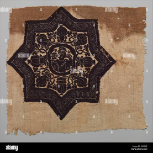
Fragment with an Eight-Pointed Star Containing a Warrior …metmuseum.org
Eight pointed star design hi-res stock photography and …alamy.com
- The Era: Late Roman, Byzantine, and Coptic periods (4th to 7th centuries CE). [1, 2]
- The Textiles: The eight-pointed star formed by two overlapping squares is a highly popular motif on woven wool and linen Coptic textiles. It appears as decorative medallions (clavi or orbiculi) on tunics and burial shrouds. [1]
- Design Style: The Egyptians directly combined the star with heavy interlace or guilloche ornament. The lines of the superimposed squares were woven to visually loop “under and over” each other, framing central figures like warriors, saints, or animals. While Pharaonic Egypt preferred five-pointed stars, the geometric eight-pointed variant flourished under late-antique and Christian influences. [1, 2]
Persia (Iran)
- The Era: Pre-Islamic Sasanian Empire (3rd–7th century CE) through the Islamic Golden Age (Samanid, Seljuk, and Ilkhanid periods). [1, 2]
- The Textiles: Persia is the epicenter of geometric interlace development. The eight-pointed star appears extensively on luxury silk compound twills (samit), silk tapestries, and early knotted carpets. [1, 2, 3]
- Design Style: Known locally in its fully realized structural form as girih (knotting), Persian designers used the motif as a fundamental grid system. Lines cross seamlessly at exact 45-degree angles to generate endless interlocking arrays. It transitioned from early astral symbols on pre-Islamic heraldic silks into a cornerstone of sophisticated mathematical tessellations on medieval Persian garments and rugs. [1, 2, 3, 4, 5, 6]
India
- The Era: Ancient Indus Valley to the Medieval and Mughal eras.
- The Textiles: The motif is prominent in traditional Indian embroidery, resist-dyed textiles, and block prints, notably in Phulkari embroidery from Punjab and geometric Ajrakh printing from Sindh and Gujarat.
- Design Style: In Hindu iconography, this exact geometry—two congruent squares rotated at 45 degrees—is the Star of Lakshmi, representing the eight forms of wealth. When woven or embroidered into textiles, it is frequently used as a central repeating field motif or inside borders. The geometric interlace was further stylized during the Mughal period, blending rigid mathematical lines with traditional Indian floral stems running through the centers of the stars. [1, 2, 3]
China
- The Era: Neolithic dawn through the Tang, Song, and Yuan Dynasties (via Silk Road exchange).
- The Textiles: The eight-pointed star (Ba Jiao Xing) appears painted on ancient Dawenkou pottery and is later woven into complex silk damasks, brocades, and tapestries (kesi).
- Design Style: In early Chinese tradition, the star represented the eight divisions of heaven and the entirety of the universe ruled by the Sky Emperor. Later, as trade with Persia flourished during the Tang and Yuan dynasties, Chinese weavers adopted western Asian interlace styles. They integrated the sharp, square-derived star into continuous geometric backgrounds, often filling the spaces with local motifs like lotus flowers, clouds, or hunting scenes. [1, 2]. …
In ancient Islamic art and textiles, the Khatam motif—most commonly recognized as an eight-pointed star (often formed by two overlapping squares)—symbolized divine order, the harmony of the cosmos, and the ultimate perfection of the Divine. [1, 2, 3, 4]Derived from sacred geometry, it served as a spiritual and philosophical bridge across various art forms, from textiles to architecture. [1, 2]1. The Bridge Between Heaven and EarthIn Islamic cosmology, geometric shapes carry distinct spiritual meanings. The square represents the earthly, physical realm, while the circle represents the infinite heavenly realm. Because the Khatam is formed by rotating and intersecting squares, it creates an eight-pointed star that acts as a transitional shape, symbolizing the harmony between the material world and the spiritual universe. [1, 2, 3, 4, 5]2. Divine Unity and CreationThe complex, interwoven lines of the Khatam motif are a visual representation of Tawhid, the fundamental Islamic concept of the indivisible oneness of God. The infinitely repeating lines and geometric symmetry symbolize how the diverse, multitudinous aspects of creation are all interconnected and unified by a single divine source. [1, 2, 3, 4]3. A “Seal” of Perfection and CompletionThe root of the word Khatam relates to a “seal,” a “signet ring,” or the act of finalizing and authenticating something. In this context, the Khatam motif represents the pinnacle of perfection, completion, and the ultimate truth of the Divine. (For example, this concept is famously used in the phrase Khatam an-Nabiyyin or “Seal of the Prophets”). [1, 2, 3]4. Symbolism in TextilesWhen woven into carpets, garments (such as the tiraz textiles), or tapestries, the Khatam motif functioned as more than mere decoration. It was often imbued with protective, blessing-granting significance. The repetition of the eight-pointed star served as a reminder of divine presence, acting almost as a spiritual seal on the fabric that brought the wearer closer to cosmic harmony. [1, 2, 3, 4, 5].’