1. ‘Sham’ – see para 7.8 of my book the ‘Contentious Trusts Handbook’.
2. ‘Illusory trust’ – see para 7.9 of my book & use the search box at the top of the blog to search for – ‘Challenging the validity of an offshore trust as being an illusory trust.’
3. ‘Jurisdiction’ – use the search box at the top of the blog to search for ‘Challenging the jurisdiction of an Offshore Trust.’
4. ‘Failure to constitute’ – use the search box at the top of the blog to search for – ‘The offshore trust that never was!’
5. ‘Validity’ – use the search box at the top of the blog to search for – ‘Can the validity of an offshore trust be challenged in the English court by HMRC seeking a determination of the applicable law?’
6. ‘There is [also] a potential elephant-sized trap in conducting the mediation of an offshore trust dispute face to face in an onshore jurisdiction [which in my experience very few trust practitioners appear to be aware of /switched on to], as a revenue authority may challenge the tax residence of the trust; therefore, it may be necessary to obtain tax advice before agreeing to the venue. … [G]reat care should be taken when setting up the mediation of an international trust dispute.’ – See my article ‘Mediating Probate and Trust Disputes – Process Challenges and Tools – Part 1.’ Published by Oxford University Press in ‘Trusts & Trustees’ worldwide in the journal in February 2023.
I can also think of several other technical ways in which a revenue authority could attack an offshore trust – but nobody is asking!
Category Archives: Uncategorized
‘My book the “Contentious Trusts Handbook” – Centre stage at the Law Society Private Client Conference 2023’
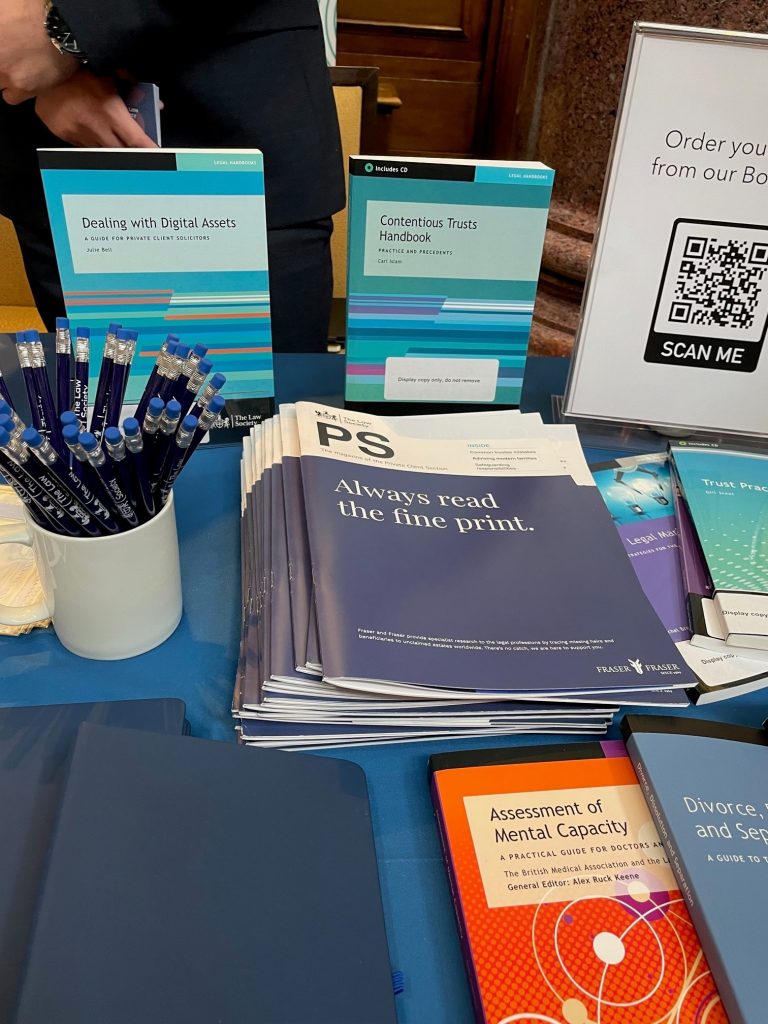
My book, the ‘Contentious Trusts Handbook’ took centre stage on the marketing stand at the Law Society Private Client Conference 2023 held on 28 June at the Law Society’s historic main office at 113 Chancery Lane, London. This image was forwarded to me by my editor at Law Society Publishing. My next book – which I have already started writing, will be the 2nd edition of the ‘Contentious Probate Handbook’. I am aiming to complete and submit the final draft to my editor at the Law Society in November 2024. This will contain a comprehensive new chapter about ‘mediating’ and ‘mediation advocacy’ in trust and estate disputes. To download and read my four recent articles about mediating trust and estate disputes, including – ‘Mediating Probate and Trust Disputes – Process Challenges and Tools – Part 2’ published by Oxford University Press in Trusts & Trustees 24.06.2023 [Abstract: https://lnkd.in/eqSkkQhG] and Part 1 (published worldwide in print in the Journal – February 2023); ‘Mediation and Estate/Business Succession Planning’ published in Taxation by Tolley 08.03.2022; and ‘Mediation and the tax-efficient settlement of probate disputes’, published in Taxation by Tolley 01.03.2022, please visit the ’Publications’ page at www.carlislam.co.uk. For book reviews please visit the ‘Contentious Trusts Handbook’ and ‘Contentious Probate Handbook’ pages of my website. Since December 2020, I have been studying part-time for a Diploma in Art Law at the Institute of Art & Law in London (https://ial.uk.com/), and going forward as a practising Barrister, CMC Registered Mediator, and author, I am developing a niche research and writing interest in ‘Art Business Contracts’, see the ‘Mediation of Art Disputes’ page at www.carlislam.co.uk. The provisional title of my three Diploma essays, which have to be written in addition to the ten compulsory course modules which students have to undertake are:
– ‘Deaccessioning Art and Cultural Heritage – The Legal and Ethical Framework.’
– ‘Mediating Cultural Property Disputes.’
– ‘Art Business Contracts.’
Working drafts are available to view on the ‘Mediation of Art Disputes’ page at www.carlislam.co.uk.
‘Infrastructure project and business opportunities in MENA if there is a convergence of interests’
On 16 May 2023 I put the following question to Professor Anoush Ehteshami (Professor of International Relations in the School of Government and International Affairs, Durham University), following a talk he gave to the Centre for Geopolitics at Cambridge University about ‘The Geopolitics of China’s Belt & Road Initiative and Western Focus’ – Q. ‘Is the potential for “convergence” in MENA a geopolitical “pivot” upon which war can be avoided in the South China seas?’ To hear the full answer Professor Ehteshami gave click on the following link and then fast forward to the Q&A at 58:02 to 1.11 using the progress bar underneath the video or on your smart TV search You Tube for ‘Anoush Ehteshami’ + ‘China’s Belt & Road’:
https://lnkd.in/eeEnAbHc
In his answer Professor Ehteshami connects:
(i) The conclusion of the UN that a better world requires the building of infrastructure.
(ii) The UN’s estimated cost of building this infrastructure of anywhere between $15-30 Trillion.
(iii) Who is going to pay for it?
(iv) The opportunity that exists for a dialogue about connectivity.
The business opportunites that exist for multinational companies in MENA are huge, provided ‘convergence’ can take place – see the ‘Geopolitical Mediation’ page at www.diplomaticlawguide.com. He describes Iran as the last ‘El Dorado.’ So, if your company is not switched on to the opportunities he describes, I would urge you to listen to his answer to my question. There appears to be an opportunity for business to shape the future of MENA by initiating and leading a mediated dialogue between stakeholders in the region. See also my previous post – ‘The Idea of Geopolitical Mediation’, and the ‘Geopolitical Mediation’ and ‘Negotiating Political Order’ pages at www.diplomaticlawguide.com.
‘Trusts & Trustees In-Depth Article: “Mediating probate and trust disputes—process challenges and tools: part 2” – Published’
My Trusts & Trustees In-Depth Article: “Mediating probate and trust disputes—process challenges and tools: part 2” has been published online by Oxford University Press 24.06.2023.’ – The print edition will be published in the Journal worldwide in September. To download the PDF article please visit the ’Publications’ page atwww.carlislam.co.uk.
I would like to thank my colleague Jacob Meagher at Cambridge University for his contribution about the Singapore Convention on Mediation. As far as I am aware, Jacob, is the first person to have commentary published about the opportunity the SCM presents, depending upon how politicians enact it. So, Politicians, Practitioners and Policy Makers – please take note. He writes:
‘What remains to be seen is whether the UK adopts an ‘opt-in or out approach’ (Art 8(1)(b)), whether parties must declare themselves bound by the SCM, or actively depart.. … It is recommended that the UK depart from this provision as the benefits from doing would allow the UK to become a mecca of off-shore and cross-border trust mediation as well as reinforcing our domestic probate, trust, and employment settlements, and doing away with the need to apply for Tomlin orders and thus wasting precious court time.’
Jacob recently submitted his PhD at Cambridge and I also would like to take this opportunity to congratulate him on his outstanding contribution to knowledge in the global field of Trust Law.
This is my 6th article on Mediation published since February 2022. It is will also be my last, until I have completed researching and writing the 2nd edition of my book the ‘Contentious Probate Handbook’ for the Law Society, which got underway in late 2022, and is on schedule for submission to the publishers in November 2024. If you would like me, or both myself & Jacob (subject to availability) to present a Zoom/TEAMS/in-person talk about mediation or Contentious Probate/Trust litigation, please email carl@ihtbar.com. As a practising Barrister, mediator and author, I also have a research and writing interest in ‘Practical Ethics in the Restitution of Art’ – see the ‘Mediation of Art Disputes’ page at www.carlislam.co.uk
Causes of catastrophic failure in electrical-mechanical plant & machinery
Logically, a catastrophic failure can only be caused by a defect in design, materials, or workmanship. Prior to practising at the Bar, I worked as a company and commercial solicitor and in-house for Rolls-Royce and Alstom (in Paris), structuring and drafting commercial contracts, and negotiating deals in multiple jurisdictions around the world (principally in the Far East, including China, South Korea, Malaysia, and India). Following the award of a major project to Rolls-Royce in the summer of 1990, I became the first solicitor in the history of the company to undertake their multi-disciplinary one-year internal training course for Project Managers of major Power Projects around the world. As I wrote in an international conference paper which I presented to the Royal Institute of Naval Architects in London in April 1999 – ‘The legal and commercial consequences of performing unspecified design work in ship-conversion projects’:
‘There is no legal definition of design. In principle there is a design element in the whole spectrum of ship-conversion activities ranging from concept design to appearance, functional criteria, detailed design, choice of materials and methods of work. Unspecified design work inevitably results in consequences which are only realised following construction. The combined impact of unspecified design work in aggregate can result in radical changes in the: (1) planned and priced volume of steelwork incorporated into the vessel; (2) specified deadweight tonnage of the vessel; (3) specified speed and fuel consumption of the vessel; (4) specified meta-centric height of the vessel; and (5) stability and trim of the vessel. Consequently, the vessel presented to Owners at re-delivery may be materially non-compliant with the Contract.’
It follows, that where there is a catastrophic failure at sea, the evidence that needs to be obtained, examined with a tooth-comb, and analysed by experts is not only lying on the sea-bed. It is also in the documentary and electronic records of design, construction, materials, testing, and workmanship (including repair). While this is no longer my field of practice, in order to investigate and draw reasoned conclusions about the probable cause(s) of a catastrophic failure based upon physical and documentary evidence, the investigators need to obtain all documentary records as a matter of urgency. The article is available to view on the ‘Publications’ page at www.carlislam.co.uk. Otherwise they may never be able to establish the chain of events that resulted in catastrophic failure – which as a forensic process, is akin to project-management in reverse.
Mediating NFT Disputes involving art
In Osbourne v Persons Unknown & Anor [2022] EWHC 1021 (Comm) (10 March 2022) Judge Pelling KC stated:
‘There is clearly going to be an issue at some stage as to whether non-fungible tokens constitute property for the purposes of the law of England and Wales, but I am satisfied on the basis of the submissions made on behalf of the claimant that there is at least a realistically arguable case that such tokens are to be treated as property as a matter of English law. [13] The other factor which is material to this claim is where such tokens are to be treated as being located as at the time when they were lost. … [N]on-fungible tokens are in effect a stream of electrons resulting in a credit item to a crypto account. As such, insofar as they have a physical manifestation at all, that is likely to be where the servers relevant to the account are maintained. However, attempting to litigate issues such as this by reference to a concept as ethereal as that would be difficult or impossible. [14] Unsurprisingly, therefore, in a series of cases relating to crypto currency fraud, it has been consistently held that crypto assets, are to be treated as located at the place where the owner of them is domiciled. There is no reason at any rate at this stage to treat non fungible tokens in any other way, assuming for present purposes as I do that they are to be treated as property as a matter of English law. [15].’
General principles of mediating commercial disputes apply to NFT disputes involving art, e.g:
- What is at stake?
- What is the value of what is at stake?
- What are the litigation & potential costs risks? – including jurisdiction.
- What are the benefits of litigation & trial?
- What is the ‘chance of winning’ multiplied by the ‘net financial gain’ versus the ‘chance of losing’ multiplied by the ‘net financial loss’?
- What are the benefits of doing a deal?– e.g., privacy & confidentiality.
- What is the ‘price of doing a deal’?
- What is the ‘commercial gap’?
- What ‘legal & commercial incentive/leverage’ is there to narrow & close the gap? – e.g., elimination of litigation risk & the time value of money.
A ‘Black Swan’ is the scope for lawful accounting & tax-efficient settlement to accommodate/cushion/mitigate the cost for each side of doing a deal that is ‘enough’. In my article – ‘Back to the future’ – Part 1 – Mediation and the tax-efficient settlement of probate disputes’, Taxation (Tolley) 01.03.2022 , I explain ‘Since this involves a technical analysis that requires the application of specialist knowledge about [each applicable tax regime & of complex/multi-jurisdictional accounting] principles, participants … prior to the mediation day [may separately appoint or] … agree to the joint-appointment of a single qualified [CTA], to provide a [Report] to … scope and explain the potential to expand the [commercial pie] through innovative … tax planning.’
‘Art of Cross-Examination’
As the late Mr Justice Hunt said, in a lecture to the South Eastern Circuit Bar Mess entitled, ‘The Art of Advocacy’,
‘Don’t [embark] on your case like Christopher Columbus, who on his voyage of discovery, didn’t know:
- where he was going;
- when he arrived, where he was; and
- after he left, where he had been!
Know where you are going, and when you have got there sit down. Set out what you want in paragraph 1 of your skeleton argument, “the Claimant’s case is…” Set out your stall, what you are asking for and want the judge to do. Say to yourself – “what am I doing here? What is my case?” Your opening is the route-map for your case containing the clearest sign-posts to point the judge in the right direction.’
There are three modes in which facts can be established:
(i) Direct evidence – that is to say, the facts are proved by an eyewitness;
(ii) Logical deduction from direct evidence;
[and]
(iii) Probable inferences, based on the facts proved by direct evidence or directly deduced from those facts.
Whether or not the burden of proof is discharged depends upon the weight and value which the judge attaches to the various strands of evidence. This involves weighing up the credibility or reliability of the evidence, and ultimately comes down to deciding which version of the relevant matters is more likely to be correct. At trial the judge is concerned with the balance of probabilities rather than certainty.
The aims of cross-examination are:
(i) To destroy the material parts of the evidence-in-chief.
(ii) To weaken the evidence where it cannot be destroyed.
(iii) To elicit new evidence, helpful to the party cross-examining.
(iv) To undermine the witness (or shake his credit) by showing that he cannot be trusted to speak the truth, or that he is deposing (however honestly) to matters of which he has no real knowledge. The art lies in leading a witness to admit that his evidence was untruthful or mistaken.
If successful, undermining destroys the assumptions on which the reliability of the evidence depends.
‘[Cross-examination] requires the greatest ingenuity; a habit of logical thought; clearness of perception in general; infinite patience and self-control; power to read men’s minds intuitively, to judge their characters by their faces, to appreciate their motives; ability to act with force and precision; a masterful knowledge of the subject-matter itself; an extreme caution; and above all, the instinct to discover the weak point in the witness under examination. One has to deal with a prodigious variety of witnesses testifying under an infinite number of differing circumstances. It involves all shades and complexions of human morals, human passions, and human intelligence. It is a mental duel between counsel and witness… It is absurd to suppose that any witness who has sworn, positively to a certain set of facts, even if he has advertently stretched the truth, is going to be readily induced by a lawyer to alter them and acknowledge his mistake. People as a rule do not reflect upon their meagre opportunities for observing facts, and rarely suspect the frailty of their own powers of observation. They come to court, when summoned as witnesses, prepared to tell what they think they know; and in the beginning they resent an attack upon their story as they would one upon their integrity. If the cross-examiner allows the witness to suspect from his manner toward him at the start, that he distrusts his integrity, he will straighten himself in the witness chair and mentally defy him at once. If, on the other hand, the counsel’s manner is courteous and conciliatory, the witness will soon lose the fear all witnesses have of the cross-examiner, and can almost imperceptibly be induced to enter into a discussion of his testimony in a fair minded spirit, which if the cross-examiner is clever, will soon disclose the weak points in the testimony… By our manner toward a witness we may have in a measure disarmed him, or at least thrown him off his guard, while his memory and conscience are being ransacked by subtle and searching questions, the scope of which will hardly be apparent to himself; but it is only with the matter of our cross-examination that we can hope to destroy him.’ (The art of Cross-Examination, by Francis L. Wellman). For more information about advocacy techniques, see the ‘Advocacy’ page at www.carlislam.co.uk
‘Perspective-taking is a vital skill for Mediators’
‘When people are placed in a partisan role or otherwise have an objective they seek to accomplish, they are prone to pervasive cognitive and motivational biases. These judgmental distortions can affect what people believe and wish to find out, the predictions they make, the strategic decisions they employ, and what they think is fair. A classic example is confirmation bias, which can cause its victims to seek and interpret information in ways that are consistent with their pre-existing views or the goals they aim to achieve. Studies consistently show that experts as well as laypeople are prone to such biases, and that they are highly resistant to change, in large part because people are generally unaware that they are operating.’ (‘Improving Lawyers’ Judgment: Is Mediation Training De-Biasing?’ by Douglas N. Frenkel & James H. Stark, Harvard Negotiation Law Review [Vol. 21:1]). As they discuss in their article, ‘Perspective-taking’, which is the ability to see things from another person’s point of view, is a vital skill for Mediators because, ‘a person in a neutral role seeking to secure an acceptable resolution between competing parties must attempt to imagine and ideally understand how each participant in a dispute views and experiences it. [That is because], to produce the change needed to resolve a conflict or improve parties’ understanding of each other, information must be exposed that counters the parties’ existing viewpoints and biases. Unlike partisan representation, no successful outcome is possible in a settlement or even transformation-oriented mediation unless the mediator forms accurate impressions of the participants, eliciting highly individuated (and often concealed) information about them and their perspectives. When a desired task outcome depends on such accuracy, research indicates that people will think more deeply about available information, paying increased attention to information that is inconsistent with their initial impressions.’ As I explain in my forthcoming article for Trusts & Trustees (OUP) – ‘Mediating probate and trust disputes – process challenges and tools: part 2’: ‘M needs to discover each P’s state of mind and attitude. Each P will view their case through the lens of their own perspective. To help the P’s climb out of their positional trenches and walk step by step toward the middle of the ground which separates them, M must first see and feel the world as they do. M should start from where each P is currently standing, by sharing their perspective, both intellectually and emotionally.
– What is the soundtrack going on inside each P’s head?
– Why does each P feel the way they do?
– What has prevented the P’s from coming to the table until now?
– Why are the P’s here today and what do they each hope to achieve in the time available?’ The article is in production for publication in print worldwide in September & online in July.
‘CFA fees in Inheritance Act claims’
The Supreme Court has granted leave to appeal in Hirachand (Appellant) v Hirachand [2021] EWCA Civ 1498. No reasons were stated. For a withering critique of the judgment on this website, search for, ‘Inheritance Act – 25% CFA cases – Hirachand v Hirachand (CA)(2021)’, in which I wrote: ‘A costs order made in proceedings may not include provision requiring the payment by one party of all or part of a success fee payable by another party under a conditional fee agreement, see: Legal Aid, Sentencing and Punishment of Offenders Act 2012, s.44: Legal Aid, Sentencing and Punishment of Offenders Act 2012 (legislation.gov.uk), see also: CFA Success Fees in Claims under the Inheritance | Ashfords Solicitors; and sections 8 (Offers to settle) and 9 (Costs in 1975 claims) of Chapter 7 of ‘Inheritance Act Claims’ by Sidney Ross. Is this decision likely to result in an increase in the making of hopeless (i.e. unmeritorious) claims using high success fees as leverage to negotiate a bigger settlement for Claimants, who on a forensic (i.e. legal merits based) analysis, have an unrealistic expectation of recovery at trial? In effect, what the court has done, is to shift the litigation risk of a successful claimant being unable to pay their own irrecoverable legal costs (i.e. the success fee), on to the defendants. Does this mean that Part 36 Offers will now need to arithmetically include an amount for a contribution to a CFA success fee, e.g. of 25%? … Has the court shifted the goal posts, to the advantage of unworthy claimants, at the expense of estates. If they have, is this likely to result in even more litigation and not less? The uncertainty this decision has created is not limited to just a future merits based analysis of Inheritance Act claims, and its impact upon the drafting and effect of settlement offers, it also leaves both practitioners and judges adrift about how in principle a contribution is to be calculated, as quantification of the contribution in this case was based upon supposition. Making an educated guess in any case is an unreliable method of quantification, because a belief may subsequently turn out to be based upon a false premise. By contrast with an empirical method, “best thinking” based upon supposition is both subjective and arbitrary. Consequently, it is prone to bias, which could result in an appeal. Has this decision increased the litigation risks involved in these claims, by adding yet another element of uncertainty into what is already a rather muddled, incoherent and unstable equation? Has the court just pushed up the price of doing a deal in mediation, i.e. where mediation is preceded by the making of a Part 36 Offer? I think it has. The problem now, is working out in any given case, “by how much?” Therefore, the earlier parties proceed to mediation, the better.’
‘A refusal by a Judge in the CLCC to hear submissions about the merits of ordering a stay for mediation may trigger mediation under the High Court Appeals Mediation Scheme [‘HCAMS’].’
The Chancery Guide 2022 states: ‘10.13 Where a High Court Judge (‘HCJ’) grants permission to appeal against a decision of the County Court or adjourns the application for permission to appeal or permission to appeal out of time, or both, for a hearing, the appeal will be recommended for mediation unless the HCJ otherwise directs. …
10.15 The recommendation is not compulsory, though a failure to mediate following a recommendation may well have consequences for any order for costs at the end of the appeal. …’
Paragraph 10.8 states: ’The court may also stay the case or adjourn a hearing of its own motion to encourage and enable the parties to use ADR. The stay will be for a specified period and may include a date by which representatives of the parties with authority to settle and their
legal advisers are required to meet, or a requirement for parties to exchange lists of neutral individuals who are available to carry out ADR and seek to agree on one. If agreement cannot be reached, the CMC can be restored for the court to facilitate agreement. Although the court may strongly recommend mediation, it cannot order that a mediation takes place and will not recommend an individual or body to facilitate ADR.’ So, although Judges in the Business and Property Courts (which does not include the CLCC) cannot compel mediation, they can in effect start the ball rolling (‘HCAMS’), or create a ‘breathing space’ (para 10.8) for consideration e.g., following the first CMC. Therefore if a Judge in the CLCC at the first CMC, refuses: (i) an application for JENE without consent (which the court has the power to order), and (ii) a subsequent submission that a ‘stay be granted for mediation’, made afterwards during the case-management ‘directions’ stage of the CMC, exclaiming ‘Let’s have a trial!’, if this behaviour results in a successful appeal it will automatically trigger HCAMS. Such a judge should therefore always allow submissions to be made and heard about the merits of ordering a stay for mediation, and provide detailed reasons ‘on the record’ of why he considers that a stay is ‘not appropriate’. A judge who reasons mediation is not appropriate simply because the parties are too far apart,’ is wrong, because that is precisely when mediation is appropriate, as is JENE, and Chancery FDR. For a discussion of the authorities which support this proposition, see my article in Trusts & Trustees – ‘Judicial-ENE and the New Normal’, published by Trusts & Trustees (Oxford University Press), 14 December 2020, which can be downloaded on the ‘Publications’ page at www.carlislam.co.uk.