by Carl Islam, LLM (Exon)(International Business Legal Studies), Diploma in Art Law (Institute of Art & Law) (London), Barrister & CMC Registered Mediator – Contentious Probate & Cultural Heritage Disputes – 1 EC Barristers, Temple, London.
In a Claim for the return of ancient Cultural Heritage, when making an ethical decision about return, a Museum should consider whether there is any risk of destruction of the artefact or of it ending up in the illicit art market, i.e. because of high level corruption.
There are also human rights issues to address.
I have argued all of this myself behind closed doors, and will of course discuss these issues in my forthcoming book – the ‘Mediation of Visual Art & Cultural Heritage Disputes’, see the page of the same name at www.carlislam.co.uk.
Reality-testing the merits of such concerns in Mediation raises a challenge in Mediating a Cultural Heritage Dispute.
That is because a Mediator is never possessed of all of the facts in any dispute.
So, such reality-testing can only be based upon information avalable in the public domain.
Where the dispute involves state actors, then e.g. in the UK, the Foreign Office may possess information that it cannot disclose without risking its sources e.g. about high level corruption.
Therefore, unless the Mediator possesses a security clearance, and although I have signed the Official Secrets Act I do not, then I think a solution is for the Mediator to put diplomats together on their own to discuss sensitive issues without actually himself/herself being in the room for that discussion.
However, this is normally regarded as bad practice, because the participants can then relegate the Mediator to a peripheral role in the conduct of the process, i.e. the Mediator can lose control of the entire Mediation process.
AI – ‘Art misattribution claims benefit from mediation by bypassing rigid legal frameworks to provide a confidential, flexible forum where commercial reputations are protected and creative, non-monetary remedies can be designed. Traditional courtrooms often struggle with the artistic nuances and subjective expert opinions intrinsic to authentication. Specialized mediation platforms—such as the Court of Arbitration for Art (CAfA) or the WIPO-ICOM Art and Cultural Heritage Mediation program—address these disputes using industry-specific experts. [1, 2, 3, 4, 5, 6]Why Mediation Outperforms Litigation for Misattribution
Protection of Market Reputation: The international art market relies heavily on trust and prestige. Mediation remains strictly confidential, shielding auction houses, galleries, and collectors from public embarrassment or plummeting asset values. [1, 2, 3, 4, 5]
Access to Art-World Expertise: General court judges rarely possess deep knowledge of connoisseurship, provenance, or technical art analysis. Art mediation programs allow parties to mutually select a neutral mediator with specific expertise in the relevant art historical era or medium. [1, 2, 3, 4]
Integration of Non-Legal Nuances: Court judgments focus narrowly on monetary damages and legal breaches. Mediation allows parties to address complex, non-legal elements including moral rights, academic pride, emotional grievances, and cultural ethics. [1, 2, 3, 4]
Bespoke and Creative Remedies: A judge can rarely order anything beyond a financial payout or title transfer. Conversely, a mediated settlement agreement can craft highly flexible and collaborative outcomes:
Shared Ownership: Splitting title or custodianship between disputing parties.
Art in Lieu of Cash: Providing alternative, verified artworks to resolve a financial discrepancy.
Modified Cataloguing: Agreeing to display the artwork with a nuanced attribution label (e.g., “Attributed to,” “Studio of,” or “Circle of”) alongside a long-term loan agreement.
Joint Research Funded Projects: Agreeing to co-sponsor further scientific or historical testing to let the definitive answer surface over time. [1, 2, 3, 4, 5]
Preservation of Long-Term Relationships: Buyers, dealers, and museums frequently interact within tight professional circles. While litigation creates a zero-sum, adversarial climate, mediation encourages consensus, leaving the door open for future commercial collaborations. [1, 2, 3, 4]. …
Establishing the true market value of a disputed artwork during mediation is highly challenging because misattribution directly destroys market confidence. [1]You can overcome this valuation dilemma in mediation by shifting the focus from finding a single “correct” price to using structured, creative legal and financial mechanisms.Independent Expert Determination
Joint Selection: Both parties mutually agree on one independent art expert.
Binding Appraisals: Agree beforehand that the expert’s valuation will be final.
Blind Appraisals: Use multiple experts who evaluate the piece without knowing the parties.
Averaged Valuation: Discard outlier prices and average the remaining expert estimates. [1]
Conditional and Structured Settlements
Price-Adjustment Clauses: Settle at a baseline price now, with future payouts if authenticated.
Resale Profit-Sharing: Sell the art as “attributed to” and split future auction profits.
Artwork Swaps: Exchange the disputed piece for an undisputed work of agreed value.
Consignment Agreements: Allow a dealer party to sell the work to test actual market appetite. [1]
Facilitated Technical Solutions
Scientific Timelines: Pause mediation to fund advanced forensic and pigment testing jointly.
Provenance Research: Hire a joint researcher to clear gaps in the ownership history.
Catalogue Raisonné Contingency: Tie the final payout to future inclusion in official volumes.
Risk-Allocation Mechanisms
Liquidated Damages: Set a fixed penalty if the attribution is later proven false.
Title Insurance: Use specialized art insurance policies to cover potential financial losses.
Stipulated Ranges: Agree on a minimum and maximum floor price to limit financial exposure.’
In cultural heritage disputes, Eurocentric bias is the habit of viewing and judging artifacts or traditions through a European lens, assuming Western values are the standard. Institutional paternalism is when major organizations (like museums or international bodies) take control over these items, claiming they know “what is best” for the heritage. [1, 2, 3, 4, 5]These concepts appear in several key ways in heritage conflicts:1. Eurocentric Bias
Defining Value: Western institutions often prioritize “universal” or material heritage—like physical monuments, ancient ruins, and art. They may overlook intangible heritage (such as oral histories, dances, or sacred rituals) that indigenous communities value more. [1, 2, 3, 4, 5]
Static Ownership: Eurocentric laws often treat heritage as property that can be bought or sold. In contrast, many cultures see heritage as a living connection to ancestors that cannot be owned. [1]
The “Universal Museum” Argument: Museums in Europe and North America may argue that holding artifacts from other cultures is for the “good of humanity”. They claim these items are better protected in Western facilities. [1, 2, 3]
2. Institutional Paternalism
Ignoring Local Voices: Large organizations dictate how disputed objects are displayed, studied, or returned. They often make decisions without meaningful input from the descendant communities who created the heritage. [1, 2, 3, 4]
The Burden of Proof: When a country or group asks for stolen artifacts to be returned, Western institutions often require them to prove they have the exact “capacity” or “facilities” to care for the item. This acts as a barrier to repatriation. [1, 2]
3. Real-World Example
A classic example of these issues is the Parthenon Sculptures Dispute. For decades, the British Museum used institutional paternalism to keep the sculptures. They claimed Greece did not have the right facility to display them and that the Trustees of the British Museum were better guardians for “the world.” Greece, however, argued this view is highly Eurocentric, ignoring the sculptures’ deep cultural and historical connection to their exact place of origin. [1]
Eurocentric bias is a prevalent cognitive error that derives from the broader ideological framework of Orientalism.
Orientalism – i.e. the academic and cultural discourse critiqued by Edward Said, functions by establishing rigid binaries that position Western (European) cultures as rational and dynamic, while framing non-Western (Eastern) cultures as static and exotic.
In conflict resolution, this historical legacy manifests as specific, often subconscious cognitive errors which include:
(i) ‘The Physical-Property Paradigm (Reification Bias)’ – This occurs when fluid, spiritual, or communal concepts of cultural heritage are squeezed into narrow, Western frameworks of standard tangible property law.
(ii) ‘Eurocentric Bias in Value Hierarchy’ – Mediators or involved parties may subconsciously evaluate the significance and ownership of heritage sites or artifacts through a European-derived lens.
This frequently results in the marginalization of Indigenous and non-Western epistemologies (ways of knowing).
(iii) ‘Confirmation Bias & Anchoring’ – The legacy of colonial discourse often leads participants to overvalue Western historical narratives while simultaneously devaluing or misunderstanding opposing, culturally distinct claims.
To achieve a resolution in Cultural Issues in International Mediation, impartial practitioners must recognize these cognitive errors and adopt an inclusive, polycentric approach to Cultural World Heritage to ensure all parties’ heritages are respected equally.
After I have completed the writing of the ‘Mediation of Visual Art & Cultural Heritage Disputes’ there is one more writing project that I would like to undertake. The provisional title of this book is – ‘Jurisprudence of the Sacred – Art, Ancestral Rights, and Transitional Justice.’
The current chapter structure for the book – which will be my last, is set out on the ‘Art & Civilization’ page at www.carlislam.co.uk.
I am planning to start work on that book in November 2027.
AI – ‘The jurisprudential root of framing cultural heritage claims as property rights disputes stems from the Western liberal legal tradition, specifically rooted in John Locke’s labor theory of property and historical natural law. This tradition treats physical objects as alienable, commodifiable assets governed by clear rules of ownership, title, and transfer. [1, 2, 3]By forcing complex historical, religious, and colonial grievances into the rigid boxes of domestic private law, courts and international bodies rely on established frameworks of property to resolve questions of possession. [1, 2]1. The Philosophical Foundations
Lockean Property Theory: Locke posited that mixing labor with a resource creates a property right. Western legal systems extended this to art and antiquities, viewing them as physical goods that can be created, bought, sold, and owned by individuals or corporate entities. [1]
Natural Law and Universality: Nineteenth-century international law relied on natural law principles to argue that property rights are universal across borders. This established the premise that an object’s legal status is primarily defined by who holds its “title”. [1, 2]
The “Cultural Property” Paradigm: Coined largely in the mid-20th century (and codified in the 1954 Hague Convention), this framing treats heritage as “property,” which naturally forces disputes into a framework of ownership, theft, and restitution. [1, 2, 3, 4, 5]
2. Why the Property Framework PersistsFraming repatriation as a property dispute is highly functional for modern legal systems for several reasons:
Courts apply the law of the jurisdiction where the object is currently located to determine ownership.
Chain of Title
Claims depend heavily on proving an unlawful break in the chain of ownership (e.g., theft or illicit excavation).
Bona Fide Purchase
Current possessors (like museums) defend their custody by claiming they purchased the items in good faith under existing laws.
3. The Inadequacy and Criticisms of the Property FrameworkLegal scholars and critical heritage advocates argue that the property rights model is fundamentally flawed for ancient cultural heritage: [1]
Incommensurability: Property law focuses on individual economic rights. It fails to capture the intangible, sacred, or communal identity values embedded in an artifact. [1, 2, 3]
Eurocentric Bias: Many Indigenous and non-Western societies do not view heritage as “property” that can be privately owned or partitioned. [1, 2]
The Static Nature of Title: Property law protects the current holder through statutes of limitations and the protection of good-faith buyers, often legalizing historical or colonial spoliation. [1, 2, 3]
4. The Modern Shift: From “Property” to “Human Rights”Because of these limitations, modern jurisprudence is gradually shifting away from rigid property law. International frameworks like the UNIDROIT Convention and human rights courts increasingly frame claims around cultural identity rights, self-determination, and the right to access one’s heritage rather than simple commercial ownership. [1, 2, 3, 4, 5] …
The leading academic articles and seminal texts exploring the jurisprudential roots of cultural property framework vs. alternative rights-based approaches are primarily found in specialized journals such as the International Journal of Cultural Property and general international law reviews.The most influential literature can be broken down by their core jurisprudential focus:1. The Foundation of the Property Paradigm
“Two Ways of Thinking About Cultural Property” by John Henry Merryman (1986)
Significance: The bedrock article that defined the entire field. Merryman famously split the legal landscape into “cultural nationalism” (the belief that artifacts belong in their country of origin) and “cultural internationalism” (the cosmopolitan view that heritage belongs to mankind and is best protected by universal museums). It heavily critiques national ownership laws through a market-liberal, property-rights lens. [1, 2]
“The Evolving Framework for the Restitution of Cultural Objects” by Various Authors (2026)
Significance: Critiques how traditional private-law ownership models and economic rights have become highly inadequate. It traces the historical shift toward treating cultural objects as expressions of collective identity rather than mere market assets. [1]
2. Lockean Roots and Natural Law Critiques
“Restitution of African Cultural Heritage: Revisiting Natural Law Concepts of Statehood and Property in the Context of Colonial Spoliation” by Clemens Danda (2024)
Significance: Directly tackles the historical natural law roots of property. Danda argues that early modern, universal natural law principles regarding state sovereignty and property originally protected non-Western states from spoliation, but were later weaponised or ignored to justify colonial exploitation and the stripping of title. [1]
3. The Move Toward Human Rights and Collective Identity
“Indigenous Cultural Property and International Law—Restitution, Rights, and Wrongs” (2026)
Significance: Focuses on the direct friction between Western individualistic property rights (ownership, transfer, control) and Indigenous communal claims. It explores how regional human rights courts are bypassing property law to resolve these disputes. [1]
“Restitution of Cultural Property and Human Rights” by Ana Filipa Vrdoljak (and related commentary)
Significance: Vrdoljak is the leading voice arguing that framing restitution purely as a property dispute ignores structural power imbalances. Her work establishes that looting and historical displacement of heritage are violations of the human right to cultural life and self-determination. [1]
4. Comprehensive Seminal Textbooks/MonographsFor a deep, multi-chapter dive into this exact philosophical transition, scholars rely on these major reference texts:
Cultural Objects and Reparative Justice: A Legal and Historical Analysis by Patty Gerstenblith (2026): Outlines how current hard laws derive from imperialism and advocates shifting the paradigm completely from property rights to a structure based on reparative justice. [1]
Restitution of Cultural Property and the Law: Complex Colonial Histories by Christa Roodt (2024): Bridges the private international law of property with anthropology, analyzing how to deconstruct hurdles concerning historical ownership claims by integrating the concept of “the sacred” into adjudication. [1]
Framing cultural heritage claims strictly as property rights disputes is driven by a cognitive phenomenon known as the physical-property paradigm (or a reification bias), which is reinforced by structural anchoring bias within Western legal systems. [1, 2, 3]When complex, multi-dimensional cultural relationships are squeezed into the narrow framework of standard property law, it triggers several specific cognitive biases and systematic errors in negotiation:1. The Physical-Property Paradigm (Reification Bias)This bias occurs when abstract, fluid, and communal concepts—such as identity, custodianship, and spiritual meaning—are treated as static, tangible commodities. Legal scholars argue that this paradigm reduces an item from a reflection of collective human history down to a mere “thing” with clear title ownership. It creates a cognitive blind spot that ignores how information, research, and stewardship can be shared independently of physical possession. [1, 2, 3]2. Legal Anchoring BiasWestern trained legal professionals naturally suffer from anchoring bias, meaning they default heavily to their primary “anchor” of training: domestic private property law. Because statutory law understands “who owns the title” much better than “who holds the cultural link,” negotiations are immediately dragged into an adversarial arena. [1, 2, 3, 4]3. The “Winner-Take-All” (Zero-Sum) HeuristicProperty law operates on a binary heuristic: you either own the asset or you do not. Framing a heritage claim this way locks both sides into a zero-sum mentality. It completely crowds out alternative, non-binary solutions, such as: [1]
Heritage Titles: Legal models that recognize a continuing identity link separate from physical ownership.
Commons-Based Management: Shared stewardship frameworks between museums and source communities.
Intellectual Property Splits: Distinguishing the physical object from the rights to its digital, educational, or creative replication. [1, 2, 3, 4]
4. The Floodgates Fallacy (Pandora’s Box Error)In cultural heritage disputes, institutions often fall victim to a specific cognitive error called the floodgates argument. When a claim is viewed through a rigid property lens, the possessor fears that returning one item sets a binding legal precedent that will “empty the museums”. This ignores the historical uniqueness of individual claims and prevents case-by-case mediated dialogue. [1]
AI – ‘Ancient Native American weavings are
not merely decorative objects; they serve as sophisticated physical
databases that encode complex cosmological maps, sacred spiritual
frameworks, detailed historical records, and deeply personal artistic
expressions. For many Indigenous cultures across North and South America, the
act of weaving is an extension of creation itself, translating abstract tribal
knowledge into tangible geometric and iconographic forms. [1]
🌌 1. Cosmological Maps and Sacred
Landscapes
Weavings frequently function as
two-dimensional models of the universe, mapping both the physical geography of
the Earth and the metaphysical layers of the cosmos.
The
Tripartite Universe:
In many traditional cosmologies, the universe is divided into three
realms: the Upper World (celestial/gods), the Middle World
(humans/nature), and the Lower World (ancestors/underworld). Andean
textiles, for instance, map this via the Chakana (Andean Cross),
using stepped geometric layers to show how these worlds interconnect. [1, 2,
3, 4, 5]
Cardinal
Directional Grids:
Navajo (Diné) weavings frequently establish a cosmic map using four
distinct quadrants or borders. These represent the four sacred mountains
bounding their ancestral homeland (Dinétah), with each direction
assigned a specific colour, element, and spiritual virtue. [1, 2]
Stellar
and Constellation Charts: Complex geometric patterns often reflect astronomical
phenomena, documenting the movements of the Pleiades, the morning star, or
the phases of the moon, which dictated planting, harvesting, and ritual
cycles.
🕊️ 2. Spiritual Frameworks and
Creation Mythologies
The very materials and structural
layout of the textiles are intrinsically tied to foundational spiritual
principles and deities.
Grandmother
Spider (Na’ashjé’íí Asdzáá): In Navajo tradition, Spider Woman taught humans the
sacred art of weaving to maintain Hózhó—a state of balance, beauty,
and harmony with the universe. The loom itself represents cosmic order:
the warp lines are the sun’s rays, the weft is the rain, and the shuttle
is made of lightning.
The
Ch’ixi Principle:
In Andean weaving, the concept of ch’ixi (parallel juxtaposition of
contrasting colours) mirrors a spiritual philosophy of duality and
complementarity, demonstrating how opposing forces (light/dark,
male/female) coexist without blending or erasing one another.
Sacred
Intermediaries:
Animals like the horned toad (symbol of protection), snakes (representing
lightning and water), and birds (messengers to the upper world) are woven
into patterns to invoke spiritual safeguarding and seasonal blessings.
📜 3. Historical Narratives and Data
Systems
Indigenous weavings served as
accurate historical archives, tracking community events, tribal migrations, and
changing political landscapes long before European contact.
Inca
Tocapu and Coded Textiles: In the Andes, tocapu—highly stylized geometric
squares found on elite Inca tunics (unkus)—functioned as a
sophisticated, non-alphabetic ideographic script. They encoded information
regarding the wearer’s ethnic origin, social status, historic battles won,
and allegiance to the empire. [1]
The
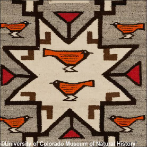
Spirit Line (Ch’ihónít’i): In late 19th-century Navajo rugs, weavers introduced a
thin, deliberate pathway of contrasting yarn extending from the central
design to the outer border. While it served to release the weaver’s
creative spirit from the pattern, it also historically chronicled the
psychological shift of adapting traditional arts to a restrictive Western
commercial market. [1]
Chronicles
of Contact:
Post-contact textiles adapted dynamically, preserving community histories
by incorporating visual data of Spanish horses, US military columns, and
trains running through native lands.
🎨 4. Personal Artistic Expressions
and Individual Agency
Despite adhering to rigorous
cultural frameworks, weavers retained profound personal expression, turning the
loom into a space for individual innovation and emotional release.
Mathematic Brilliance: Weavers did not rely on drawn sketches or written patterns. Instead, they mapped highly complex symmetrical and asymmetrical geometries entirely within their minds, dynamically calculating the tension, thread counts, and dye gradients as they worked upward from the bottom of the loom.
Creative Anomalies: Individual artists embedded subtle “signatures” within their work—such as an unexpected shift in colour block, a change in border layout, or a slight asymmetry—asserting their personal artistic voice and emotional state during the weeks or months spent on a single piece. …
The striking similarity between symbols in Afghan rugs and ancient Native American weavings is not the result of a shared, direct cosmology, but rather a combination of the physical limitations of loom technology, human psychological archetypes, and historical trade intervention. While it is beautiful to imagine an ancient, direct spiritual link, the true cross-cultural connection lies in how different humans independently solve the exact same structural and creative problems. [1, 2, 3]Here is a breakdown of why these distant cultures share nearly identical design elements.
1. Convergent Evolution and Loom MechanicsThe most powerful driver of these similarities is convergent evolution dictated by physics. When working on a traditional warp-and-weft loom, drawing smooth, curved lines is incredibly difficult because the textile is structurally built on a strict, square horizontal and vertical grid. [1, 2, 3]
The Grid Effect: Because weavers are forced to build shapes pixel-by-pixel out of square knots or threads, curves naturally become steps or jagged lines. [1, 2, 3]
Inevitable Shapes: If you try to weave a circle on a grid loom, you naturally end up with a diamond. If you try to weave a wavy line, it naturally becomes a zigzag. [1]
Universal Math: Both Afghan tribal weavers and Native American (such as Navajo) weavers used similar upright or horizontal looms, meaning the mathematics of the loom forced their hands into the exact same geometric constraints. [1, 2, 3]
2. Universal Human Archetypes (The Visual Vocabulary)Humans living in tribal, nature-dependent societies share fundamental life experiences, leading to what psychologist Carl Jung described as psychological archetypes. Because both cultures looked at the same sky, mountains, and animals, they used the exact same basic shapes to represent universal concepts: [1, 2]
Running water, life force, or protection against evil spirits
Lightning, rain clouds, or rivers
Diamonds
The “Eye” (protection from the evil eye) or fertility
Sacred spaces, specific mountains, or a woman’s womb
Triangles
Amulets or protective dog-tooth borders
Mountains, prayer plumes, or physical shelter
Crosses / Stars
The “Seal of Solomon” or celestial navigation
The four cardinal directions or morning/evening stars
3. The “Western Trader” InterventionThere is also a fascinating, direct historical connection that occurred in the late 19th and early 20th centuries. When the transcontinental railroad opened up the American Southwest, white Anglo traders like Lorenzo Hubbell and J.B. Moore set up trading posts in Navajo territory. [1, 2]
The Marketing Push: These traders realized that wealthy East Coast buyers loved the aesthetic of Caucasian, Turkish, and Persian oriental rugs, which were the height of interior design luxury at the time. [1, 2]
Exporting Patterns: The traders actively brought photos and samples of Middle Eastern and Central Asian rug patterns (such as borders, central medallions, and specific geometric latch-hook borders) to Navajo weavers. [1, 2]
The Cultural Blend: Navajo weavers adapted these imported motifs, weaving them using their own traditional techniques and infusing them with their own local spiritual meaning. This deliberate synthesis permanently blurred the lines between Middle Eastern and Native American textile designs. [1, 2]
Ultimately, the similarities are a testament to human unity. Separated by thousands of miles, human minds interacting with a structured loom will beautifully arrive at the exact same artistic destinations. …
Ancient Afghan weavings—crafted by nomadic and settled tribes such as the Turkmen, Baluch, Hazara, and Uzbeks—are far more than decorative textiles. They are sophisticated cultural manuscripts, cosmic maps, and historical archives knotted in wool. Because these societies historically relied heavily on oral traditions, the loom served as a primary visual language to encode their relationship with the universe, the divine, and their turbulent history. [1, 2, 3, 4]🌌 Deep Cosmological MapsTraditional Afghan rug structures and geometric motifs often mimic an infinite, ordered universe. [1, 2]
The Infinite Grid: The layouts of Turkmen carpets (such as Teke or Yomut) utilize a strict, repeating grid of octagonal guls (tribal emblems). This rhythmic repetition is designed to reflect cosmic infinitude and the divine balance of the universe. It mirrors the macrocosm (the heavens) within the microcosm of the domestic tent. [1, 2, 3, 4]
The Four Cardinal Directions: Many central medallions and quadrant designs partition the rug into four segments. This layout mirrors ancient Central Asian shamanic and later Islamic geocentric models, representing the four corners of the earth, the four elements, and cosmic stability. [1, 2, 3]
Celestial Geometry: The frequent inclusion of the eight-pointed star and nested circles tracks back to ancient Bactrian cosmology (found in archaeological sites like Aï Khanoum). These shapes symbolize the sun, the morning star, and the rotating celestial spheres. [1, 2, 3]
📿 Spiritual FrameworksAfghan textiles interweave centuries of layered spiritualities, seamlessly blending pre-Islamic animism, Zoroastrianism, and Buddhism with Sufi Islamic mysticism. [1, 2]
Visual Dhikr: In Sufi cosmology, the intense, repetitive process of counting and tying knots is viewed as a physical manifestation of dhikr (the repetitive remembrance of God). The weaver moves rhythmically through a pattern, translating a spiritual journey into physical form. [1]
The Tree of Life (Hayat Ağaci): Rooted in ancient Zoroastrian and Islamic paradise traditions, this motif connects the underworld, the earthly plane, and the heavens. It represents the axis mundi, fertility, and the human desire for immortality or a blissful afterlife. [1, 2, 3, 4]
The Lotus (Nilofar): A legacy of the Silk Road and Afghanistan’s rich pre-Islamic Buddhist history (most famously symbolized by the Bamiyan valley), the lotus remains embedded in regional weaving vocabularies to signify spiritual purity and rebirth. [1, 2]
Amuletic Protection: To guard against evil forces, weavers integrated geometric protective matrices. The rhombus (Zan) represents female creative energy and fertility, while stylized scorpions (Akrep), snakes, and wolf mouths (Kurt Izi) act as literal and spiritual wards to trap negative spirits within the rigid borders of the rug. [1, 2, 3, 4]
📜 Historical NarrativesWhen a major geopolitical shift occurs in Afghanistan, it is immediately registered on the loom. [1]
The Silk Road Legacy: Ancient motifs carry Achaemenid, Persian, and Mongol influences. They record centuries of trade, conquest, and ethnic integration along the world’s most famous commercial highway. [1, 2, 3, 4]
The “War Rug” Phenomenon: The most profound modern evolutionary shift occurred during the 1979 Soviet invasion. Traditional floral and geometric elements were replaced by Kalashnikovs, tanks, fighter jets, and maps of the homeland. [1, 2, 3, 4]
Cartographic Resistance: Rather than just commercial novelties, these contemporary war rugs are acts of indigenous placemaking and historical documentation. During periods of heavy censorship, illiteracy, or displacement, women recorded the trauma of foreign occupation, drone warfare, and refugee flights directly into the wool, transforming the rugs into silent historical testaments. [1, 2, 4]
🎨 Personal Artistic ExpressionsWhile tribal conventions dictating color and pattern are strict, the individual weaver always embeds her own autonomy and emotional landscape into the piece. [1, 2]
Chromative Emotional Expression: Using raw materials like pomegranate peels, madder root, and wild saffron, weavers concocted distinct dye batches. A deep, saturated red was deployed to express joy, courage, and the vibrant life force; blue was reserved for deep spirituality and fate; and yellow signified solar wisdom.
Subversive Deviations: Look closely at an antique Afghan weaving and you will often find intentional asymmetries, sudden color shifts (abrash), or a single misplaced symbol. These are highly personal signatures. Sometimes they were humble nods to the weavers’ belief that “only God is perfect,” but often they reflected a sudden life event—a mourning period, a marriage, a drought, or a personal prayer whispered directly into the loom. [1, 2, 3, 4, 5]’