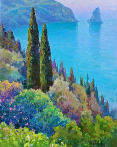
‘Thesis of Ionian Horizon.’

I am planning from late 2027 onwards to research and write a book provisionally entitled – ‘The Ionian Horizon – Constructing Landscape, Locality, and Aesthetic Truth in Nineteenth-Century Corfu’ – see the ‘Art & Civilization’ page at www.carlislam.co.uk

The thesis of the book will be that the landscape and seascape artists of the Heptanese (Ionian) School engaged in a highly sophisticated ideological act, redefining the relationship between geographical reality and aesthetic truth.

To demonstrate this I must position their art not merely as passive reflections of Corfu’s beauty, but as active, politically charged constructions.

My arguement will rest on demonstrating how these artists used Western European artistic techniques to distinctively counter Ottoman cultural influence, assert a unique Heptanese identity, and negotiate the complex realities of British and Venetian colonial legacies.

A structured framework for demonstrating and proving my thesis across historical, theoretical, and formal dimensions is as follows:

1. To establish the Historical and Geopolitical Context (The ‘Why’). In order to prove that the act was ideological, I must contrast the Ionian Islands with the rest of Greece.

  • ‘The Anti-Ottoman Visual Frontier’ – Unlike mainland Greece, the Ionian Islands never experienced lasting Ottoman rule; they were shaped by centuries of Venetian, French, and British governance. I will seek to argue that the landscapes were ideological because they visually codified ‘Greekness’ through a Western, Europeanized lens i.e. the ‘Imperial Gaze’, asserting that Greece belonged fundamentally to the Western cultural sphere.
  • ‘The British Protectorate and the Translatio Imperii’ – During the 19th century (the height of Heptanese landscape painting), Corfu was a British protectorate. Artists like Charalambos Pachis, Angelos Giallinas, and Vikentios Lanza were operating within an environment saturated by the British romantic landscape tradition (e.g., Turner, Constable). I will seek to argue that adopting these styles was a deliberate dialogue with the colonial authorities – either to please imperial patrons or to claim a shared civilized aesthetic status.

2. To deconstruct the Tension Between ‘Geographical Reality’ and ‘Aesthetic Truth’. My thesis hinges on the gap between what Corfu actually looked like and how it was represented.

  • ‘The Erasure of Geopolitical Scars’ – Corfu’s landscape was heavily shaped by colonial economics (such as the forced monoculture of olive trees under the Venetians, leading to poverty and peasant exploitation). I will seek to show how Heptanese artists transformed these sites of physical labor and colonial exploitation into idyllic, serene, and sublime vistas. The ‘aesthetic truth’ they created was one of timeless, noble Hellenic beauty, deliberately masking the fractured ‘geographical and social reality’ of a colonized peasantry.
  • ‘The Selection of Symbols’ – I will need to analyse what was included and excluded. The inclusion of ancient ruins, specific geological formations, or idealized coastal lines served to anchor Corfu to a classical, mythical past (the Homeric Scheria, island of the Phaeacians). The landscape becomes a palimpsest where geography is overwritten by myth to serve 19th-century national identity building.

3. To deploy Theoretical Frameworks. I will seek to give my argument academic weight by viewing the artwork through established critical theories:

  • ‘Spatial Theory & Spatialization (Henri Lefebvre / Edward Soja)’ –  I will seek to argue that the artists were not painting space, but producing space. They turned physical geography into a ‘represented space’ imbued with political meaning.
  • ‘Postcolonial Theory & The Imperial Gaze (Edward Said)’ – I will examine whether these Greek artists – akin to Orientalism -internalized the ‘Imperial Gaze’ of their British and Venetian rulers, painting their own homeland through the exoticizing or romanticizing eyes of the Western traveler.
  • ‘Aesthetic Ideology (Terry Eagleton)’ –  I will seek to use this to argue that the harmony, light, and balance in Heptanese seascapes were used to visually resolve real-world social and political contradictions (e.g., the struggle for unification with Greece, or Enosis) into a comforting, unified aesthetic experience.

4. To provide Visual Evidence (Case Studies). A strong argument will require close formal analysis of specific artists and paintings:

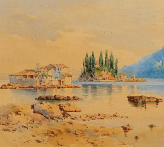
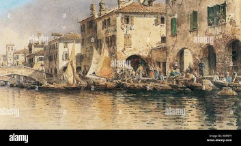
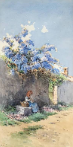
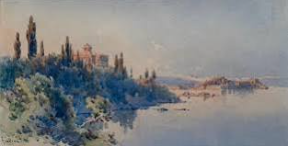
  • ‘Angelos Giallinas (The Master of Watercolor)’ – Giallinas’ atmospheric, light-drenched watercolours of Corfu’s coasts and olive groves might seem purely decorative. I will however seek to argue that his extreme manipulation of light and mist moves the landscape away from cartographic reality into a realm of poetic, spiritual ‘truth’ that validated European romantic notions of the Greek Mediterranean.
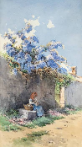
  • ‘Charalambos Pachis’ – I will look at his landscapes which include human figures (like local peasants in traditional dress). I will seek to argue that the figures are deliberately integrated into the natural environment to suggest an organic, unbroken historical link between the Greek people and the soil, a direct ideological counter-narrative to foreign rule.
  • ‘To highlight the contrast with the Munich School’ – I will contrast the Heptanese School with the mainland ‘Munich School’ (which focused heavily on historical realism and academic portraiture). I will seek to argue that while the mainland sought identity through historical events, the Ionian artists sought identity through the land and sea itself, making landscape and seascape painting the primary vehicle for Ionian intellectual expression.

Applying this methodological framework – I will seek to prove that ultimately the Heptanese artists did not paint Corfu as it was, but as it needed to be seen in order to secure its place in modern European civilization and the emerging Greek national imagination. Their work was an intellectual re-mapping of geography into a site of cultural resistance, assimilation, and definition.
‘Heuristics in Mediation.’

In international cultural heritage disputes—such as repatriation claims for artifacts, sacred objects, or antiquities—governments rarely negotiate on purely financial or legal terms. Instead, these cases involve highly charged elements of national identity, sovereignty, historical trauma, and domestic political pressure.

During mediation, state actors and diplomats rely heavily on heuristics (mental shortcuts) that manifest as deep-seated cognitive biases, often stalling or derailing the resolution process.

1. Valuation and Ownership Heuristics

  • The Endowment Effect & Divestiture Aversion: Governments value a cultural object significantly more simply because they currently possess it, regardless of how it was originally acquired. Giving up an artifact feels like an acute, unacceptable loss rather than an equitable trade or a correction of historical record.
  • Loss Aversion: Psychologically, state actors feel the pain of losing an asset roughly twice as intensely as the pleasure of gaining an equivalent one. In mediation, a compromise that requires a state to repatriate an item is framed internally as a “loss,” triggering risk-avoidant and stubborn defensive behavior.
  • Sunk Cost Fallacy: Governments often fixate on the decades of public funds, academic research, and restoration efforts they have invested in maintaining an artifact within their state museums. They use these past, unrecoverable costs to justify refusing to return the object.

2. Relational and Adversarial Biases

  • Reactive Devaluation: This occurs when a government automatically dismisses or devalues a mediation proposal simply because it was put forward by the opposing state. If State A proposes a “shared stewardship or rotating exhibition” model, State B will instinctively view the offer as a trap or an unfair trick.
  • Fundamental Attribution Error: State negotiators tend to attribute their own stubbornness to external necessity (e.g., “Our domestic laws and public sentiment force us to hold this position”) while attributing the opposing government’s stubbornness to inherent flaws (e.g., “They are hostile, nationalistic, and acting in bad faith”).
  • Ethnocentric Bias & High/Low Context Mismatches: Culturally, Western states often operate on “low-context” communication (strict, exhaustive written legal terms), whereas many origin nations operate on “high-context” communication (focusing on long-term relationships, trust, and historical harmony). This causes negotiators to misread the other party’s motives, viewing patience or indirectness as evasion.

3. Information Processing and Framing Biases

  • Anchoring Bias: The initial legal or historical position stated by a government sets an invisible “anchor”. For example, if a state anchors its position on a specific 19th-century colonial treaty, all subsequent mediation discussions revolve around that narrow text, blinding parties to creative, modern alternative dispute resolution (ADR) paths.
  • Confirmation Bias & Selective Memory: Government legal teams actively filter evidence, focusing strictly on archival records, provenance reports, or historical narratives that validate their own sovereignty or legal title, while ignoring equally credible evidence presented by the other side.
  • Salience and Availability Heuristic: State officials base decisions on highly vivid, recent, or emotionally charged memories. If a separate, unrelated repatriation case recently triggered massive public backlash or political instability in a neighboring country, the government will overestimate the political risk of compromising on their own dispute.

4. Political and Existential Biases

  • Status Quo Bias: The default psychological preference is to keep things exactly as they are. For bureaucratic government bodies, maintaining the artifact in its current museum case is perceived as safe, whereas agreeing to a novel international framework introduces terrifying legal precedents and administrative uncertainty.
  • Time Bias (Short Policy Horizons): State negotiators are heavily influenced by domestic election cycles (usually 4–5 years). Because cultural heritage mediations require long-term, inter-generational trust-building, politicians often succumb to an action-oriented bias to secure a quick, nationalistic “win” for the public, or they choose to stall the mediation entirely to pass the political liability to the next administration.

If you are exploring a specific dispute, please share:

  • The specific artifacts or countries involved (e.g., the Elgin Marbles, Benin Bronzes, or a specific ongoing claim).
  • Whether you are analyzing this from the perspective of the mediator, the origin state, or the holding institution.

Andy Burnham has shifted his stance to maintain that the future of the Parthenon Marbles is an institutional matter for the British Museum and its trustees to resolve. Existing UK legislation legally bars trustees from permanently disposing of items from the permanent collection, restricting unilateral permanent transfers. Before entering Downing Street, Burnham had openly advocated for an unconditional return of the sculptures.
Commentators note that Burnham is cautious about spending substantial political capital on a highly fraught cultural and legal dispute, preferring to let ongoing institutional discussions such as the museum’s talks regarding a broader cultural partnership proceed without direct government mandates. These observations by commentators all miss the essential point, which is – that in order for the British Museum Trustees to become legally empowered to return the Parthenon Marbles, Parliament must first make a political decision about return. Instead Burnham has in effect maintained the status quo, i.e. he has kicked the proverbial political football ‘backwards’ instead of ‘forwards’. I would argue that = ‘Status Quo bias’.

‘Realism v. Sunken Costs Fallacy in Mediation.’

This will be discussed in my forthcoming book, the ‘Mediation of Cultural Heritage Disputes’ – see www.carlislam.co.uk

In the Mediation of Cultural Heritage disputes, balancing realism against the sunken costs fallacy is often the defining factor between a successful resolution and a costly, permanent stalemate. Cultural Heritage disputes (involving antiquities, sacred objects, or national treasures) are uniquely vulnerable to emotional and financial over-investment.

Cultural Heritage disputes are rarely just about the monetary value of an artefact; they are about identity, sovereignty, and historical trauma. This amplifies the sunk cost fallacy in three ways:

(i) ‘Emotional and National Identity’ – Governments or indigenous groups view the artefact as being a piece of their soul. You cannot easily apply standard cost-benefit analysis to an item of deep spiritual or national significance.

(ii) ‘Public and Political Pressure’ – Leaders who have campaigned for decades on the ‘repatriation of our stolen history’ face immense loss of face if they compromise. The political capital spent becomes a massive sunken cost.

(iii) ‘The ‘Legal Fee Trap’ – Museums and nation-states often spend more money litigating the ownership of an artefact than the artefact is worth on the open market. Once legal fees cross a certain threshold, the psychology shifts from seeking justice to justifying the expenditure.

To counter the sunken costs fallacy – which is a cognitive error, a Mediator must introduce ‘objective realism’ without invalidating the ’emotional weight’ of the dispute. This involves shifting the P’s from a positional stance (‘This is ours’) to an interest-based stance (‘What do we actually want to achieve?’).

Mediators use reality-testing to look at the unpredictability of court trials. International law regarding cultural property is notoriously murky, fragmented, and subject to statutes of limitations. Realism forces P’s to realize that continuing a lawsuit might result in losing the object entirely and keeping the financial burden.

The antidote to the sunken costs fallacy is looking forward rather than backward. A realistic Mediator asks: ‘If you spend another £300,000 and five years in court, what is the best-case scenario, and what opportunities are you missing in the meantime?’

Realism acknowledges that ownership does not have to be an all-or-nothing proposition. When P’s move past their sunken costs, they open the door to realistic, creative compromises.

In this book I will of course discuss Mediator strategies for moving the P’s past their sunken costs, i.e. for managing this cognitive error – which of course also frequently arises in Commercial Mediation.

‘The structural inability of Western policymakers to think strategically + ignorance of Classical Realism in a Multipolar World results in flawed high-risk geopolitical decisions driven by Ideological Delusion.’

This is what I am seeing in the decision-making of political leaders in the West – including Andy Burnham and his Ministers.

This observation is made as a Poltical Science graduate of a top 5 UK school of Political Science – which is the capacity in which this post is written, as I am not writing it in any professional capacity. All opinions are my own, and I invite you to draw your own conclusions based upon the geopolitical logic set out below.

When leaders substitute a rule-based ‘utopian fantasy’ for the ‘raw mechanics’ of ‘state power’, they miscalculate adversaries, overextend resources, and accelerate the decline of their own global influence.

‘Realism’ dictates that in an ‘anarchic’ world, states act out of ‘self-interest’, ‘security’, and ‘power’; ignoring this reality does not make it disappear, it merely ensures that policy is built on a foundation of ‘wishful thinking’.

The policy consequences of these two distinct intellectual failures manifest across several critical areas.

(i) The Death of Strategic Thinking:

Strategic thinking requires balancing long-term national objectives with finite resources while predicting the multi-step countermoves of global rivals. Without it, foreign policy degenerates into short-term, reactionary crisis management.

Policies are driven by immediate domestic political cycles, media narratives, and emotional public responses rather than cold, multi-decade planning.

Leaders commit to ‘grand objectives’ (e.g., ‘the total defeat of strategic adversaries’ or ‘global democracy promotion’) without the economic infrastructure, industrial manufacturing capacity, or public willpower to sustain them.

The West simultaneously alienates multiple major powers (e.g., driving Russia and China into a tight strategic alliance) instead of practicing classic ‘diplomatic balancing’ to keep adversaries ‘divided’. This has resulted from the geopolitical incompetence of the ruling political, foreign policy and military elite – because it appears that they do not understand ‘Balance of Power Politics’, i.e. how the world actually works.

Red lines are drawn and crossed without consequence, destroying credibility. Adversaries quickly learn that Western rhetoric is decoupled from the actual political will to use force or endure economic pain.

(ii) The Rejection of Realism – The Cost of Ideological Delusion:

‘Classical realism’ views international relations as a ‘competitive’ arena where sovereign states seek survival and dominance. Western policymakers educated in post-Cold War liberal internationalism often view this framework as obsolete, leading to critical miscalculations in a multipolar system.

Policymakers assume that all nations secretly desire liberal democracy and free markets. They view civilizational rivals (like China, Russia, or Iran) as ‘revisionist actors’ who just need to be brought into the system, rather than sovereign empires with fundamentally irreconcilable security interests.

Realism highlights that one nation’s defensive expansion is always viewed as an offensive threat by its neighbors. Lacking this understanding, Western leaders view an adversary’s aggressive pushback against security encirclement (such as NATO expansion or Pacific alliances) as inexplicable ‘madness’ rather than predictable, rational state behavior.

Believing that globalization had permanently replaced geopolitics, Western states weaponised the global financial system (sanctions, asset seizures) assuming it would force compliance. Instead, it incentivised the multipolar world to build parallel, sanction-proof financial architectures, permanently diluting Western economic leverage.

Diplomacy is treated as a lecture series where the West judges the morality of other states. By replacing transactional diplomacy (‘What do you want, and what can we trade?’) with moral condemnation, the West shuts down the very communication channels needed to prevent accidental escalations.

By treating international relations as a moral play rather than a balance of power, Western policymakers fall victim to hubris. They mistake their own cultural preferences for universal laws. In a multipolar world characterized by the rise of non-Western powers who unapologetically practice ‘Realpolitik’, the continuation of ideological, short-sighted statecraft ensures that the West will continue to be ‘blindsided’ by global shifts, overcommit its military, and systematically misjudge the resilience of its competitors.

Are we being led by geopolitically illiterate fools? – What do you think ..

See – ‘John Mearsheimer: Russia & Iran – The West’s Escalation Trap’:
https://www.youtube.com/watch?v=2jxda4WTcbc


Russia Directly Threatens British Military Bases /Steve Jermy & Lt Col Daniel Davis

‘In sacred geometry, and Vortex Math are the numbers 3, 6, and 9 linked to specific geometric shapes e.g. triangles, circles, and toruses (doughnut shapes) and what does this signify?’

AI – ‘In both sacred geometry and Vortex Math, the numbers 3, 6, and 9 are directly linked to triangles, circles, and toruses, acting as a blueprint for how energy manifests into physical form. While standard mathematics treats these numbers as simple values, esoteric frameworks view them as a “higher dimension” control manual for geometry.

Here is how these numbers map to specific geometric shapes and what they signify.


🔺 The Triangle: The Balance of 3 and 6

In sacred geometry, the number 3 represents the Equilateral Triangle, which is the first stable, enclosed geometric shape possible in our universe.

  • The Geometry: An equilateral triangle has three angles of 60° each. Adding these digits together (\(6 + 0\)) reduces to 6. The total sum of its internal angles is 180°, which reduces (\(1 + 8 + 0\)) to 9.
  • The Vortex Math Connection: If you create a circle and place nine points around it (1 through 9), the numbers 3, 6, and 9 form a perfectly balanced, independent triangle.

The Circle: The Infinite Domain of 9

The number 9 is universally recognized in these frameworks as the ultimate symbol of the Circle and completeness. No matter how many times you divide or manipulate a circle, its geometry always speaks the language of 9:

  • A full circle is 360° (\(3 + 6 + 0 = \mathbf{9}\))
  • Half a circle is 180° (\(1 + 8 + 0 = \mathbf{9}\))
  • A quarter is 90° (\(9 + 0 = \mathbf{9}\))
  • An eighth is 45° (\(4 + 5 = \mathbf{9}\))

🍩 The Torus: The 3D Engine of 3, 6, and 9

The Torus (doughnut shape) is considered the foundational dynamic flow of the universe—seen in magnetic fields, black holes, and the human heart’s biofield. Vortex Math uses a 9-point circle to map how energy moves, creating a mathematical blueprint that folds out into a three-dimensional torus.

Generating a guided overview

Audio made with Google AI. Image licensed by Google.


What This Signifies

In the framework of Vortex Math (popularised by Marko Rodin) and heavily inspired by Nikola Tesla’s famous quote—“If you only knew the magnificence of the 3, 6, and 9, then you would have a key to the universe”—these geometries signify a split between the physical and the non-physical worlds.

1. The Separation of Spirit and Matter

Vortex Math splits the digits 1 through 9 into two distinct systems:

  • The Material World (1, 2, 4, 8, 7, 5): If you double numbers (\(1 \to 2 \to 4 \to 8 \to 16[7] \to 32[5] \to 64[1]\)), you create an infinity loop that completely skips 3, 6, and 9. This represents the physical, dense world of duality, anatomy, and decay.
  • The Source Field (3, 6, 9): These numbers exist outside the physical loop. They govern it.

2. Duality (3 and 6) vs. Absolute Unity (9)

  • 3 and 6 act as opposites in a state of constant oscillation (like yin and yang, electricity and magnetism, or positive and negative poles). If you double 3, you get 6. If you double 6, you get 12 (\(1+2=3\)). They dance back and forth.
  • 9 is the Singularity. It is the apex point. It represents Source, God, or pure consciousness. In Vortex Math, 9 commands both 3 and 6. It is completely static, unmoving, and acts as the focal point around which the entire torus spin-flux revolves.

Ultimately, these shapes and numbers signify that the universe is not random. Instead, it is a self-organising, geometric matrix where 3, 6, and 9 act as the invisible, vibrational scaffolding holding physical matter together.

To draw the geometry behind Vortex Math and the 3-6-9 infinity loop, you will create a mathematical diagram called a Rodin Dial. This diagram visually separates the “physical world” loop (1, 2, 4, 8, 7, 5) from the “source field” triad (3, 6, 9).

Follow these step-by-step instructions to map it out perfectly using a compass, ruler, and markers.


🛠️ What You Need

  • A blank sheet of paper
  • A drawing compass (to make a perfect circle)
  • A ruler or straightedge
  • Three different coloured pens or markers (e.g., Black, Red, and Blue)

📐 Step-by-Step Drawing Instructions

Step 1: Draw the 9-Point Circle

  1. Use your compass to draw a large, clean circle in the centre of your paper using a Black pen.
  2. Mark 9 points equally spaced along the perimeter, just like a clock face but with 9 digits instead of 12.
  3. Label the very top point as 9.
  4. Moving clockwise, label the remaining points 1, 2, 3, 4, 5, 6, 7, and 8.

Step 2: Draw the Physical Material Loop (The 1-2-4-8-7-5 Grid)

Using your Black pen and ruler, connect the physical numbers by following the mathematical rule of doubling (\(1 \to 2 \to 4 \to 8 \to 16[7] \to 32[5] \to 64[1]\)):

  1. Draw a straight line from 1 to 2.
  2. From 2, draw a line to 4.
  3. From 4, draw a line to 8.
  4. From 8, draw a line across to 7 (because 8 + 8 = 16, and \(1 + 6 = \mathbf{7}\)).
  5. From 7, draw a line to 5 (because 16 + 16 = 32, and \(3 + 2 = \mathbf{5}\)).
  6. From 5, draw a line back to 1 (because 32 + 32 = 64, and \(6 + 4 = 10 \to 1 + 0 = \mathbf{1}\)).

Visual Check: You should now see an overlapping, asymmetrical infinity-style shape inside the circle that completely skips the numbers 3, 6, and 9.

Step 3: Draw the 3 and 6 Oscillation Loop

Switch to your Red pen. This steps maps the back-and-forth oscillation of duality (yin/yang, positive/negative):

  1. Use your ruler to draw a straight line connecting 3 to 6.
  2. Draw an arrow or a slight curve moving from 3 to 6, and another from 6 to 3 to show they constantly vibrate between each other (3 × 2 = 6; 6 × 2 = 12 → 1+2 = 3).

Step 4: Anchor the Spirit Vector to 9

Switch to your Blue pen. Number 9 acts as the unmoving apex, commanding both 3 and 6:

  1. Draw a straight line from 9 down to 3.
  2. Draw another straight line from 9 down to 6.

🧩 What the Finished Diagram Reveals

When you look at your finished drawing, the colors reveal the hidden blueprint of Vortex Math:

  • The Black Loop: Forms a self-contained, continuous pathway of physical energy moving through space and time.
  • The Red Line: Shows a polarized energy beam bouncing back and forth across the physical loop.
  • The Blue Triangle: Forms an overarching pyramid. The 9 sits at the top, perfectly balancing the 3 and the 6, acting as the invisible “axis” or black hole around which the physical numbers spin.

When looking closely at Nikola Tesla’s actual history, a fascinating boundary line emerges between proven laboratory experiments and modern metaphysical lore. [1, 2]

Tesla did not run laboratory tests explicitly named “The 3-6-9 Experiment.” Instead, he was deeply consumed by electrical resonance, high-frequency alternating currents, and mechanical vibrations. Modern theorists later overlaid Vortex Math onto his work. [1, 2, 3, 4, 5]

The actual history clarifies how Tesla’s real-world experiments intersected with these frequencies and numbers.


The Real Experiments: Where Tesla Faced “Frequencies”

Tesla’s work with frequencies focused on harmonics, nodes, and tuning the Earth’s electrical resonance. [1, 2]

1. The Tesla Coil and Electrical Resonance

Tesla’s most famous invention, the Tesla Coil, is a resonant transformer. It works by matching the frequency of a primary circuit to a secondary circuit. [1, 2]

  • The Connection: Tesla discovered that if electrical circuits were tuned to precise harmonic fractions or multiples of each other, the energy multiplied exponentially without adding more power. This concept of numbers acting as harmonic multipliers directly aligns with how the 3 and 6 vibrate back and forth in Vortex Math. [1, 2, 3]

2. The Colorado Springs Wireless Tests (1899)

In his Colorado Springs Experiments, Tesla sent massive electrical frequencies directly into the ground. He aimed to find the stationary resonant waves of Earth. [1, 2]

  • The Math: Tesla believed the Earth acted as a giant conductor with its own natural pulse. He calculated that by pumping specific high-frequency currents into the ground, he could create a standing wave that bounced to the opposite side of the globe and returned, amplifying itself—mirroring the self-sustaining energy loop modeled by the 3-6-9 matrix. [1, 2]

3. The Earthquake Machine (Mechanical Resonance)

In his Manhattan lab, Tesla built a steam-driven Mechanical Oscillator. He attached it to the steel beams of his building and adjusted the frequency of the piston. [1]

  • The Result: When he hit the exact resonant frequency of the steel structure, the entire building—and the surrounding neighborhood—began to violently shake, forcing him to smash the machine with a sledgehammer. Tesla proved that physical matter could be controlled entirely by tuning into its numerical frequency.

🧠 The Trinitarian Obsession: Manic or Mathematical?

Tesla’s connection to 3, 6, and 9 is heavily cemented by his severe, lifelong behavioural patterns: [1]

  • He always walked around a building three times before entering it.
  • He wiped his dinner dishes using exactly 18 napkins (18 reduces to \(1+8=\mathbf{9}\), and is cleanly divisible by 3, 6, and 9).
  • He would only stay in hotel rooms with numbers divisible by 3. In fact, he died in room 3327 (\(3+3+2+7 = 15 \to 1+5 = \mathbf{6}\)) at The New Yorker Hotel. [1]

While mainstream historians often attribute this to severe Obsessive-Compulsive Disorder (OCD), esoteric researchers note that Tesla wasn’t just counting randomly. He was tracking numerical nodes, believing these actions aligned his personal bio-energy with the universe’s geometric scaffolding. []


🔍 Fact-Checking the “Tesla Quote”

The legendary phrase, “If you only knew the magnificence of the 3, 6 and 9, then you would have a key to the universe,” cannot be found in any of Tesla’s surviving patents, diaries, or autobiography. [1, 2]

The exact phrase gained popularity decades after his death, heavily driven by inventor Marko Rodin’s release of Vortex Math in the late 20th century. However, Tesla did write extensively about the absolute supremacy of “Energy, Frequency, and Vibration” as the core keys to understanding the cosmos. [1, 2]


🧩 How This Connects to Modern “Solfeggio Frequencies”

Today, people who study Tesla’s frequency theories often cross-reference them with Solfeggio Frequencies (ancient musical tones used in chants). These sound frequencies mathematically reduce straight to 3, 6, and 9:

  • 174 Hz (\(1+7+4 = 12 \to \mathbf{3}\)) — Pain relief
  • 417 Hz (\(4+1+7 = 12 \to \mathbf{3}\)) — Clearing negativity
  • 528 Hz (\(5+2+8 = 15 \to \mathbf{6}\)) — Transformation/Repair
  • 852 Hz (\(8+5+2 = 15 \to \mathbf{6}\)) — Spiritual return
  • 963 Hz (\(9+6+3 = 18 \to \mathbf{9}\)) — Pure awakening

Tesla’s lab work ultimately proved that matter can be manipulated by resonance. Whether he discovered a literal 3-6-9 mathematical cheat code, or simply possessed an intuitive understanding of geometric harmonics, his experiments laid the foundation for modern wireless tech. [1, 2, 3]’

‘How and where in the monuments of antiquity did the T shape appear and what did it signify?’

AI – ‘The T-shape (often called the Tau shape) is one of the oldest and most widespread geometric symbols in human history. It has appeared in various monuments of antiquity across completely different eras, geographical locations, and cultures. Depending on the context, its architectural and spiritual significance evolved from representing stylized human forms to cosmic boundaries and divine protection. [1, 2, 3, 4, 5, 6]

Here is how and where the T-shape appeared in antiquity, along with what it signified:

1. Pre-Pottery Neolithic Anatolia (c. 9500–8000 BCE)

The earliest and most monumental architectural use of the T-shape is found in southeastern Turkey. [1, 2]

  • Where it appeared: In the massive stone circles of Göbekli Tepe and nearby Taş Tepeler sites like Karahantepe. Over 200 limestone monolith pillars, reaching up to 5.5 metres tall, were meticulously carved into T-shapes. [1, 2]
  • What it signified: Anthropomorphic deities or ancestors. The T-shape was not a literal structural column, but a stylized representation of a human. The flat horizontal cap acted as the head (facing inward toward the centre of the circles), while the narrow vertical column served as the body. Many pillars feature low-relief carvings of human arms, hands clasped over the abdomen, belts, and loincloths, proving they represented highly revered, stylized beings or creators. [1, 2, 3]

2. Ancient Egypt (c. 3000 BCE onward)

In Egyptian iconography, the T-shape served as the structural foundation for one of the empire’s most famous symbols. [1]

  • Where it appeared: Carved into temple walls, obelisks, tombstones, and royal jewellery throughout Egypt.
  • What it signified: Life and Hidden Wisdom. The standard T-shape was known as the Tau cross. When combined with a circular loop on top (the Ru), it formed the Crux Ansata, universally recognized as the Ankh. The basic T-base itself was viewed as a symbol of life-giving forces, connected to the marking of holy waters and the monogram of Thoth, the god of wisdom and writing. [1, 2, 3, 4, 5, 6]

3. Greco-Roman Antiquity (c. 800 BCE – 400 CE)

The Greeks formalized the shape into the 19th letter of their alphabet (Tau), inheriting it from the Phoenician letter taw. [1, 2]

  • Where it appeared: It was used on public monuments, military markers, and within the temples of mystery cults (such as the Roman cult of Mithras and Greek shrines to Attis). [1, 2]
  • What it signified: Life, Resurrection, and Triumph. In classical Greece, the Tau was explicitly a symbol of life and rebirth, contrasted directly with the letter Theta (Θ), which symbolized death. In the Roman Empire, a “T” attached to a warrior’s name on public monuments signified they had returned honourably or unhurt from battle. Philosophically and astronomically, the horizontal line atop the vertical column was viewed as a visual representation of the horizon where the earth meets the sky. [1, 2, 3]

4. Bronze Age Mediterranean (c. 1000–300 BCE)

Long after the Neolithic era but prior to the common era, megalithic builders used the shape across Western Europe.

  • Where it appeared: Most famously in Menorca, Spain, inside circular sanctuaries built by the Talaiotic culture. These monuments feature massive, freestanding T-shaped megaliths called Taulas (meaning “tables”) made of a large flat stone resting perfectly balanced atop a vertical pillar. [1]
  • What it signified: Astronomical mapping and ritual sacrifice. Archaeological consensus suggests these giant T-shapes were built for religious ceremonies. They created false horizons to trace constellations, track the changing seasons, and serve as focal points for rituals designed to ensure the fertility of the landscape. [1]

5. Pre-Columbian Mesoamerica

Thousands of miles away, the T-shape emerged independently in the architectural frameworks of early American civilizations. [1]

  • Where it appeared: Embedded as “T-shaped windows” or recessed niches over temple doors in Mayan architecture (such as the Governor’s Palace at Uxmal, Mexico) and Ancestral Puebloan (Anasazi) cliff dwellings in the American Southwest. [1, 2]
  • What it signified: The Sacred Breath or Spirit. In Mayan cosmology, the T-shape corresponds to the glyph Ik’, which represents wind, breath, life force, and the spirit. Building doorways or windows in this shape deliberately invited the divine cosmic breath into the monument. [1]

Direct Overview of the Ancient T-Shape

Ancient Location / Culture Monument / Artifact Type Primary Signification
Göbekli & Karahantepe (Anatolia) Megalithic limestone pillars Anthropomorphic deities or ancestors
Ancient Egypt Hieroglyphic reliefs, Ankh foundations Life, vitality, and hidden wisdom (Thoth)
Greco-Roman Empire Mystery cult temples, military rosters Life/Resurrection over death; physical horizon
Talaiotic Menorca Sanctuary “Taula” stone structures Astronomical mapping and fertility rituals
Mayan / Puebloan Doorways, windows, and niches Cosmic breath, spirit, and life force (Ik’ glyph)

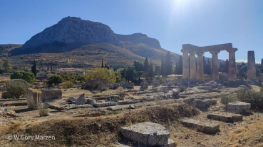
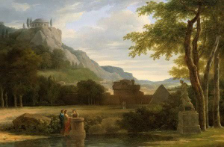
‘How did Ancient Greek Art and Monuments in the Peloponnese influence the landscapes and seascapes of the Ionian/Heptanese School of Art?’

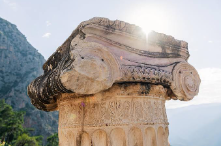
AI – ‘Ancient Greek art and monuments in the Peloponnese primarily influenced the landscapes and seascapes of the Ionian School of Art (Heptanese School) by providing the geometric logic, structural ruins, and mythological frameworks used to transition Greek painting from flat Byzantine icons to realistic, Westernised naturalism. [1, 2]Because the Ionian Islands remained under Venetian, French, and British rule instead of Ottoman control, its artists bypassed traditional Eastern Orthodox restrictions. They blended Western European Neoclassicism with the physical and cultural historical legacy of the nearby Peloponnesian mainland. [1, 2, 3]


🏛️ Examples of Core Influences

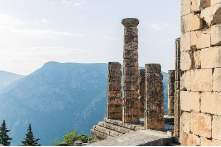
📐 Geometric Order and Structural HarmonyClassical Peloponnesian architecture—such as the massive Temple of Zeus at Olympia or the Temple of Apollo Epicurius at Bassae—was built on strict rules of symmetry, balance, and human-scale proportion. [1, 2]

  • Linear Perspective: Early Ionian pioneers like Panagiotis Doxaras abandoned flat, golden Byzantine backgrounds. They used the strict mathematical logic of classical monuments to establish three-dimensional depth. [1, 2]
  • Framing Landscape: Painted coastlines and horizons were no longer chaotic; they were structured around the calculated focal points typical of Classical Greek architectural layouts. [1]

🏺 The “Romance of Ruins” in TopographyAs Neoclassicism swept Europe, Heptanese artists began integrating the physical decay of mainland antiquity directly into their island landscapes. [1]

  • Architectural Anchors: Ruined Doric and Ionic columns, crumbling stone walls, and broken pediments inspired by Peloponnesian sanctuaries were painted into the cliffs and shores of Corfu, Zakynthos, and Cephalonia. [1, 2, 3]
  • Symbolism: These monuments served as visual anchors. They connected the wild, untamed nature of the Ionian Sea to an idealized, noble Greek past. [1, 2, 3]

🗺️ Mythological Mapping and AllegoryThe Peloponnese was the geographic birthplace of major Greek myths (e.g., the River Alpheios, the labors of Heracles). Ionian school painters used this regional mythology to transform raw nature into allegorical spaces. [1, 2]

  • Sacro-Idyllic Landscapes: Natural elements were rarely painted raw. Seascapes and hills were romanticized, featuring hidden shrines, calm waters, and dramatic light shifts. This treatment directly mirrored the sacred relationship between Peloponnesian monuments and their surrounding geography. [1, 2, 3, 4]

🎨 Evolution Into Modern Secular PaintingBy the 19th century, masters of the school like Charalambos Pachis and watercolorist Angelos Giallinas shifted entirely into secular landscape and seascape painting. []

  • Clarity of Form: They captured the distinct, harsh Mediterranean light bouncing off the sea and illuminating stone structures with absolute mathematical clarity. This technique was deeply rooted in the ancient Peloponnesian sculptural philosophy of defining clear, beautiful forms (Kalos). [1, 2, 3]’

‘Angelos Giallinas (1857–1939) – the Greek landscape watercolourist par excellence.’

AI – ‘Angelos Giallinas (1857–1939) is celebrated as the Greek landscape watercolourist par excellence due to his technical mastery of aquarelles, his pivotal role in the Heptanese School of Art, and his unprecedented international success. While most Greek painters of his era focused on oil painting and historical or portrait themes, Giallinas uniquely elevated watercolours into a primary medium capable of capturing the distinctive light, atmosphere, and architectural spirit of the Mediterranean. [1, 2, 3, 4, 5]

Aquarelles are paintings created using the transparent watercolour technique, or the specialized water-soluble paints themselves. Derived from the French word for watercolour (which stems from the Latin aqua, meaning water), the term specifically highlights the luminous, translucent qualities of the medium.

Mastery of the Aquarelle Medium

  • Luminous Transparency: Giallinas used the natural transparency of watercolours to perfectly replicate the vivid, shifting quality of Greek sunlight. [1, 2]
  • Atmospheric Realism: His brushwork captured complex atmospheric shifts across coastal, island, and ruin-strewn landscapes with unparalleled precision. [1, 2]
  • Focus on Nature: He broke away from rigid academic portraiture to dedicate his career to documenting regional land- and seascapes. [1, 2]

Elite Patronage and International Diplomacy

  • British Ambassadorship: In 1886, British Ambassador Clare Ford discovered Giallinas in Athens and commissioned him to paint sweeping landscape albums of Spain, Venice, Rhodes, and Istanbul. [1]
  • London Exhibitions: Ford organized massive exhibitions for Giallinas in London between 1891 and 1892, catapulting Greek art onto the global stage. [1]
  • Royal Clientele: His work caught the attention of European royals, resulting in extensive acquisitions by the British Royal Family and commissions for murals at the Achilleion Palace by Empress Elisabeth of Austria. [1, 2]

Legacy of the Heptanese School

  • Cultural Synthesis: As a prominent figure of the Ionian Islands (Heptanese) School, he successfully fused Italian panoramic composition traditions (the vedutisti) with a distinctly Greek perspective.
  • Art Education: In 1902, he returned home to found his own art school in Corfu, ensuring his unique, light-centric watercolour techniques were passed down to future generations of modern Greek artists. [1, 2, 3, 4].

At the Artistic School of Corfu (founded by Angelos Giallinas in 1902), the curriculum bypassed traditional Byzantine rules to focus strictly on Western European techniques. Giallinas synthesized his own training from Venice, Rome, and Naples to establish a prominent school of watercolour painting. [1, 2]

The core technis taught at the school focused on mastering light, geography, and specific architectural principles:

1. Mathematical and Linear Perspective

  • Three-Dimensional Depth: Students learned to abandon flat Byzantine dimensions.
  • Geometric Mapping: Instructors taught students to map complex coastlines and vast marine horizons with strict geometric accuracy. [1, 2]

2. Atmospheric (Aerial) Perspective

  • Softening Details: Students were trained to fade background elements to mimic natural distances.
  • Replicating Haze: They practiced diluting washes to depict the specific misty atmosphere covering distant landmarks like the Albanian mountains. [1, 2]

3. Architectural Integration (Vedutismo)

  • Topographical Framing: Mirroring Italian vedutisti and Western Neoclassicism, the school emphasized structural realism.
  • Historic Anchors: Students integrated classical Greek ruins, ancient temples, and local country estates directly into the natural topography.

4. Plein Air Light Capture

  • Out-of-Studio Study: The school prioritized painting directly from nature over indoor copying.
  • Tracking Sun Shifts: Artists learned how different times of day altered the color and visibility of Mediterranean flora and seascapes. [1, 2]

5. Precision and Spontaneity

  • Clean Washes: Students practiced placing precise, bright watercolour washes without muddying the paper.
  • Structural Rigor: The curriculum demanded strong foundational drawing skills to balance the fluid spontaneity of the aquarelle medium.

The Italian vedutisti (view painters) heavily shaped Angelos Giallinas’ early cityscapes and urban panoramas, providing him with a rigorous blueprint for architectural accuracy and perspective. During his foundational travels and formal studies in Venice, Naples, and Rome between 1875 and 1878, Giallinas moved away from the flat, religious style common in Greece to adopt the grand Italian tradition of painting realistic, sprawling city vistas. [1, 2]

While he ultimately surpassed these rigid structural layouts to find his true voice in loose, poetic watercolours, the vedutisti left several permanent marks on his early artistic output: [1, 2]

1. Topographical Precision in Cityscapes

  • Urban Mapping: Following the traditions of masters like Canaletto and Panini, Giallinas’ earliest works treated cities—particularly Venice and Naples—not just as backdrops, but as the main subjects. [1, 2, 3]
  • Architectural Accuracy: He rendered buildings, arches, and plazas with immense geometric precision, treating city layouts almost like an architectural draughtsman. [1]

2. Deep Geometric Perspective

  • The Illusion of Distance: The vedutisti relied heavily on linear perspective to draw the viewer’s eye down long streets, canals, or pathways.
  • Early Framing Techniques: In Giallinas’ early watercolours, you can observe stark diagonal lines formed by stone walls, rows of houses, or ancient ruins that anchor the composition and create a believable three-dimensional space.

3. Fusing Grandeur with Realism

  • Documentary Style: Early Italian vedute were essentially painted postcards or high-end souvenirs for wealthy travelers doing the European Grand Tour.
  • Monumental Focus: Giallinas mirrored this concept by cataloging the major monuments, classical ruins, and sweeping vistas of the Mediterranean, ensuring they were immediately recognizable to international collectors. [1]

4. Transition into the Scuola di Posillipo

  • Softening the Edges: While Venice taught him linear vedutismo, his time in Naples introduced him to the Scuola di Posillipo.

  The Shift to Atmosphere: This group of artists took the rigid, formulaic perspective of the early vedutisti and dissolved it into soft, romantic landscape paintings. This vital stepping stone allowed Giallinas to pivot from stiff urban drawings toward the “veiled, suspended atmospheres” that made his mature watercolours universally famous.

The British Royal Collection holds nine specific watercolour landscapes by Angelos Giallinas. These paintings entered the royal archives through his deep connection to King George I of Greece, which led to direct patronage from George’s sister, Queen Alexandra, and King Edward VII (when they were the Prince and Princess of Wales). Later, Queen Mary (as Duchess of York) attended three separate exhibitions of his work in London to purchase more of his serene vistas. [1, 2, 3]

Because some of the watercolours were acquired directly from exhibitions or gifted to the royal yacht, their documentation lists them both by specific locations and as curated landscape groupings: [1, 2]

1. Corfu, with Mon Repos on the left (c. 1890)

  • The Subject: A highly detailed pencil and watercolour view featuring the Palace of Mon Repos on the left, a towering historical citadel in the far right distance, and sweeping mountain ranges beyond. [1, 2]
  • Significance: Mon Repos was a prominent Greek royal palace on Giallinas’ home island of Corfu, making it a piece of immense familial sentiment for the British and Greek royal families. [1]

2. Garden in Greece or Corfu

  • The Subject: A vivid, atmospheric watercolour capturing a lush Mediterranean estate. It prominently features a classical stone urn resting on a plinth tucked away inside a dense grove of orange trees and local coastal bushes. [1, 2]
  • Significance: This piece beautifully illustrates Giallinas’ hallmark style—using translucent, layered washes to let the raw light filter through garden foliage. [1, 2]

3. Scenes around Corfu and Athens (The Royal Yacht Collection)

  • The Subject: A series of multiple panoramic views tracking the historic monuments of Attica (Athens) and the peaceful coastlines of Corfu.
  • Significance: This specific set of watercolours was hand-selected by the royal family to be hung directly inside Queen Mary’s bedroom aboard the British royal yacht, providing a tranquil decorative escape during state voyages. [1, 2, 3]’

‘How did the paintings of landscapes and seascapes by the artists of the Ionian school on Corfu significantly intersect with and influence global art networks and international artists?’

AI – ‘The painting of landscapes and seascapes by the artists of the Ionian School (Heptanese School) on Corfu significantly intersected with global art networks through academic exchange, high-profile diplomatic patronage, and cross-pollination with prominent international artists. Because the Ionian Islands bypassed Ottoman rule under Venetian, French, and British governance, Corfu became a vital geopolitical and cultural conduit connecting Eastern Mediterranean themes with Western European aesthetic movements. [1, 2, 3, 4, 5]

The school’s global artistic influence was driven by several key intersections:

🎒 Transnational Academic Exchanges

Masters of the Ionian School—such as Angelos Giallinas, Spyridon Skarvellis, and Charalambos Pachis—extensively trained at prestigious European academies in Venice, Rome, Naples, and Munich. By importing Italianate naturalism, geometric linear perspective, and Western plein air watercolor techniques back to Corfu, they bridged the gap between post-Byzantine aesthetics and global academic art movements. [1, 2, 3]

👑 Diplomatic & Royal Patronage

Corfiot landscape painting gained a global stage through influential international networks:

  • The British Connection: In 1886, the British Ambassador to Spain and Greece, Sir Clare Ford, discovered Angelos Giallinas in Athens. Ford commissioned Giallinas to paint expansive landscape albums across Spain, Italy, and Rhodes. He subsequently sponsored Giallinas’ highly successful London exhibitions (1891–1892), introducing Corfiot watercolor innovations directly to the British public. [1, 2]
  • Imperial Commissions: European royalty actively integrated Ionian artists into their private spheres. Empress Elisabeth of Austria (“Sisi”) commissioned Giallinas to paint monumental landscape murals for her grand Corfu retreat, the Achilleion Palace, firmly cementing the school’s prestige among the European elite. [1]

🎨 Interaction with Foreign Masters

Corfu’s vibrant topography attracted notable international artists who worked alongside the local community, creating a rich cross-cultural dialogue. The famous British poet and painter Edward Lear spent considerable periods living and working in Corfu. Lear’s interactions with the landscape and local artistic environments informed his highly detailed topographical style, which later introduced the raw visual poetry of the Ionian world back to British art markets. [1]

🌍 Print Networks and Global Dissemination

By the early 20th century, the atmospheric seascapes and landscapes of the Ionian School were reproduced by major printing houses, such as Corfu’s famous Aspiotis publishing firm. These works were circulated internationally as high-quality art postcards and print portfolios, making the specific luminous light and classical ruins of Corfiot landscape art globally recognizable collectibles. [1, 2]

The primary academic art history terms used to describe this phenomenon of international cross-pollination and networked influence are transnationalism (or transnational art history) and cultural transfer (transfert culturel). [1, 2, 3, 4]

Depending on the exact framework an art historian is using, the concept can be broken down into a few precise academic terms:

🔄 Cultural Transfer (Transfert Culturel)

Coined by scholars Michel Espagne and Michael Werner, cultural transfer focuses on how artistic ideas, techniques, or objects do not just move passively from one country to another, but undergo re-semanticization and transformation when they arrive. For example, when Corfiot artists brought Italianate naturalism back to Greece, they didn’t just copy it; they adapted it to capture the distinct local topography and Mediterranean light. [1, 2, 3, 4, 5]

🌐 Transnationalism / The Global Turn

In modern art history, shifting away from rigid national categories (like studying only “Greek art” or “British art”) is known as the transnational approach or the global turn. It evaluates how art is formed by fluid boundaries, migration, and cosmopolitan lifestyles rather than isolated nation-states. [1, 2, 3, 4]

📡 Artistic Circulation / Network Theory

Rather than viewing art history as a one-way street where a “center” (like Paris or Rome) simply dictates styles to a “periphery” (like Corfu), historians use artistic circulation. This term highlights a multidirectional, non-hierarchical network where artists, exhibitions, patrons, and printed media constantly move and influence one another simultaneously. [1, 2, 3]

🤝 Artistic Syncretism / Hybridity

When two distinct cultural traditions merge to form a completely new style—such as the Ionian School blending centuries of Eastern Byzantine iconography with Western European academic realism—it is academically referred to as artistic syncretism or hybridity. [1, 2]’

‘The architectural design features seen in Cusco and Sacsayhuamán appear across several distinct ancient civilisations globally.’

My Q. ‘Does the design and electromagnetic properties of the stone used in the megaliths of Cusco – most famously showcased at the majestic citadel of Sacsayhuamán, appear anywhere else in the ancient world?

AI – ‘Yes, the architectural design features seen in Cusco and Sacsayhuamán appear across several distinct ancient civilisations globally, though the idea of engineered “electromagnetic properties” remains a topic of alternative history and fringe theories rather than mainstream archaeology. [1, 2, 3, 4]From a scientific standpoint, the stones at Sacsayhuamán possess unique physical traits because they are composed of andesite, basalt, and diorite, which are iron-rich volcanic rocks. These minerals inherently display high magnetic susceptibility. While alternative researchers speculate that the tight, mortarless joints and specific angles act as acoustic or energy lenses, mainstream geologists attribute their layout strictly to anti-seismic engineering designed to survive earthquakes. [1, 2, 3, 4, 5, 6]The architectural design—known as polygonal masonry or cyclopean stonework—can be found in several major archaeological zones worldwide: [1, 2, 3, 4]


Global Examples of Mirror Architectural Design

  • Greece (Mycenae and Delphi): The ancient Mycenaean civilization utilized massive, irregularly shaped blocks fitted together without mortar to build fortresses and defensive structures. The most notable parallels are found at the Lion Gate of Mycenae and the Polygonal Wall of Delphi, which feature the same precise, pillowed-edge interlocking puzzle aesthetic.
  • Italy (Etruscan and Roman Foundations): Prior to the rise of the Roman Empire, the Etruscans built massive fortifications using perfectly joined polygonal limestone blocks. Remarkable examples still stand in cities like Alatri, Amelia, and Segni, mirroring the tight seam tolerances seen in the Andes. [1, 2, 3]
  • Egypt (Giza and Abydos): While Egypt is famous for its straight-edged blocks, the interior walls of the Valley Temple of Giza and the subterranean Osireion at Abydos utilize monumental granite and quartzite blocks. These stones feature wrapped, curved corners and mortarless, interlocking joints that match the complexity of Cusco’s precision. [1, 2, 3, 4, 5]
  • Japan (Edo-Period Castle Foundations): The stone bases of Osaka Castle and Kumamoto Castle employ a technique called Ano-zumi. This involves utilizing heavily compressed, mortarless polygonal stones specifically engineered to withstand severe seismic activity—utilizing the exact same physics as the Inca builders. [1, 2, 4]
  • Easter Island / Rapa Nui (Ahu Vinapu): Closer to Peru, the ceremonial platform at Ahu Vinapu showcases stone masonry that is so nearly identical to Cusco’s structures that early explorers hypothesized a direct oceanic contact between the two cultures.

Directly Comparing the Architectural and Material Properties

RegionPrimary Site ExampleMasonry StyleMain Material UsedConfirmed Engineering Purpose
Cusco, PeruSacsayhuamán CitadelPolygonal / CyclopeanAndesite, Diorite, LimestoneSeismic shock absorption and stability.
Giza, EgyptValley TempleMegalithic / AshlarGranite, QuartziteStructural weight bearing and longevity.
Mycenae, GreeceLion Gate FortressCyclopeanLimestone, BrecciaDefensive fortifications and terrain retention.
Lazio, ItalyAlatri AcropolisPolygonalLimestoneFoundations built for defensive longevity.
Osaka, JapanOsaka Castle BaseAno-zumi (Polygonal)GraniteEarthquake resistance via flexible dry-stacking.

The Reality Behind the “Electromagnetic” ClaimsThe claim that these ancient walls are energetic grids usually stems from the presence of vitrification (a glassy, highly reflective sheen found on some stone faces) and piezoelectric minerals like quartz. When pressure is applied to quartz-bearing rock, it generates a microscopic electrical charge. Because these sites sit on major geological fault lines, natural tectonic forces compress the stones, creating measurable localized magnetic anomalies. However, there is no peer-reviewed historical or archaeological evidence proving that ancient civilisations deliberately selected or arranged these stones to harness or manipulate electromagnetic energy fields. [1, 2, 3]If you would like to explore this topic further, would you prefer to look deeper into the quarrying techniques used to cut these hard minerals, or examine the transoceanic theories connecting these architectures? [1]

The Egyptians, Inca, and Rapa Nui achieved laser-straight edges and vacuum-tight joints without modern tools, we have to look past the tools themselves and look at the physics of materials.

When you do not have hardened steel, you must rely on three core principles: the Mohs scale of hardness, fracture mechanics, and repetition. Here is exactly how each civilization used friction, physics, and patience to conquer stone. [1, 2, 3]


🏜️ 1. The Egyptians: Abrasive Friction & Hydraulic PowerThe builders of the Valley Temple of Giza and the Osireion at Abydos faced a massive challenge: cutting and shaping granite, which ranks a 6 to 7 on the Mohs hardness scale. The copper and bronze tools they possessed were a mere 3 on the scale. Trying to chisel granite with copper is like trying to cut a steak with a plastic spoon—the tool simply bends and dulls.

+---------------------------+-----------------------------------+-----------------------------------------+

| Step                      | Physics / Phenomenon Used         | How It Worked                           |
+---------------------------+-----------------------------------+-----------------------------------------+

| Quarrying & Splitting     | Hydraulic Expansion               | Wet wooden wedges swelled to pop rock   |
| Rough Shaping             | Impact Energy & Fracture Zones    | Heavy dolerite balls shattered granite  |
| Precision Flattening      | "Three-Plate Method" & Abrasives  | Rubbing rocks with quartz sand & water  |
+---------------------------+-----------------------------------+-----------------------------------------+
  • The Sand Trick (Friction over Hardness): The Egyptians understood that while copper is soft, quartz sand (Mohs 7) is harder than granite. To cut straight lines, they used long, teethless copper slab saws or tubular copper drills. Workers poured a slurry of quartz sand and water into the groove. As the copper blade dragged back and forth, the sand grains became embedded in the soft copper. The copper acted merely as a guide, holding the razor-sharp sand grains in place as they ground away the granite via friction. [1, 2, 3, 4]
  • The Three-Plate Method (True Flatness): To make a block perfectly flat, you cannot just eyeball it. The Egyptians used a basic geometric principle: if you take three stones and rub them against each other in rotating pairs (Stone A against B, B against C, C against A) with abrasive sand, they will eventually grind each other down into perfectly flat planes. [1, 2]
  • Hydraulic Wedge Splitting: To harvest blocks with straight edges right out of the quarry, they cut small slots into the stone, hammered in dry wooden wedges, and poured water over them. The wood fibers absorbed the water, expanding with massive force (up to 100+ PSI), cleanly snapping the stone along its natural crystalline fault lines. [1]

⛰️ 2. The Inca: Kinetic Pounding & The “Scribe” PrincipleThe Inca at sites like Saksaywamán and Machu Picchu did not use saws or mortar. Their trademark style features giant polygonal blocks fitting together so tightly that you cannot slide a piece of paper between them. They achieved this using kinetic energy and geometry. [1, 2]

  • Progressive Kinetic Fracture: The Inca worked with diorite and granite. They used hammerstones made of dolerite or hematite, which are exceptionally dense and heavy. Instead of swinging a chisel, an Inca mason dropped or slammed these hammerstones repeatedly against the boulder. Every strike pulverized a microscopic layer of stone into dust. They started with heavy, basketball-sized hammerstones to knock off large chunks, and transitioned to tiny, golf-ball-sized hammerstones for fine detailing. [1]
  • The Trial-and-Error Inversion (The Scribe): To make two irregular stones fit perfectly, the Inca didn’t guess the shape. They positioned the first stone, then suspended the second stone above it. Using a simple marking technique (similar to a modern carpenter’s log scribe), they traced the exact contours of the bottom stone onto the top stone. [1]
  • Under-Cutting: Workers pounded away the rock on the inside of the joint, leaving only a lip of about 1 to 2 centimetres wide along the visible exterior edge. Because they only had to make that tiny outer lip perfectly match the stone beneath it, they dramatically reduced the surface area that required precision fitting.

🗿 3. The Rapa Nui: “Toki” Pickaxes & Gravity SlurryThe mastery at Ahu Vinapu on Easter Island is arguably the most impressive, because the islanders were completely isolated from the metallurgical developments of the rest of the world. They worked with hard basalt and softer volcanic tuff using pure Stone Age technology.

  • The “Toki” Chisel: Rapa Nui master carvers used hand-held chisels called toki, made from the highest-grade, microcrystalline basalt or obsidian available on the island. By constantly striking the stone at a precise 45-degree angle, they chipped away the rock. As the toki dulled, they simply flaked the edges of the tool to make it razor-sharp again. [1]
  • Basalt Slurry Grinding: To get the perfectly flat, smooth faces seen on the Ahu Vinapu platforms, the Rapa Nui used a technique called puki. After rough-shaping the blocks, they placed a slurry of water and fine volcanic sand between the stones. They then dragged a heavy basalt polishing stone back and forth. The water lubricated the movement while the sand acted as liquid sandpaper, eroding any microscopic high points until the faces were completely flush.

⏳ The Missing Ingredient: The Economy of TimeThe ultimate secret weapon shared by these three civilizations was an abundance of organized labor and a completely different relationship with time.In modern construction, time is money; tasks must be completed quickly. In these ancient societies, architecture was tied to religion, the cosmos, and the absolute power of rulers or gods.

  • A single Egyptian casing stone could take weeks of continuous, rhythmic sawing by teams of workers.
  • An Inca block might be lifted, lowered, tested, and re-pounded hundreds of times over several months before it was permanently set into a wall.

By leveraging basic laws of physics—like using harder minerals to grind softer ones, using water to expand wood, and using friction to sand down rough edges—these cultures proved that highly evolved mechanics are not required to achieve geometric perfection.

The megalithic stones used by the Rapa Nui, ancient Egyptians, and Incas do possess natural electromagnetic and physical properties. However, there is a major distinction between proven geological and structural physics and speculative pseudoscientific theories regarding how these properties were used. [1]


🌋 The Geological Science: Do the Stones Have EM Properties?All three civilizations utilized stone types that inherently possess distinct electromagnetic and physical properties: [1, 2, 3]

  • Rapa Nui (Easter Island): The Moai statues were predominantly carved from volcanic tuff (compressed ash) and basalt. Basalt is highly rich in iron and ferrous minerals. This gives certain rocks on the island, such as the famous Te Pito Kura boulder, natural ferrimagnetism. This natural magnetism is strong enough to make handheld magnetic compasses spin irregularly when placed nearby. [1, 2, 3, 4, 5]
  • Ancient Egyptians: The Great Pyramid of Giza contains thousands of tons of granite (specifically in the King’s Chamber). Granite contains high concentrations of quartz crystals. Quartz is inherently piezoelectric, meaning it generates a small electrical charge when subjected to immense mechanical stress or physical vibration. [1, 2, 3, 4]
  • The Inca: The Incas built their famous polygonal walls out of heavy basalt, andesite, and diorite. Like the stones in Rapa Nui, these volcanic rocks have a high iron content, giving them localized magnetic variations and “remanent magnetism” locked into the stone from when the lava originally cooled. [1, 2, 3, 4, 5]

🔬 The Physics of Shape vs. “Ancient Power Plants”In recent years, legitimate scientific studies have looked at how these materials and shapes interact with electromagnetic waves. [1]The most famous example is a 2018 study published in the Journal of Applied Physics by ITMO University. Researchers created a theoretical model of the Great Pyramid of Giza and discovered that its specific shape can focus radio waves (electromagnetic energy) into its internal chambers and base under resonance conditions. [1, 2]However, the physicists explicitly noted two things:

  1. This is a coincidence of geometry and size.
  2. The ancient Egyptians did not know about or design the pyramid for radio waves, as they did not possess electromagnetic technology. Instead, modern scientists are using this architectural quirk to help design efficient nanoparticles for modern solar cells and sensors. [1, 2, 3]

⚠️ Separating Fact from Alternative TheoriesOn the internet and in alternative history circles (such as Christopher Dunn’s The Giza Power Plant), these natural geological properties are woven into grander theories: [1]

AspectScientific ConsensusAlternative / Speculative Theories
Material PropertiesStones contain iron (magnetism) and quartz (piezoelectricity).Stones were chosen to act as giant electrical batteries or wireless energy transmitters.
Why they matchThe civilizations used the hardest, most durable local volcanic and metamorphic stones available.A lost global civilization shared an “energy grid” blueprint across continents.
Stonemasonry PrecisionTight, mortarless joints were achieved through incredible craftsmanship, pounding stones, and massive labor.The ancients used acoustic levitation or sonic frequencies to melt and mold the stones.
Purpose of SitesBuilt for spiritual, ancestral, and political prominence.Built as cosmic radiation monitors, power generators, or earthquake predictors.

Ultimately, while the stones used by these three ancient cultures share similar geological signatures (high iron and quartz concentrations that interact with electromagnetic forces), they were selected because they were durable, majestic, and locally available, rather than for an ancient electrical purpose. [1, 2, 3, 4]’

See also: