
AI – ‘Ancient Greek art and monuments in the Peloponnese primarily influenced the landscapes and seascapes of the Ionian School of Art (Heptanese School) by providing the geometric logic, structural ruins, and mythological frameworks used to transition Greek painting from flat Byzantine icons to realistic, Westernised naturalism. [1, 2]Because the Ionian Islands remained under Venetian, French, and British rule instead of Ottoman control, its artists bypassed traditional Eastern Orthodox restrictions. They blended Western European Neoclassicism with the physical and cultural historical legacy of the nearby Peloponnesian mainland. [1, 2, 3]
🏛️ Examples of Core Influences
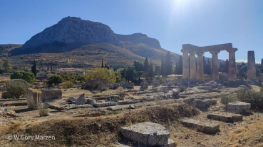
📐 Geometric Order and Structural HarmonyClassical Peloponnesian architecture—such as the massive Temple of Zeus at Olympia or the Temple of Apollo Epicurius at Bassae—was built on strict rules of symmetry, balance, and human-scale proportion. [1, 2]
- Linear Perspective: Early Ionian pioneers like Panagiotis Doxaras abandoned flat, golden Byzantine backgrounds. They used the strict mathematical logic of classical monuments to establish three-dimensional depth. [1, 2]
- Framing Landscape: Painted coastlines and horizons were no longer chaotic; they were structured around the calculated focal points typical of Classical Greek architectural layouts. [1]
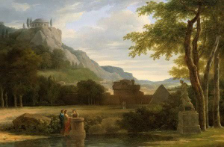
🏺 The “Romance of Ruins” in TopographyAs Neoclassicism swept Europe, Heptanese artists began integrating the physical decay of mainland antiquity directly into their island landscapes. [1]
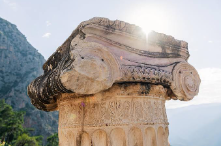
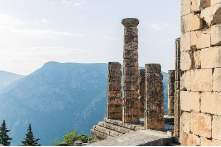
- Architectural Anchors: Ruined Doric and Ionic columns, crumbling stone walls, and broken pediments inspired by Peloponnesian sanctuaries were painted into the cliffs and shores of Corfu, Zakynthos, and Cephalonia. [1, 2, 3]
- Symbolism: These monuments served as visual anchors. They connected the wild, untamed nature of the Ionian Sea to an idealized, noble Greek past. [1, 2, 3]
🗺️ Mythological Mapping and AllegoryThe Peloponnese was the geographic birthplace of major Greek myths (e.g., the River Alpheios, the labors of Heracles). Ionian school painters used this regional mythology to transform raw nature into allegorical spaces. [1, 2]
- Sacro-Idyllic Landscapes: Natural elements were rarely painted raw. Seascapes and hills were romanticized, featuring hidden shrines, calm waters, and dramatic light shifts. This treatment directly mirrored the sacred relationship between Peloponnesian monuments and their surrounding geography. [1, 2, 3, 4]
🎨 Evolution Into Modern Secular PaintingBy the 19th century, masters of the school like Charalambos Pachis and watercolorist Angelos Giallinas shifted entirely into secular landscape and seascape painting. []
- Clarity of Form: They captured the distinct, harsh Mediterranean light bouncing off the sea and illuminating stone structures with absolute mathematical clarity. This technique was deeply rooted in the ancient Peloponnesian sculptural philosophy of defining clear, beautiful forms (Kalos). [1, 2, 3]’