
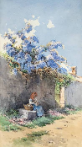
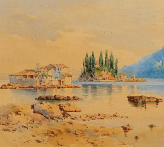
AI – ‘Angelos Giallinas (1857–1939) is celebrated as the Greek landscape watercolourist par excellence due to his technical mastery of aquarelles, his pivotal role in the Heptanese School of Art, and his unprecedented international success. While most Greek painters of his era focused on oil painting and historical or portrait themes, Giallinas uniquely elevated watercolours into a primary medium capable of capturing the distinctive light, atmosphere, and architectural spirit of the Mediterranean. [1, 2, 3, 4, 5]
Aquarelles are paintings created using the transparent watercolour technique, or the specialized water-soluble paints themselves. Derived from the French word for watercolour (which stems from the Latin aqua, meaning water), the term specifically highlights the luminous, translucent qualities of the medium.
Mastery of the Aquarelle Medium
- Luminous Transparency: Giallinas used the natural transparency of watercolours to perfectly replicate the vivid, shifting quality of Greek sunlight. [1, 2]
- Atmospheric Realism: His brushwork captured complex atmospheric shifts across coastal, island, and ruin-strewn landscapes with unparalleled precision. [1, 2]
- Focus on Nature: He broke away from rigid academic portraiture to dedicate his career to documenting regional land- and seascapes. [1, 2]
Elite Patronage and International Diplomacy
- British Ambassadorship: In 1886, British Ambassador Clare Ford discovered Giallinas in Athens and commissioned him to paint sweeping landscape albums of Spain, Venice, Rhodes, and Istanbul. [1]
- London Exhibitions: Ford organized massive exhibitions for Giallinas in London between 1891 and 1892, catapulting Greek art onto the global stage. [1]
- Royal Clientele: His work caught the attention of European royals, resulting in extensive acquisitions by the British Royal Family and commissions for murals at the Achilleion Palace by Empress Elisabeth of Austria. [1, 2]
Legacy of the Heptanese School
- Cultural Synthesis: As a prominent figure of the Ionian Islands (Heptanese) School, he successfully fused Italian panoramic composition traditions (the vedutisti) with a distinctly Greek perspective.
- Art Education: In 1902, he returned home to found his own art school in Corfu, ensuring his unique, light-centric watercolour techniques were passed down to future generations of modern Greek artists. [1, 2, 3, 4].
At the Artistic School of Corfu (founded by Angelos Giallinas in 1902), the curriculum bypassed traditional Byzantine rules to focus strictly on Western European techniques. Giallinas synthesized his own training from Venice, Rome, and Naples to establish a prominent school of watercolour painting. [1, 2]
The core technis taught at the school focused on mastering light, geography, and specific architectural principles:
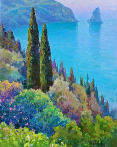
1. Mathematical and Linear Perspective
- Three-Dimensional Depth: Students learned to abandon flat Byzantine dimensions.
- Geometric Mapping: Instructors taught students to map complex coastlines and vast marine horizons with strict geometric accuracy. [1, 2]
2. Atmospheric (Aerial) Perspective
- Softening Details: Students were trained to fade background elements to mimic natural distances.
- Replicating Haze: They practiced diluting washes to depict the specific misty atmosphere covering distant landmarks like the Albanian mountains. [1, 2]
3. Architectural Integration (Vedutismo)
- Topographical Framing: Mirroring Italian vedutisti and Western Neoclassicism, the school emphasized structural realism.
- Historic Anchors: Students integrated classical Greek ruins, ancient temples, and local country estates directly into the natural topography.
4. Plein Air Light Capture
- Out-of-Studio Study: The school prioritized painting directly from nature over indoor copying.
- Tracking Sun Shifts: Artists learned how different times of day altered the color and visibility of Mediterranean flora and seascapes. [1, 2]
5. Precision and Spontaneity
- Clean Washes: Students practiced placing precise, bright watercolour washes without muddying the paper.
- Structural Rigor: The curriculum demanded strong foundational drawing skills to balance the fluid spontaneity of the aquarelle medium.
The Italian vedutisti (view painters) heavily shaped Angelos Giallinas’ early cityscapes and urban panoramas, providing him with a rigorous blueprint for architectural accuracy and perspective. During his foundational travels and formal studies in Venice, Naples, and Rome between 1875 and 1878, Giallinas moved away from the flat, religious style common in Greece to adopt the grand Italian tradition of painting realistic, sprawling city vistas. [1, 2]
While he ultimately surpassed these rigid structural layouts to find his true voice in loose, poetic watercolours, the vedutisti left several permanent marks on his early artistic output: [1, 2]
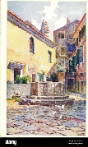
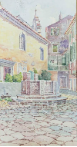
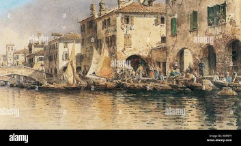
1. Topographical Precision in Cityscapes
- Urban Mapping: Following the traditions of masters like Canaletto and Panini, Giallinas’ earliest works treated cities—particularly Venice and Naples—not just as backdrops, but as the main subjects. [1, 2, 3]
- Architectural Accuracy: He rendered buildings, arches, and plazas with immense geometric precision, treating city layouts almost like an architectural draughtsman. [1]
2. Deep Geometric Perspective
- The Illusion of Distance: The vedutisti relied heavily on linear perspective to draw the viewer’s eye down long streets, canals, or pathways.
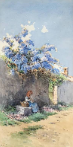
- Early Framing Techniques: In Giallinas’ early watercolours, you can observe stark diagonal lines formed by stone walls, rows of houses, or ancient ruins that anchor the composition and create a believable three-dimensional space.
3. Fusing Grandeur with Realism
- Documentary Style: Early Italian vedute were essentially painted postcards or high-end souvenirs for wealthy travelers doing the European Grand Tour.
- Monumental Focus: Giallinas mirrored this concept by cataloging the major monuments, classical ruins, and sweeping vistas of the Mediterranean, ensuring they were immediately recognizable to international collectors. [1]
4. Transition into the Scuola di Posillipo
- Softening the Edges: While Venice taught him linear vedutismo, his time in Naples introduced him to the Scuola di Posillipo.
The Shift to Atmosphere: This group of artists took the rigid, formulaic perspective of the early vedutisti and dissolved it into soft, romantic landscape paintings. This vital stepping stone allowed Giallinas to pivot from stiff urban drawings toward the “veiled, suspended atmospheres” that made his mature watercolours universally famous.
The British Royal Collection holds nine specific watercolour landscapes by Angelos Giallinas. These paintings entered the royal archives through his deep connection to King George I of Greece, which led to direct patronage from George’s sister, Queen Alexandra, and King Edward VII (when they were the Prince and Princess of Wales). Later, Queen Mary (as Duchess of York) attended three separate exhibitions of his work in London to purchase more of his serene vistas. [1, 2, 3]
Because some of the watercolours were acquired directly from exhibitions or gifted to the royal yacht, their documentation lists them both by specific locations and as curated landscape groupings: [1, 2]
1. Corfu, with Mon Repos on the left (c. 1890)
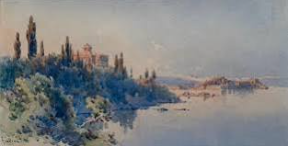
- The Subject: A highly detailed pencil and watercolour view featuring the Palace of Mon Repos on the left, a towering historical citadel in the far right distance, and sweeping mountain ranges beyond. [1, 2]
- Significance: Mon Repos was a prominent Greek royal palace on Giallinas’ home island of Corfu, making it a piece of immense familial sentiment for the British and Greek royal families. [1]
2. Garden in Greece or Corfu
- The Subject: A vivid, atmospheric watercolour capturing a lush Mediterranean estate. It prominently features a classical stone urn resting on a plinth tucked away inside a dense grove of orange trees and local coastal bushes. [1, 2]
- Significance: This piece beautifully illustrates Giallinas’ hallmark style—using translucent, layered washes to let the raw light filter through garden foliage. [1, 2]
3. Scenes around Corfu and Athens (The Royal Yacht Collection)
- The Subject: A series of multiple panoramic views tracking the historic monuments of Attica (Athens) and the peaceful coastlines of Corfu.
- Significance: This specific set of watercolours was hand-selected by the royal family to be hung directly inside Queen Mary’s bedroom aboard the British royal yacht, providing a tranquil decorative escape during state voyages. [1, 2, 3]’