
AI – ‘In antiquity, the pomegranate was a multifaceted symbol that primarily represented fertility, life and death, abundance, and the indissolubility of marriage. Its complex duality stemmed from its striking physical traits: its countless crimson seeds naturally evoked imagery of reproduction and wealth, while its blood-red juice linked it intimately to blood, sacrifice, and the underworld. [1, 2, 3, 4, 5]


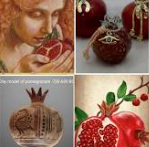
Life, Death, and the Underworld [1]In Greek mythology, the pomegranate was famously dubbed the “fruit of the dead.” [1]
- The Persephone Myth: According to the Homeric Hymns, Hades used pomegranate seeds to trick Persephone into binding herself to the underworld. Because she ate the seeds, she was legally tethered to the realm of the dead for a third of every year. This myth explains the cyclical change of the seasons, linking the fruit directly to the cycles of decay, winter, and spring rebirth. [1, 2, 3, 4, 5]
- Association with Blood: It was believed that the very first pomegranate tree sprouted from the blood of Adonis or Dionysus. Because of this connection to blood, it was regularly placed in ancient tombs as a grave offering to ensure the soul’s journey into the afterlife. [1, 2, 3, 4, 5]
Fertility and Marriage [1]Despite its grim underworld associations, the fruit’s internal abundance made it a widespread emblem of life and marital fidelity. [1, 2]
- Goddesses of Love and Unions: The fruit was strictly sacred to Hera (the goddess of marriage) and Aphrodite (the goddess of love). Cult statues, such as Polyclitus’ famous statue of Hera at Argos, often depicted the goddess holding a sceptre in one hand and a pomegranate in the other. [1, 2, 3]
- Wedding Traditions: In Ancient Roman culture, newlyweds wore wreaths woven from pomegranate leaves to ensure a fruitful union. Its juice was also widely utilised in ancient medicine to treat infertility. [1, 2]
Abundance and Wealth Across Cultures [1]Beyond Greece and Rome, the pomegranate held deep regional significance across the Near East. [1, 2]
- Persian Royalty: In ancient Persian culture, the pomegranate blossom (golnār) was a sacred emblem of imperial authority and prosperity. Achaemenian kings are depicted in stone reliefs at Persepolis holding pomegranate flowers to signal divine blessing and royal luxury. [1]
- Hebrew Tradition: The fruit was an architectural motif in Solomon’s Temple, adorning the capitals of the great bronze pillars. It was stitched into the robes of Jewish high priests as a emblem of righteousness and the commandments of God. [1, 2]. …
The pomegranate became the symbol of Granada due to a linguistic blend of the city’s historical names with the Spanish word for the fruit, and it was later adopted by the Spanish monarchy as a heraldic trophy to mark the completion of the Reconquista. [1, 2]The Evolution into Granada’s SymbolWhile the pomegranate fruit had been grown in the Andalusian region since ancient times, its official adoption as the city’s emblem stems from a linguistic coincidence: [1, 2, 3]
- The Arabic Origins: During Islamic rule, the Moors referred to the city as Gárnata. The exact etymology of Gárnata is debated, with theories linking it to an Arabic word meaning “hill of pilgrims” or a phrase meaning “hill of strangers”. [1, 2, 3, 4]
- The Latin Confusion: Separately, the Latin word for pomegranate was pomum granatum (meaning “seeded apple”). As the Spanish language evolved, this Latin term transformed into the modern Spanish word for the fruit: granada. [1, 2, 3, 4]
- The Linguistic Merge: Over centuries, the phonetically similar Moorish name Gárnata naturally morphed into Granada under Castilian linguistic influence. Because the city’s new name was completely identical to the word for the fruit, the pomegranate was adopted through visual punning as the definitive, living symbol of the city. [1, 2, 3, 4]
Adoption by the Spanish MonarchyThe transition from a local city symbol to a grand royal emblem occurred during one of the most pivotal moments in Spanish history: [1, 2, 3, 4]
- The Fall of Granada (1492): In January 1492, the Catholic Monarchs—King Ferdinand and Queen Isabella—successfully conquered the Emirate of Granada, the final Muslim-ruled stronghold on the Iberian Peninsula. [1, 2, 3, 4, 5]
- A Symbol of Victory: To permanently commemorate this momentous triumph and the final unification of Spain, Ferdinand and Isabella officially incorporated the pomegranate (granada) into the bottom peak of the Spanish Royal Coat of Arms. [1, 2]
- Imperial Meaning: Beyond just representing the conquered territory, the monarchy leaned into the fruit’s natural anatomy. A pomegranate features a hard outer husk holding together hundreds of internal seeds under a crown-like calyx. To the crown, this perfectly symbolised imperial unity—the gathering of many different domains and peoples under one single Catholic monarch. [1, 2, 3, 4, 5]
This royal legacy spread globally; for instance, Ferdinand and Isabella’s daughter, Catherine of Aragon, carried the pomegranate to England as her personal badge when she married Henry VIII. Today, the open pomegranate remains prominently featured at the very bottom of the Official Flag and Coat of Arms of Spain.’